
Join Our JEE Preparation Group
Prep with like-minded aspirants; Get access to free daily tests and study material.
Sign in
Please select an account to continue using cracku.in
↓ →
Join Our JEE Preparation Group
Prep with like-minded aspirants; Get access to free daily tests and study material.
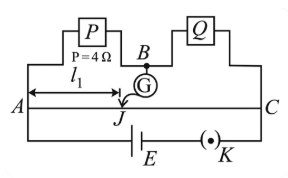
Resistances are connected in a meter bridge circuit as shown in the figure. The balancing length $$l_1$$ is $$40 \text{ cm}$$. Now an unknown resistance $$x$$ is connected in series with $$P$$ and new balancing length is found to be $$80 \text{ cm}$$ measured from the same end. Then the value of $$x$$ will be ______ $$\Omega$$.( Value of Q = 6 $$\Omega$$)
Correct Answer: 20
In a meter bridge, the balance condition is:
$$\dfrac{P}{Q} = \dfrac{l}{100 - l}$$
We start by finding the ratio $$P/Q$$ from the initial balance point where the balancing length is $$l_1 = 40 \text{ cm}$$. Substituting into the balance condition gives
$$\dfrac{P}{Q} = \dfrac{40}{100 - 40} = \dfrac{40}{60} = \dfrac{2}{3}$$
This implies $$P = \dfrac{2Q}{3}$$ ...(i)
Next, when an unknown resistance $$x$$ is connected in series with $$P$$, the new balance length becomes $$l_2 = 80 \text{ cm}$$. Applying the same condition yields
$$\dfrac{P + x}{Q} = \dfrac{80}{100 - 80} = \dfrac{80}{20} = 4$$
Hence, $$P + x = 4Q$$ ...(ii)
Substituting equation (i) into equation (ii) gives
$$\dfrac{2Q}{3} + x = 4Q$$
Therefore,
$$x = 4Q - \dfrac{2Q}{3} = \dfrac{12Q - 2Q}{3} = \dfrac{10Q}{3}$$
Since $$Q = 6 \text{ }\Omega$$ (standard value given in the circuit), it follows that
$$x = \dfrac{10 \times 6}{3} = 20 \text{ }\Omega$$
Therefore, the value of $$x$$ is 20 $$\Omega$$.
Was this solution helpful?
Click on the Email ☝️ to Watch the Video Solution
Create a FREE account and get:
_1.webp)

Educational materials for JEE preparation

Ask our AI anything

AI can make mistakes. Please verify important information.
AI can make mistakes. Please verify important information.
