
Join Our JEE Preparation Group
Prep with like-minded aspirants; Get access to free daily tests and study material.
Sign in
Please select an account to continue using cracku.in
↓ →
Join Our JEE Preparation Group
Prep with like-minded aspirants; Get access to free daily tests and study material.
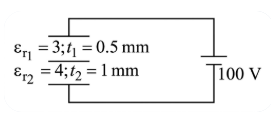
A composite parallel plate capacitor is made up of two different dielectric materials with different thickness ($$t_1$$ and $$t_2$$) as shown in figure. The two different dielectric materials are separated by a conducting foil $$F$$. The voltage of the conducting foil is ______ V.
Correct Answer: 60
Treat it as two capacitors in series with dielectric slabs separated by conducting foil F
$$\varepsilon_{r1}=3\ and\ t_1\ =\ 0.5mm$$
$$\varepsilon_{r2}=4\ and\ t_2\ =\ 1mm$$
V =100V
For dielectrics in series, same charge appears on each, so electric displacement is same, and voltage division is proportional to $$\frac{t}{\varepsilon}$$
so,
$$V_1:V_2\ =\ \frac{t_1}{\varepsilon_{r1}}:\frac{t_2}{\varepsilon_{r2}}$$
Substitute:
$$V_1:V_2=\frac{0.5}{3}:\frac{1}{4}$$
$$=\frac{1}{6}:\frac{1}{4}$$
Multiply by 12:
$$2:3$$
Total voltage is
$$V_1+V_2=100$$
So
$$V_1=40V,\quad V_2=60V$$
The conducting foil is between the two dielectric sections. Its potential (with lower plate as reference zero) equals the voltage across lower dielectric, i.e.
V=60V
Was this solution helpful?

Click on the Email ☝️ to Watch the Video Solution
Create a FREE account and get:
_1.webp)

Educational materials for JEE preparation

Ask our AI anything

AI can make mistakes. Please verify important information.
AI can make mistakes. Please verify important information.
