
Join Our JEE Preparation Group
Prep with like-minded aspirants; Get access to free daily tests and study material.
Sign in
Please select an account to continue using cracku.in
↓ →
Join Our JEE Preparation Group
Prep with like-minded aspirants; Get access to free daily tests and study material.
Let $$O$$ be the origin and $$A$$ be the point $$z_1 = 1 + 2i$$. If $$B$$ is the point $$z_2$$, $$\text{Re}(z_2) < 0$$, such that $$OAB$$ is a right angled isosceles triangle with $$OB$$ as hypotenuse, then which of the following is NOT true?
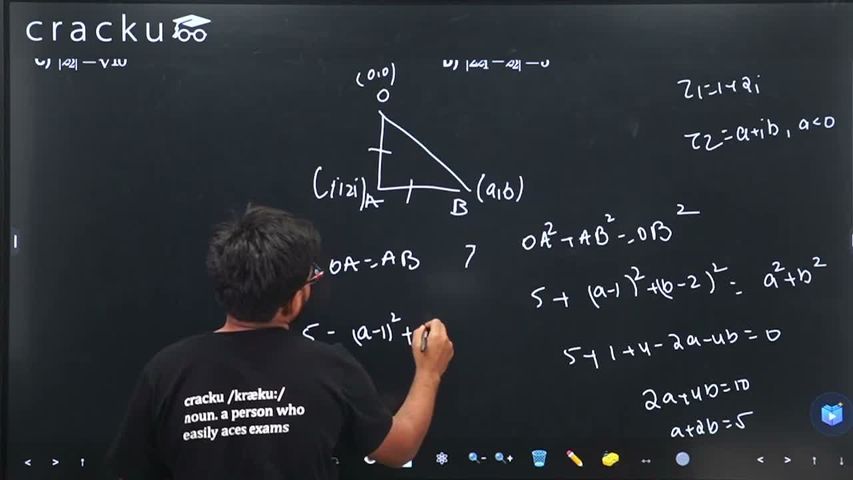
We are given O (origin), A = $$z_1 = 1 + 2i$$, and B = $$z_2$$ with $$\text{Re}(z_2) < 0$$, such that OAB is a right-angled isosceles triangle with OB as hypotenuse.
We start by using the Pythagorean theorem and the isosceles condition. Since OB is the hypotenuse, the right angle is at A, and OA = AB.
By the Pythagorean theorem: $$|z_2 - z_1|^2 + |z_1|^2 = |z_2|^2$$
Let $$z_2 = a + bi$$:
$$(a-1)^2 + (b-2)^2 + 5 = a^2 + b^2$$
Therefore, $$-2a - 4b + 10 = 0 \implies a + 2b = 5 \quad \cdots(1)$$
Next, applying OA = AB gives $$|z_1|^2 = |z_2 - z_1|^2$$.
Hence, $$5 = (a-1)^2 + (b-2)^2 \quad \cdots(2)$$
Then, from (1) we have $$a = 5 - 2b$$. Substituting into (2) yields
$$(4 - 2b)^2 + (b - 2)^2 = 5$$
which can be rewritten as $$4(b-2)^2 + (b-2)^2 = 5$$
Hence, $$5(b-2)^2 = 5 \implies b = 3 \text{ or } b = 1$$
If $$b = 3$$ then $$a = -1$$, which satisfies $$\text{Re}(z_2) < 0$$, whereas $$b = 1$$ leads to $$a = 3$$ and is therefore rejected.
As a result, $$z_2 = -1 + 3i$$.
Finally, verifying each option shows that for Option A, $$\arg(z_2) = \arg(-1 + 3i) = \pi - \tan^{-1}3$$, which is TRUE.
Similarly, Option B gives $$z_1 - 2z_2 = (1+2i) - 2(-1+3i) = 3 - 4i$$ so that $$\arg(3 - 4i) = -\tan^{-1}\frac{4}{3}$$, which is TRUE.
Option C yields $$|z_2| = \sqrt{1 + 9} = \sqrt{10}$$, which is TRUE.
However, Option D produces $$2z_1 - z_2 = 2(1+2i) - (-1+3i) = 3 + i$$ and hence $$|3 + i| = \sqrt{10} \neq 5$$, making it NOT TRUE.
Therefore, the correct answer is Option D.
Was this solution helpful?
Click on the Email ☝️ to Watch the Video Solution
Create a FREE account and get:
_1.webp)

Educational materials for JEE preparation

Ask our AI anything

AI can make mistakes. Please verify important information.
AI can make mistakes. Please verify important information.
