
Join Our JEE Preparation Group
Prep with like-minded aspirants; Get access to free daily tests and study material.
Sign in
Please select an account to continue using cracku.in
↓ →
Join Our JEE Preparation Group
Prep with like-minded aspirants; Get access to free daily tests and study material.
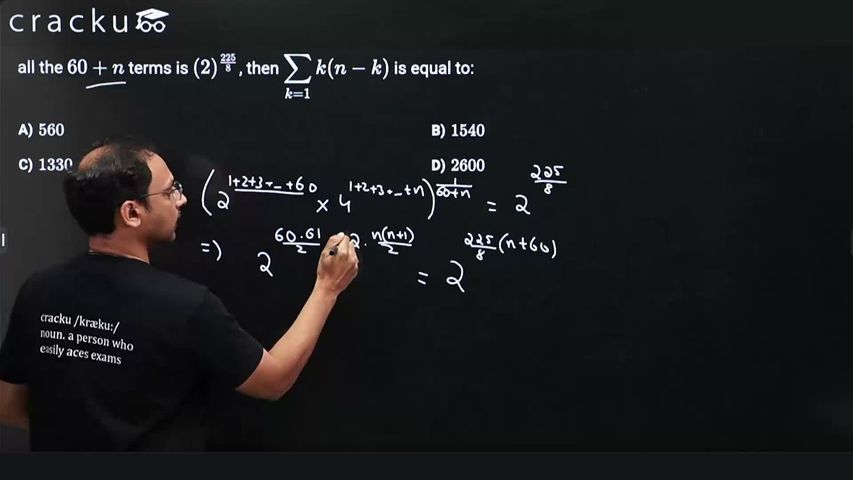
Consider two G.P.s $$2, 2^2, 2^3, \ldots$$ and $$4, 4^2, 4^3, \ldots$$ of $$60$$ and $$n$$ terms respectively. If the geometric mean of all the $$60 + n$$ terms is $$(2)^{\frac{225}{8}}$$, then $$\displaystyle\sum_{k=1}^{n} k(n-k)$$ is equal to:
We have two G.P.s: $$2, 2^2, 2^3, \ldots, 2^{60}$$ (60 terms) and $$4, 4^2, 4^3, \ldots, 4^n$$ (n terms).
We start by finding the product of all terms. The product of the first G.P. is $$2^{1+2+\cdots+60} = 2^{1830}$$. By expressing the second G.P. in base 2 as $$2^2, 2^4, \ldots, 2^{2n}$$, its product becomes $$2^{2+4+\cdots+2n} = 2^{n(n+1)}$$.
Next, setting up the geometric mean of all $$60 + n$$ terms gives $$(2^{1830} \cdot 2^{n(n+1)})^{\frac{1}{60+n}} = 2^{\frac{225}{8}}$$. This implies $$\frac{1830 + n^2 + n}{60 + n} = \frac{225}{8}$$.
Multiplying both sides by $$8(60 + n)$$ yields $$8(1830 + n^2 + n) = 225(60 + n)$$, which simplifies to $$14640 + 8n^2 + 8n = 13500 + 225n$$ and then to $$8n^2 - 217n + 1140 = 0$$. Solving this quadratic gives $$n = \frac{217 \pm \sqrt{217^2 - 4 \cdot 8 \cdot 1140}}{16} = \frac{217 \pm \sqrt{47089 - 36480}}{16} = \frac{217 \pm 103}{16}$$, so $$n = 20$$ or $$n = \frac{114}{16}$$, the latter being rejected.
Finally, to calculate the required sum, we note that $$\sum_{k=1}^{n} k(n-k) = n\sum_{k=1}^{n} k - \sum_{k=1}^{n} k^2 = n \cdot \frac{n(n+1)}{2} - \frac{n(n+1)(2n+1)}{6}$$. Substituting $$n = 20$$ yields $$20 \cdot \frac{20 \cdot 21}{2} - \frac{20 \cdot 21 \cdot 41}{6} = 20 \times 210 - 2870 = 4200 - 2870 = 1330$$.
Therefore, the correct answer is Option C: 1330.
Was this solution helpful?
Click on the Email ☝️ to Watch the Video Solution
Create a FREE account and get:
_1.webp)

Educational materials for JEE preparation

Ask our AI anything

AI can make mistakes. Please verify important information.
AI can make mistakes. Please verify important information.
