
Join Our JEE Preparation Group
Prep with like-minded aspirants; Get access to free daily tests and study material.
Sign in
Please select an account to continue using cracku.in
↓ →
Join Our JEE Preparation Group
Prep with like-minded aspirants; Get access to free daily tests and study material.
The odd natural number $$a$$, such that the area of the region bounded by $$y = 1$$, $$y = 3$$, $$x = 0$$, $$x = y^a$$ is $$\dfrac{364}{3}$$, is equal to:
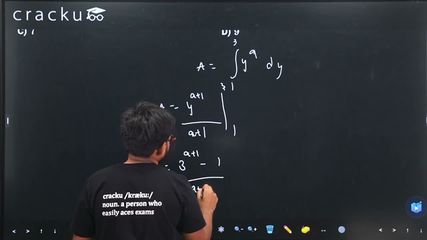
We need to find the odd natural number $$a$$ such that the area of the region bounded by $$y = 1$$, $$y = 3$$, $$x = 0$$, and $$x = y^a$$ equals $$\dfrac{364}{3}$$. Since the region is bounded on the left by $$x = 0$$ and on the right by $$x = y^a$$, with $$y$$ ranging from 1 to 3, the area is $$A = \int_1^3 y^a \, dy$$.
Next, evaluating the integral gives $$A = \left[\dfrac{y^{a+1}}{a+1}\right]_1^3 = \dfrac{3^{a+1} - 1}{a+1}$$.
From this, we set up the equation $$\dfrac{3^{a+1} - 1}{a+1} = \dfrac{364}{3}$$. Substituting $$a = 5$$ yields $$\dfrac{3^6 - 1}{6} = \dfrac{729 - 1}{6} = \dfrac{728}{6} = \dfrac{364}{3} \quad \checkmark$$.
Verification: For other odd options: $$a = 3$$: $$\dfrac{3^4 - 1}{4} = \dfrac{80}{4} = 20 \ne \dfrac{364}{3}$$; $$a = 7$$: $$\dfrac{3^8 - 1}{8} = \dfrac{6560}{8} = 820 \ne \dfrac{364}{3}$$.
The correct answer is Option B: $$5$$.
Was this solution helpful?
Click on the Email ☝️ to Watch the Video Solution
Create a FREE account and get:
_1.webp)

Educational materials for JEE preparation

Ask our AI anything

AI can make mistakes. Please verify important information.
AI can make mistakes. Please verify important information.
