
Join Our JEE Preparation Group
Prep with like-minded aspirants; Get access to free daily tests and study material.
Sign in
Please select an account to continue using cracku.in
↓ →
Join Our JEE Preparation Group
Prep with like-minded aspirants; Get access to free daily tests and study material.
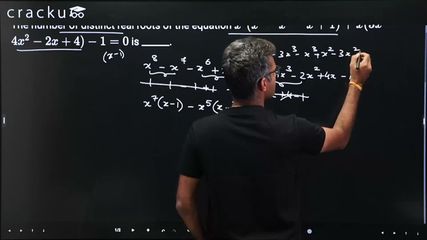
The number of distinct real roots of the equation $$x^5(x^3 - x^2 - x + 1) + x(3x^3 - 4x^2 - 2x + 4) - 1 = 0$$ is ______.
Correct Answer: 3
The given equation is:
$$x^5(x^3 - x^2 - x + 1) + x(3x^3 - 4x^2 - 2x + 4) - 1 = 0$$
Let us break down and factor the expression. First, factor the polynomial in the first term:
$$x^3 - x^2 - x + 1$$
$$= x^2(x - 1) - 1(x - 1)$$
$$= (x^2 - 1)(x - 1)$$
$$= (x - 1)(x + 1)(x - 1)$$
$$= (x - 1)^2(x + 1)$$
Now, let us expand the remaining part of the equation:
$$x(3x^3 - 4x^2 - 2x + 4) - 1$$
$$= 3x^4 - 4x^3 - 2x^2 + 4x - 1$$
By substituting $$x = 1$$, we can see that it is a root because $$3 - 4 - 2 + 4 - 1 = 0$$. Since $$x = 1$$ is a root, $$(x - 1)$$ is a factor. Dividing the polynomial by $$(x - 1)$$ gives:
$$3x^4 - 4x^3 - 2x^2 + 4x - 1 = (x - 1)(3x^3 - x^2 - 3x + 1)$$
Checking $$x = 1$$ again for the quotient where $$3(1)^3 - (1)^2 - 3(1) + 1 = 0$$, we find $$(x - 1)$$ is a factor again:
$$3x^3 - x^2 - 3x + 1 = (x - 1)(3x^2 + 2x - 1)$$
Now, factor the remaining quadratic equation:
$$3x^2 + 2x - 1$$
$$= 3x^2 + 3x - x - 1$$
$$= 3x(x + 1) - 1(x + 1)$$
$$= (3x - 1)(x + 1)$$
Combining these, the second part of our original equation factors to:
$$(x - 1)^2(x + 1)(3x - 1)$$
Now, substitute both factored parts back into the original equation:
$$x^5[(x - 1)^2(x + 1)] + [(x - 1)^2(x + 1)(3x - 1)] = 0$$
Factor out the common terms:
$$(x - 1)^2(x + 1)[x^5 + 3x - 1] = 0$$
This gives us our roots by setting each part to zero:
To find the number of real roots for the polynomial $$x^5 + 3x - 1 = 0$$, let $$f(x) = x^5 + 3x - 1$$.
Taking the derivative:
$$f'(x) = 5x^4 + 3$$
Since $$x^4$$ is always positive or zero for real values of $$x$$, $$5x^4 + 3$$ is always strictly greater than $$0$$. This means $$f(x)$$ is a strictly increasing continuous function for all real values of $$x$$.
Because it is strictly increasing, it crosses the horizontal axis exactly once, meaning $$x^5 + 3x - 1 = 0$$ has exactly $$1$$ real root.
Let us verify this root is distinct from our other roots $$1$$ and $$-1$$:
$$f(1) = (1)^5 + 3(1) - 1 = 3 \neq 0$$
$$f(-1) = (-1)^5 + 3(-1) - 1 = -5 \neq 0$$
Therefore, we have exactly $$3$$ distinct real roots which are $$x = 1$$, $$x = -1$$, and the single real root from $$x^5 + 3x - 1 = 0$$.
The number of distinct real roots is $$3$$.
Was this solution helpful?
Click on the Email ☝️ to Watch the Video Solution
Create a FREE account and get:
_1.webp)

Educational materials for JEE preparation

Ask our AI anything

AI can make mistakes. Please verify important information.
AI can make mistakes. Please verify important information.
