
Join Our JEE Preparation Group
Prep with like-minded aspirants; Get access to free daily tests and study material.
Sign in
Please select an account to continue using cracku.in
↓ →
Join Our JEE Preparation Group
Prep with like-minded aspirants; Get access to free daily tests and study material.
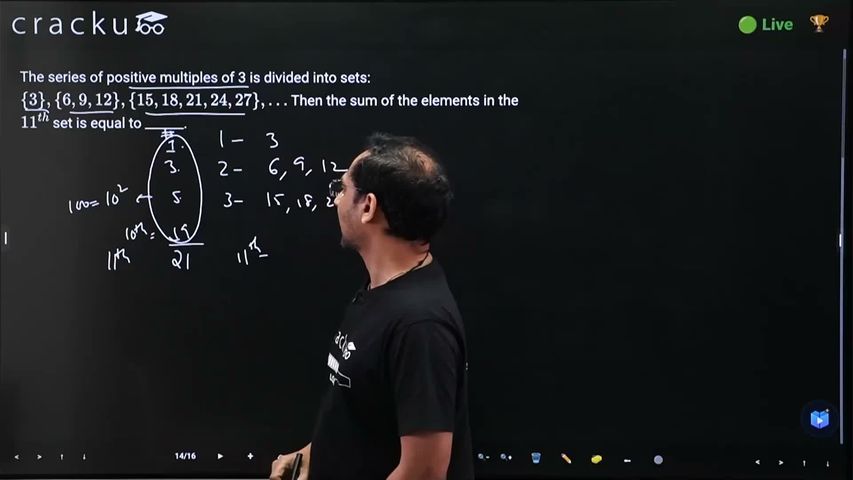
The series of positive multiples of 3 is divided into sets: $$\{3\}, \{6, 9, 12\}, \{15, 18, 21, 24, 27\}, \ldots$$ Then the sum of the elements in the $$11^{th}$$ set is equal to ______.
Correct Answer: 6993
The series of positive multiples of 3 is: $$3, 6, 9, 12, 15, 18, 21, 24, 27, \ldots$$
These are grouped as: $$\{3\}, \{6, 9, 12\}, \{15, 18, 21, 24, 27\}, \ldots$$
Identifying the pattern, Set 1 has 1 element, Set 2 has 3 elements, Set 3 has 5 elements, ..., Set $$n$$ has $$(2n - 1)$$ elements.
Since the total number of elements before the $$n$$-th set is the sum of odd numbers, we have $$1 + 3 + 5 + \cdots + (2(n-1) - 1) = (n-1)^2$$.
To find the starting element of the 11th set, note that elements before Set 11: $$(11 - 1)^2 = 100$$. Next, the first element of Set 11 is the 101st multiple of 3, which is $$3 \times 101 = 303$$.
Next, Set 11 has $$2(11) - 1 = 21$$ elements. The elements are $$303, 306, 309, \ldots$$ (21 terms in AP with common difference 3), and the last element is $$303 + 3 \times 20 = 363$$.
Finally, computing the sum gives $$S = \dfrac{21}{2}(303 + 363) = \dfrac{21}{2} \times 666 = 21 \times 333 = 6993$$.
The correct answer is $$\boxed{6993}$$.
Was this solution helpful?
Click on the Email ☝️ to Watch the Video Solution
Create a FREE account and get:
_1.webp)

Educational materials for JEE preparation

Ask our AI anything

AI can make mistakes. Please verify important information.
AI can make mistakes. Please verify important information.
