
Join Our JEE Preparation Group
Prep with like-minded aspirants; Get access to free daily tests and study material.
Sign in
Please select an account to continue using cracku.in
↓ →
Join Our JEE Preparation Group
Prep with like-minded aspirants; Get access to free daily tests and study material.
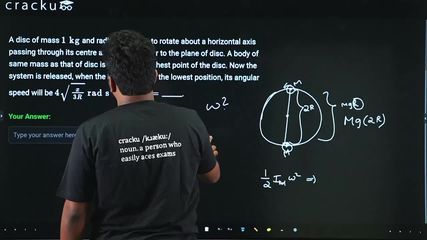
A disc of mass $$1 \text{ kg}$$ and radius $$R$$ is free to rotate about a horizontal axis passing through its centre and perpendicular to the plane of disc. A body of same mass as that of disc is fixed at the highest point of the disc. Now the system is released, when the body comes to the lowest position, its angular speed will be $$4\sqrt{\frac{x}{3R}} \text{ rad s}^{-1}$$ where $$x =$$ ______.
Correct Answer: 5
$$Massofdisc=1kg$$
$$Massofparticle=1kg$$
$$Radius=R$$
Initially the particle is at the top, finally at the bottom
Loss in potential energy of particle:
$$ΔPE=mg(2R)=1\times g\times2R=2gR$$
Disc’s potential energy does not change (its centre stays at same height)
So total energy converted to rotation:
$$2gR=\frac{1}{2}I_{total}ω^2$$
Now moment of inertia:
Disc about centre:
$$I_{disc}=\frac{1}{2}MR^2=\frac{1}{2}R^2$$
Particle at distance R:
$$I_{particle}=MR^2=R^2$$
So:
$$I_{total}=\frac{1}{2}R^2+R^2=\frac{3}{2}R^2$$
Now substitute:
$$2gR=\frac{1}{2}\left(\frac{3}{2}R^2ω^2\right)$$
$$2gR=(3/4)R^2ω^2$$
Solve:
$$ω^2=(8g)/(3R)$$
$$ω=\sqrt{\ \frac{8g}{3r}}$$
Given answer form:
$$ω=4\sqrt{\ \frac{x}{3r}}$$
Compare:
$$x=\frac{g}{2}$$
Given g = 10:
x = 5
Final answer:
5
Was this solution helpful?
Click on the Email ☝️ to Watch the Video Solution
Create a FREE account and get:
_1.webp)

Educational materials for JEE preparation

Ask our AI anything

AI can make mistakes. Please verify important information.
AI can make mistakes. Please verify important information.
