Join Our JEE Preparation Group
Prep with like-minded aspirants; Get access to free daily tests and study material.
Sign in
Please select an account to continue using cracku.in
↓ →
Join Our JEE Preparation Group
Prep with like-minded aspirants; Get access to free daily tests and study material.
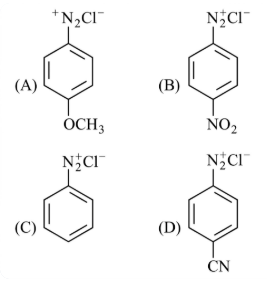
To determine the decreasing order of stability for the given benzenediazonium salts, we must evaluate the electronic effects of the substituents on the benzene ring. The stability of a diazonium ion depends heavily on how well the positive charge on the nitrogen atoms can be dispersed.
Electron-donating groups (+R effect) push electron density into the ring, which helps neutralize and delocalize the positive charge on the diazonium group, thereby increasing stability. Conversely, electron-withdrawing groups (-R effect) pull electron density away from the ring, which intensifies the positive charge and decreases stability.
In compound (A), the methoxy group (-OCH₃) exhibits a strong electron-donating +R effect, making the diazonium ion the most stable. Compound (C) has no substituent and serves as the neutral baseline. In compounds (D) and (B), the cyano (-CN) and nitro (-NO₂) groups act as powerful electron-withdrawing groups via the -R effect, highly destabilizing the ion. Because the nitro group exerts a stronger electron-withdrawing effect than the cyano group, compound (B) is the least stable of all.
Therefore, the decreasing order of stability is: (A) > (C) > (D) > (B).
Was this solution helpful?

Click on the Email ☝️ to Watch the Video Solution
Create a FREE account and get:
_1.webp)

Educational materials for JEE preparation

Ask our AI anything

AI can make mistakes. Please verify important information.
AI can make mistakes. Please verify important information.