
Join Our JEE Preparation Group
Prep with like-minded aspirants; Get access to free daily tests and study material.
Sign in
Please select an account to continue using cracku.in
↓ →
Join Our JEE Preparation Group
Prep with like-minded aspirants; Get access to free daily tests and study material.
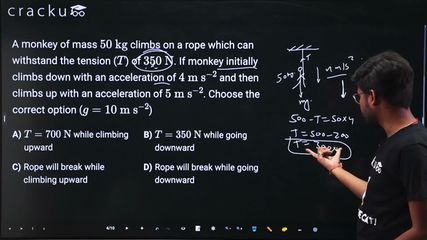
A monkey of mass $$50 \text{ kg}$$ climbs on a rope which can withstand the tension ($$T$$) of $$350 \text{ N}$$. If monkey initially climbs down with an acceleration of $$4 \text{ m s}^{-2}$$ and then climbs up with an acceleration of $$5 \text{ m s}^{-2}$$. Choose the correct option ($$g = 10 \text{ m s}^{-2}$$)
A monkey of mass $$50 \text{ kg}$$ climbs on a rope that can withstand a maximum tension of $$T_{max} = 350 \text{ N}$$. We need to check if the rope breaks in either case.
We start by determining the tension when the monkey climbs down with acceleration $$a = 4 \text{ m/s}^2$$, taking downward as positive:
$$mg - T = ma$$
$$T = m(g - a) = 50(10 - 4) = 50 \times 6 = 300 \text{ N}$$
Since $$T = 300 \text{ N} \lt 350 \text{ N}$$, the rope does not break while climbing down.
Next, when the monkey climbs up with acceleration $$a = 5 \text{ m/s}^2$$, the net upward force must produce this acceleration:
$$T - mg = ma$$
$$T = m(g + a) = 50(10 + 5) = 50 \times 15 = 750 \text{ N}$$
Since $$T = 750 \text{ N} \gt 350 \text{ N}$$, the rope breaks while climbing upward.
Now we evaluate the options:
Option A: $$T = 700 \text{ N}$$ while climbing upward — Incorrect, $$T = 750 \text{ N}$$.
Option B: $$T = 350 \text{ N}$$ while going downward — Incorrect, $$T = 300 \text{ N}$$.
Option C: Rope will break while climbing upward — Correct, since $$750 \text{ N} \gt 350 \text{ N}$$.
Option D: Rope will break while going downward — Incorrect, since $$300 \text{ N} \lt 350 \text{ N}$$.
Therefore, the correct answer is Option C: Rope will break while climbing upward.
Was this solution helpful?
Click on the Email ☝️ to Watch the Video Solution
Create a FREE account and get:
_1.webp)

Educational materials for JEE preparation

Ask our AI anything

AI can make mistakes. Please verify important information.
AI can make mistakes. Please verify important information.
