
Join Our JEE Preparation Group
Prep with like-minded aspirants; Get access to free daily tests and study material.
Sign in
Please select an account to continue using cracku.in
↓ →
Join Our JEE Preparation Group
Prep with like-minded aspirants; Get access to free daily tests and study material.
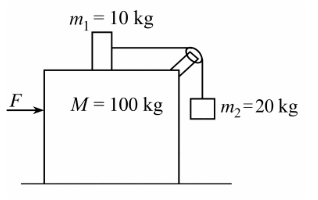
Three masses $$M = 100 \text{ kg}$$, $$m_1 = 10 \text{ kg}$$ and $$m_2 = 20 \text{ kg}$$ are arranged in a system as shown in figure. All the surfaces are frictionless and strings are inextensible and weightless. The pulleys are also weightless and frictionless. A force $$F$$ is applied on the system so that the mass $$m_2$$ moves upward with an acceleration of $$2 \text{ m s}^{-2}$$. The value of $$F$$ is (Take $$g = 10 \text{ m s}^{-2}$$)
Given values:
Mass $$M = 100\text{ kg}$$
Mass $$m_1 = 10\text{ kg}$$
Mass $$m_2 = 20\text{ kg}$$
Upward acceleration of mass $$m_2$$, $$a_{2,y} = 2\text{ m s}^{-2}$$
Acceleration due to gravity, $$g = 10\text{ m s}^{-2}$$
1. Motion of $$m_2$$ relative to the wedge $$M$$:
For mass $$m_2$$ to move upward relative to the block/wedge $$M$$ with an acceleration $$a_r = 2\text{ m s}^{-2}$$, mass $$m_1$$ must move to the right relative to $$M$$ with the same relative acceleration $$a_r = 2\text{ m s}^{-2}$$ (since the string is inextensible).
2. Equation for mass $$m_2$$ in the vertical direction:
The vertical forces acting on $$m_2$$ are tension $$T$$ pulling upward and weight $$m_2 g$$ pulling downward:
$$$T - m_2 g = m_2 a_r$$$
$$$T - 20(10) = 20(2) \implies T = 200 + 40 = 240\text{ N}$$$
3. Horizontal motion of $$m_1$$ in the frame of reference of wedge $$M$$:
Let the horizontal acceleration of the whole system (the wedge $$M$$) to the right be $$a_x$$.
In the non-inertial reference frame of the wedge $$M$$ moving rightward with acceleration $$a_x$$, a pseudo force $$m_1 a_x$$ acts to the left on $$m_1$$.
The equation of motion for $$m_1$$ along the horizontal direction relative to the wedge $$M$$ is:
$$$m_1 a_x - T = m_1 a_r$$$
Substitute the known values:
$$$10 a_x - 240 = 10(2)$$$
$$$10 a_x = 240 + 20 = 260 \implies a_x = 26\text{ m s}^{-2}$$$
4. Total Applied Force $$F$$:
Considering the entire $$M\ and\ m_2$$, both having same acceleration in x direction
$$F-T=(M+m_2)a_x$$
The value of $$F$$ is 3360 N
Was this solution helpful?
Click on the Email ☝️ to Watch the Video Solution
Create a FREE account and get:
_1.webp)

Educational materials for JEE preparation

Ask our AI anything

AI can make mistakes. Please verify important information.
AI can make mistakes. Please verify important information.
