
Join Our JEE Preparation Group
Prep with like-minded aspirants; Get access to free daily tests and study material.
Sign in
Please select an account to continue using cracku.in
↓ →
Join Our JEE Preparation Group
Prep with like-minded aspirants; Get access to free daily tests and study material.
As per the given figure, two blocks each of mass $$250 \text{ g}$$ are connected to a spring of spring constant $$2 \text{ N m}^{-1}$$. If both are given velocity $$v$$ in opposite directions, then maximum elongation of the spring is
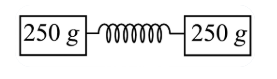
Two blocks, each of mass $$250 \text{ g} = 0.25 \text{ kg}$$, are connected by a spring of spring constant $$k = 2 \text{ N/m}$$. Both are given velocity $$v$$ in opposite directions. We need to find the maximum elongation of the spring.
We start by using the concept of reduced mass. When two blocks connected by a spring move toward/away from each other, we use the reduced mass to analyze the oscillation:
$$\mu = \frac{m \times m}{m + m} = \frac{m}{2} = \frac{0.25}{2} = 0.125 \text{ kg}$$
Next, we find the relative velocity. Since both blocks are given velocity $$v$$ in opposite directions, the relative velocity of approach (or separation) is:
$$v_{rel} = v - (-v) = 2v$$
Then we apply energy conservation. At maximum elongation, the relative velocity becomes zero. All kinetic energy (in the center-of-mass frame) converts to spring potential energy:
$$\frac{1}{2}\mu \cdot v_{rel}^2 = \frac{1}{2}k \cdot x_{max}^2$$
$$\frac{1}{2} \times 0.125 \times (2v)^2 = \frac{1}{2} \times 2 \times x_{max}^2$$
$$\frac{1}{2} \times 0.125 \times 4v^2 = \frac{1}{2} \times 2 \times x_{max}^2$$
$$0.25v^2 = x_{max}^2$$
Next, we solve for the maximum elongation:
$$x_{max}^2 = 0.25v^2 = \frac{v^2}{4}$$
$$x_{max} = \frac{v}{2}$$
Therefore, the correct answer is Option B: $$\dfrac{v}{2}$$.
Was this solution helpful?
Click on the Email ☝️ to Watch the Video Solution
Create a FREE account and get:
_1.webp)

Educational materials for JEE preparation

Ask our AI anything

AI can make mistakes. Please verify important information.
AI can make mistakes. Please verify important information.
