
Join Our JEE Preparation Group
Prep with like-minded aspirants; Get access to free daily tests and study material.
Sign in
Please select an account to continue using cracku.in
↓ →
Join Our JEE Preparation Group
Prep with like-minded aspirants; Get access to free daily tests and study material.
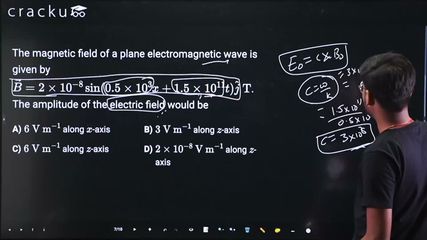
The magnetic field of a plane electromagnetic wave is given by $$\vec{B} = 2 \times 10^{-8} \sin(0.5 \times 10^3 x + 1.5 \times 10^{11} t) \hat{j} \text{ T}$$. The amplitude of the electric field would be
The magnetic field of a plane electromagnetic wave is given by:
$$\vec{B} = 2 \times 10^{-8} \sin(0.5 \times 10^3 x + 1.5 \times 10^{11} t)\,\hat{j} \text{ T}$$
We need to find the amplitude of the electric field. From the wave equation $$\sin(kx + \omega t)$$ we identify $$k = 0.5 \times 10^3 \text{ rad/m}$$ and $$\omega = 1.5 \times 10^{11} \text{ rad/s}$$. Substituting gives $$c = \frac{\omega}{k} = \frac{1.5 \times 10^{11}}{0.5 \times 10^3} = 3 \times 10^8 \text{ m/s}$$.
Next, the relation between electric and magnetic field amplitudes in an EM wave is $$E_0 = c \times B_0 = 3 \times 10^8 \times 2 \times 10^{-8} = 6 \text{ V/m}$$.
Since the wave propagates in the $$-x$$ direction (the argument $$kx + \omega t$$ gives $$-\hat{i}$$) and the magnetic field is along $$\hat{j}$$, the fields are mutually perpendicular with $$\hat{E} \times \hat{B}$$ giving the direction of propagation. This gives $$\hat{E} \times \hat{j} = -\hat{i}$$. Then $$\hat{E} = \hat{k} \quad \text{(since } \hat{k} \times \hat{j} = -\hat{i}\text{)}$$, so the electric field is along the $$z$$-axis.
The correct answer is Option C: $$6 \text{ V m}^{-1}$$ along $$z$$-axis.
Was this solution helpful?
Click on the Email ☝️ to Watch the Video Solution
Create a FREE account and get:
_1.webp)

Educational materials for JEE preparation

Ask our AI anything

AI can make mistakes. Please verify important information.
AI can make mistakes. Please verify important information.
