
 Group
Group
 Group
Group
JEE Nitrogen-Containing Compounds PYQ
JEE Nitrogen-Containing Compounds PYQs help you understand the preparation, properties, and reactions of amines, diazonium salts, nitro compounds, nitriles, and isocyanides. Questions from this chapter are commonly based on basic strength, identification tests, reaction mechanisms, product formation, and named reactions.
This chapter becomes easier when you connect the structure of a compound with its chemical behaviour. For example, the basic strength of an amine depends on the availability of the lone pair on nitrogen. In aniline, the lone pair takes part in resonance with the benzene ring, making it less available for protonation.
While preparing this topic, focus on important reagents, reaction conditions, basicity order, and conversions involving amines and diazonium salts. Regularly solving JEE Nitrogen-Containing Compounds Questions will help you understand common reaction patterns and improve your product-prediction skills.
In this blog, you can download important PYQs, revise key formulas and reactions, avoid common mistakes, and attempt selected questions as a chapter-wise test.
JEE Nitrogen-Containing Compounds Important PYQ PDF
The JEE Nitrogen-Containing Compounds Important PYQ PDF includes selected questions from amines, diazonium salts, nitriles, isocyanides, basic strength, preparation methods, and important named reactions.
While solving the questions, first identify the functional group and the reagent used. Then check whether the reaction involves preparation, substitution, elimination, diazotisation, coupling, or conversion into another nitrogen-containing compound.
After completing the PDF, revise every incorrect question and understand the reason behind the correct answer. Solving a JEE Advanced PYQ can also help you practise questions that combine multiple reactions or compare the behaviour of different compounds.
Important Formulas for Nitrogen-Containing Compounds PYQ
This is mainly a reaction-based chapter. Therefore, a JEE Mains Chemistry Formula Sheet for this topic should contain important reaction equations, reagents, tests, and reactivity orders.
| Concept or Reaction | Formula or General Reaction |
|---|---|
| General formula of primary amines | $$R−NH2$$ |
| General formula of secondary amines | $$R2NH$$ |
| General formula of tertiary amines$$ | $$R3N$$ |
| Reduction of a nitro compound | $$R−NO2+6[H]→R−NH2+2H2O$$ |
| Reduction of a nitrile | $$R−CN+4[H]→R−CH2NH2$$ |
| Ammonolysis of a haloalkane | $$R−X+2NH3→R−NH2+NH4X$$ |
| Hofmann bromamide reaction | $$R−CONH2+Br2+4KOH→R−NH2+K2CO3+2KBr+2H2O$$ |
| Diazotisation of aniline | $$C6H5NH2+NaNO2+2HCl→C6H5N2+Cl−+NaCl+2H2O$$ |
| Sandmeyer reaction | $$ArN2+X−CuXArX+N2$$ |
| Reaction of diazonium salt with water | $$ArN2+Cl−+H2OwarmArOH+N2+HCl$$ |
| Carbylamine reaction | $$R−NH2+CHCl3+3KOH→R−NC+3KCl+3H2O$$ |
| Acylation of a primary amine | $$R−NH2+R′COCl→R′CONHR+HCl$$ |
Remember that the Hofmann bromamide reaction produces a primary amine containing one carbon less than the original amide. Diazotisation of a primary aromatic amine is generally carried out between 273 and 278 K.
Top 5 Common Mistakes to Avoid in JEE Nitrogen-Containing Compounds PYQs
1. Using one basicity order in every medium
The basicity order of amines may change between the gaseous and aqueous phases. In water, solvation and steric effects must also be considered.
2. Forgetting the temperature of diazotisation
Aromatic diazonium salts are prepared and kept stable at low temperatures, generally between 273 and 278 K.
3. Applying the carbylamine test to every amine
Only primary aliphatic and primary aromatic amines give a positive carbylamine test. Secondary and tertiary amines do not respond.
4. Missing the loss of one carbon
In the Hofmann bromamide reaction, the amide forms a primary amine with one carbon atom less.
5. Ignoring resonance in aniline
The lone pair on nitrogen is delocalised into the benzene ring. Therefore, aniline is less basic than aliphatic amines.
List of JEE Nitrogen-Containing Compounds PYQs
Below, you can attempt selected JEE Nitrogen-Containing Compounds PYQs as a short chapter-wise test.
Question 1
Match the Compounds (List - I) with the appropriate Catalyst/Reagents (List - II) for their reduction into corresponding amines.
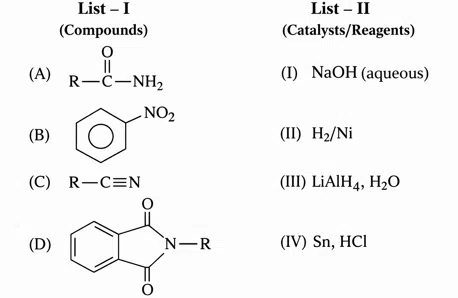
Choose the correct answer from the options given below :
correct answer:- 4
Question 2
Which one of the following reaction sequences will give an azo dye?
correct answer:- 1
Question 3
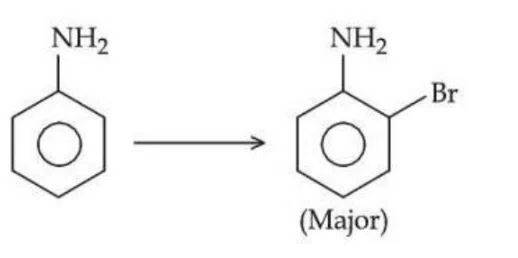
For reaction
The correct order of set of reagents for the above conversion is :
correct answer:- 2
Question 4
Consider the following molecules: Br$$_3$$O$$_8$$, F$$_2$$O, H$$_2$$S$$_4$$O$$_6$$, H$$_2$$S$$_5$$O$$_6$$, and C$$_3$$O$$_2$$.
Count the number of atoms existing in their zero oxidation state in each molecule. Their sum is ____.
correct answer:- 6
Question 5
'A' is a neutral organic compound $$(M.F : C_{8}H_{9}ON)$$. On treatment with aqueous $$Br_{2}/OH_{(-)}$$, 'A' forms a compound 'B' which is soluble in dilute acid. 'B' on treatment with aqueous $$NaNO_{2} / HCl (0-5^{o}C)$$ produces a compound 'C' which on treatment with $$CuCN/NaCN$$ produces 'D'. Hydrolysis of 'D' produces 'E' which is also obtainable from the hydrolysis of'A'. 'E' on treatment with acidified $$KMnO_{4}$$ produces 'F'. 'F' contains two different types of hydrogen atoms. The structure of 'A' is
correct answer:- 1

Question 6
The steam volatile compounds among the following are :
(A)
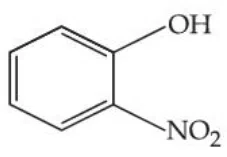
(B)
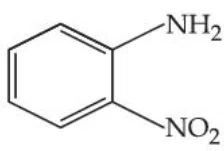
(C)
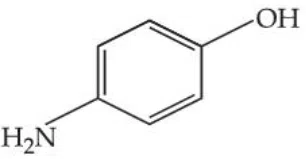
(D)
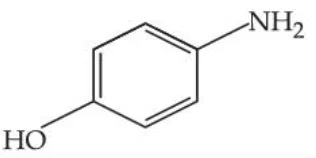
Choose the correct answer from the options given below :
correct answer:- 4
Question 7
The number of ions from the following that are expected to behave as oxidising agent is : $$Sn^{4+}, Sn^{2+}, Pb^{2+}, Tl^{3+}, Pb^{4+}, Tl^{+}$$
correct answer:- 2
Question 8
The $$F^-$$ ions make the enamel on teeth much harder by converting hydroxyapatite (the enamel on the surface of teeth) into much harder fluoroapatite having the formula.
correct answer:- 4
Question 9
Given below are two statements: one is labelled as Assertion (A) and the other is labelled as Reason (R).
Assertion (A): $$\alpha$$-halocarboxylic acid on reaction with dil. $$NH_3$$ gives good yield of $$\alpha$$-amino carboxylic acid whereas the yield of amines is very low when prepared from alkyl halides.
Reason (R): Amino acids exist in zwitter ion form in aqueous medium.
In the light of the above statements, choose the correct answer from the options given below :
correct answer:- 1
Question 10
Given below are two statements:
Statement I : Aniline is less basic than acetamide.
Statement II : In aniline, the lone pair of electrons on nitrogen atom is delocalised over benzene ring due to resonance and hence less available to a proton.
Choose the most appropriate option:
correct answer:- 2

Question 11
Which of the following reaction is an example of ammonolysis?
correct answer:- 4
Question 12
Given below are two statements, one is labelled as Assertion (A) and other is labelled as Reason (R).
Assertion (R) : Gabriel phthalimide synthesis cannot be used to prepare aromatic primary amines.
Reason : Aryl halides do not undergo nucleophilic substitution reaction.
In the light of the above statements, choose the correct answer from the options given below:
correct answer:- 3
Question 13
Fluorination of an aromatic ring is easily accomplished by treating a diazonium salt with $$HBF_4$$. Which of the following conditions is correct about this reaction?
correct answer:- 3
Question 14
Match List I with List II
List I (Amines) List II (pKb)
A. Aniline I. 3.25
B. Ethanamine II. 3.00
C. N-Ethylethanamine III. 9.38
D. N,N-Diethylethanamine IV. 3.29
Choose the correct answer from the options given below:-
correct answer:- 4
Question 15
X g of ethylamine is subjected to reaction with NaNO₂/HCl followed by water; evolved dinitrogen gas which occupied 2.24 L volume at STP. X is ______ × 10⁻¹ g.
correct answer:- 45

Question 16
Given below are two statements: Statement I : Gallium is used in the manufacturing of thermometers. Statement II : A thermometer containing gallium is useful for measuring the freezing point of brine solution (256 K). In the light of the above statements, choose the correct answer from the options given below :
correct answer:- 4
Question 17
Evaluate the following statements related to group 14 elements for their correctness. (A) Covalent radius decreases down the group from C to Pb in a regular manner. (B) Electronegativity decreases from C to Pb down the group gradually. (C) Maximum covalance of C is 4 whereas other elements can expand their covalance due to presence of d orbitals. (D) Heavier elements do not form $$p\pi - p\pi$$ bonds. (E) Carbon can exhibit negative oxidation states. Choose the correct answer from the options given below :
correct answer:- 2
Question 18
Identify correct statements : (A) Primary amines do not give diazonium salts when treated with $$NaNO_{2}$$ in acidic condition. (B) Aliphatic and aromatic primary amines on heating with $$CHCl_{3}$$and ethanolic KOH form carbylamines. (C) Secondary and tertiary amines also give carbylamine test. (D) Benzenesulfonyl chloride is known as Hinsberg's reagent. (E) Tertiary amines reacts with benzenesulfonyl chloride very easily. Choose the correct answer from the options given below :
correct answer:- 3
Question 19
In The following substitution reaction :
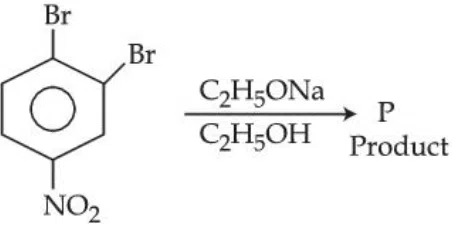
product 'P'formed is :
correct answer:- 4
Question 20
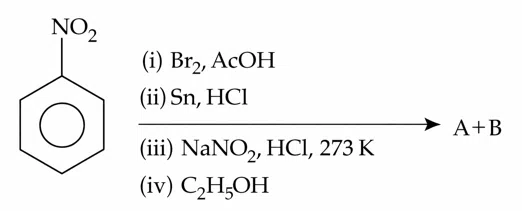
The products formed in the following reaction sequence are :
correct answer:- 3

Question 21
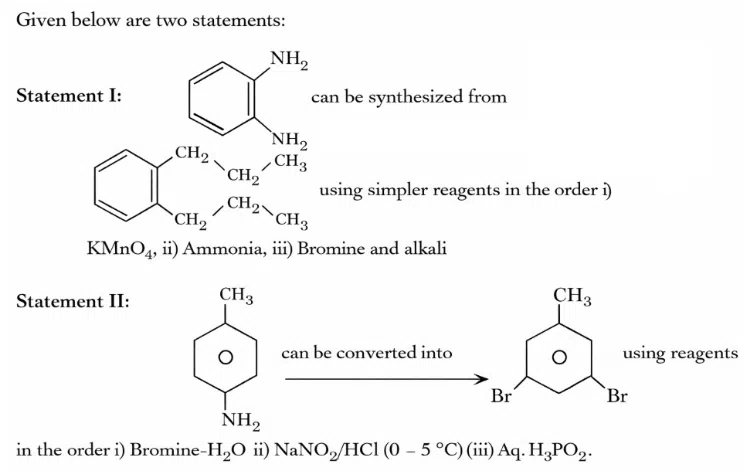
In the light of the above statements, choose the correct answer from the options given below
correct answer:- 3
Question 22
Consider the following sequence of reactions to produce major product (A)
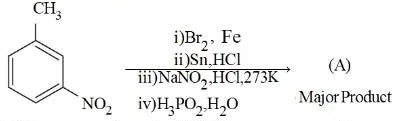
Molar mass of product (A) is $$gmol^{-1}$$. (Given molar mass in $$gmol^{-1}$$ of C : 12, H : 1, O : 16, Br : 80, N : 14, P : 31)
correct answer:- 171
Question 23
A student has been given a compound "x" of molecular formula- $$C_{6}H_{7}N$$. 'x' is sparingly soluble in water. However, on addition of dilute mineral acid, 'x' becomes soluble in water. 'x' when treated with $$CHCl_{3}$$ and KOH(alc), 'Y' is produced. 'y' has a specific unpleasant smell. On treatment with benzenesulphonyl chloride, 'x' gives a compound 'z' which is soluble in alkali. The number of different "H" atoms present in 'z' is :-
correct answer:- 4
Question 24
Which of the following reaction/s will not give $$p$$-aminoazobenzene?
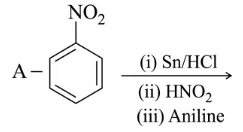
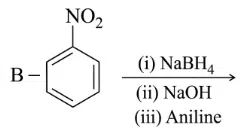
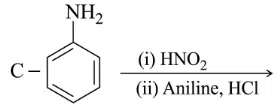
correct answer:- 1
Question 25
Identify the incorrect statements about group 15 elements : (A) Dinitrogen is a diatomic gas which acts like an inert gas at room temperature. (B) The common oxidation states of these elements are $$-3, +3$$ and $$+5$$. (C) Nitrogen has unique ability to form $$p\pi - p\pi$$ multiple bonds. (D) The stability of $$+5$$ oxidation states increases down the group. (E) Nitrogen shows a maximum covalency of 6. Choose the correct answer from the options given below :
correct answer:- 3

Question 26
The correct sequential order of the reagents for the given reaction is
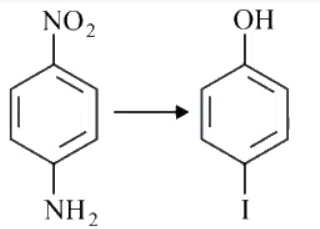
correct answer:- 2
Question 27
Aryl fluoride may be prepared from arene diazonium chloride using :
correct answer:- 1
Question 28
The most appropriate reagent for conversion of $$\text{C}_2\text{H}_5\text{CN}$$ into $$\text{CH}_3\text{CH}_2\text{CH}_2\text{NH}_2$$ is:
correct answer:- 3
Question 29
Given below are two statements:
Statement I:
Sulphanilic acid gives esterification test for carboxyl group.
Statement II:
Sulphanilic acid gives red colour in Lassigne's test for extra element detection.
In the light of the above statements, choose the most appropriate answer from the options given below:
correct answer:- 4
Question 30
The order of basicity of amines in gaseous state is :
correct answer:- 3