
Join Our JEE Preparation Group
Prep with like-minded aspirants; Get access to free daily tests and study material.
Sign in
Please select an account to continue using cracku.in
↓ →
Join Our JEE Preparation Group
Prep with like-minded aspirants; Get access to free daily tests and study material.
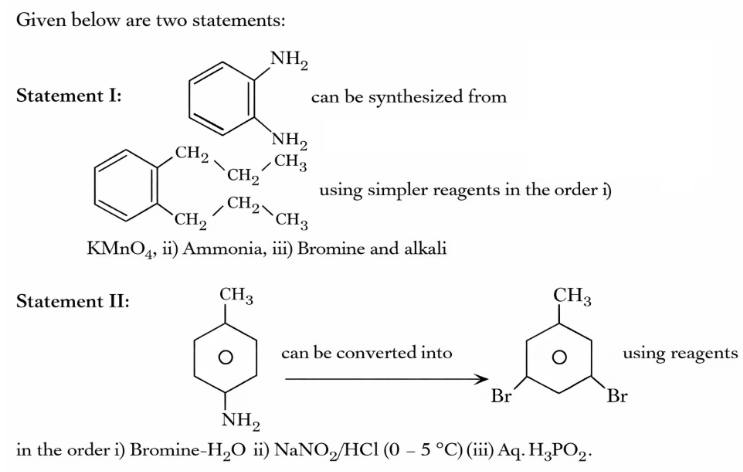
In the light of the above statements, choose the correct answer from the options given below
We need to evaluate the correctness of two organic reaction sequences presented in Statement I and Statement II.
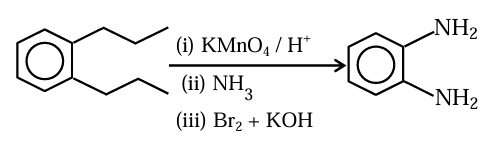
The first sequence outlines the conversion of tetralin (a bicyclic hydrocarbon where a benzene ring is fused to a 6-membered aliphatic ring) into 1,2-diaminobenzene:
$$\implies \text{Statement I is True}$$
The second sequence outlines the synthesis of 3,5-dibromotoluene starting from 4-methylaniline (p-toluidine):
$$\implies \text{Statement II is True}$$
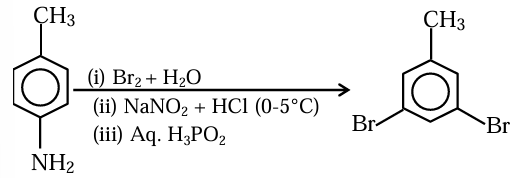
Both reaction sequences proceed successfully as described to form their respective major products.
Answer: Option C — Both Statement I and Statement II are true
Was this solution helpful?
Click on the Email ☝️ to Watch the Video Solution
Create a FREE account and get:
_1.webp)

Educational materials for JEE preparation

Ask our AI anything

AI can make mistakes. Please verify important information.
AI can make mistakes. Please verify important information.
