
Join Our JEE Preparation Group
Prep with like-minded aspirants; Get access to free daily tests and study material.
Sign in
Please select an account to continue using cracku.in
↓ →
Join Our JEE Preparation Group
Prep with like-minded aspirants; Get access to free daily tests and study material.
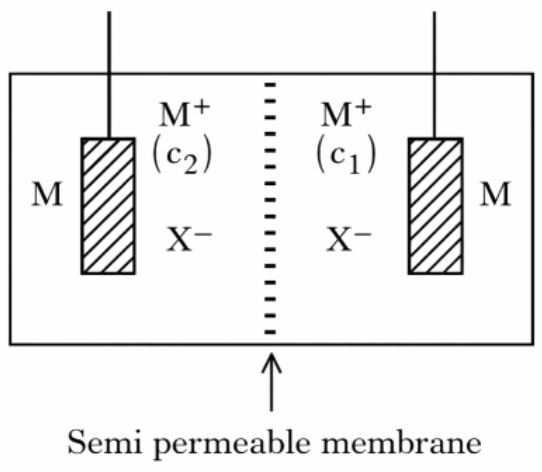
Consider the above electrochemical cell where a metal electrode (M) is undergoing redox reaction by forming $$M^{+}(M\rightarrow M^{+}+e^{-})$$. The cation $$M^{+}$$ is present in two different concentrations $$c_{1}$$ and $$c_{2}$$ as shown above. which of the following statement is correct for generating a positive cell potential?
The given cell is a metal/metal-ion concentration cell: the same metal $$M(s)$$ is present at both electrodes, but the molar concentration of the cation $$M^{+}$$ differs.
Overall cell reaction (at 298 K):
Anode (oxidation) $$M(s) \rightarrow M^{+}(c_{\text{anode}})+e^{-}$$
Cathode (reduction) $$M^{+}(c_{\text{cathode}})+e^{-}\rightarrow M(s)$$
Using the Nernst equation for a concentration cell with $$n=1$$ transferred electron, the cell potential is
$$E_{\text{cell}} = \frac{0.0591}{1}\,\log\left(\frac{c_{\text{cathode}}}{c_{\text{anode}}}\right)$$
For the cell potential to be positive we must have
$$\log\left(\frac{c_{\text{cathode}}}{c_{\text{anode}}}\right) \gt 0 \quad\Longrightarrow\quad c_{\text{cathode}} \gt c_{\text{anode}}$$
Now compare the four statements provided:
Case 1: Option A — “If $$c_1$$ is present at anode, then $$c_1=c_2$$.”
If the two concentrations are equal, $$c_{\text{cathode}}=c_{\text{anode}}$$, so $$E_{\text{cell}}=0$$, not positive. Hence wrong.
Case 2: Option B — “If $$c_1$$ is present at cathode, then $$c_1 \gt c_2$$.”
Here $$c_{\text{cathode}}=c_1$$ and $$c_{\text{anode}}=c_2$$. The requirement for a positive potential is exactly $$c_1 \gt c_2$$, so this statement is correct.
Case 3: Option C — “If $$c_1$$ is present at cathode, then $$c_1 \lt c_2$$.”
This yields $$c_{\text{cathode}} \lt c_{\text{anode}}$$, giving a negative $$E_{\text{cell}}$$, so it is incorrect.
Case 4: Option D — “If $$c_1$$ is present at anode, then $$c_1 \gt c_2$$.”
That would imply $$c_{\text{anode}} \gt c_{\text{cathode}}$$, again producing a negative cell potential; therefore wrong.
Hence, the only correct statement that guarantees a positive cell potential is:
Option B which is: If $$c_1$$ is present at cathode, then $$c_1 \gt c_2$$.
Was this solution helpful?
Create a FREE account and get:
_1.webp)

Educational materials for JEE preparation

Ask our AI anything

AI can make mistakes. Please verify important information.
AI can make mistakes. Please verify important information.
