Join WhatsApp Icon JEE WhatsApp Group
Question 67

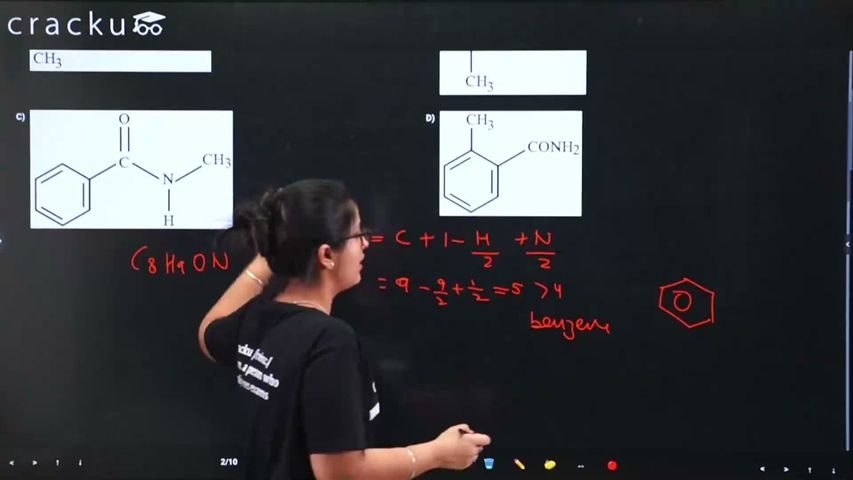
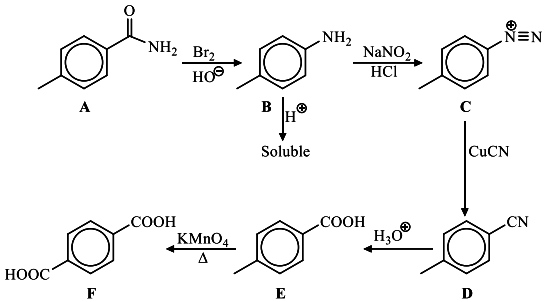
'A' is a neutral organic compound $$(M.F : C_{8}H_{9}ON)$$. On treatment with aqueous $$Br_{2}/OH_{(-)}$$, 'A' forms a compound 'B' which is soluble in dilute acid. 'B' on treatment with aqueous $$NaNO_{2} / HCl (0-5^{o}C)$$ produces a compound 'C' which on treatment with $$CuCN/NaCN$$ produces 'D'. Hydrolysis of 'D' produces 'E' which is also obtainable from the hydrolysis of'A'. 'E' on treatment with acidified $$KMnO_{4}$$ produces 'F'. 'F' contains two different types of hydrogen atoms. The structure of 'A' is
image

1. Structure A (Hofmann Degradation)

  • Reaction Conditions: Compound A has the molecular formula$$C_{8}H_{9}ON$$ and undergoes a Hofmann bromamide degradation when treated with aqueous $$Br_{2}/HO^{-}$$. This indicates that 'A' is a primary amide attached to a substituted benzene ring.
  • Product B: The amide group ($$-CONH_{2}$$) is converted into a primary amine ($$-NH_{2}$$), yielding 3-methylaniline (m-toluidine), which is basic and soluble in dilute acid.

2. Intermediate Conversions (B → C → D → E)

  • Diazotization (B → C): Treatment of 3-methylaniline with$$NaNO_{2}/HCl$$ at $$0\text{--}5^{\circ}C$$ converts the amine group into a diazonium salt ($$-N_{2}^{+}Cl^{-}$$).
  • Sandmeyer Reaction (C → D): Reacting the diazonium salt with$$CuCN/NaCN$$ replaces the diazonium group with a nitrile group ($$-CN$$), forming 3-ethylbenzonitrile.
  • Hydrolysis (D → E): Complete acid hydrolysis of the nitrile group converts it into a carboxylic acid ($$-COOH$$), producing 3-methylbenzoic acid. This matches the product obtained from the direct hydrolysis of the amide group in 'A'.

3. Final Oxidation (E → F)

  • Reaction Conditions: 3-methylbenzoic acid is oxidized using acidified$$KMnO_{4}$$ with heating. The side-chain methyl group ($$-CH_{3}$$) undergoes complete oxidation into a carboxylic acid group ($$-COOH$$).
  • Product F: The reaction yields benzene-1,3-dicarboxylic acid (isophthalic acid). Due to its symmetrical meta-substitution, the structure contains two distinct types of aromatic hydrogen atoms.

Get AI Help

Video Solution

video

Create a FREE account and get:

  • Free JEE Mains Previous Papers PDF
  • Take JEE Mains paper tests
Ask AI