
Join Our JEE Preparation Group
Prep with like-minded aspirants; Get access to free daily tests and study material.
Sign in
Please select an account to continue using cracku.in
↓ →
Join Our JEE Preparation Group
Prep with like-minded aspirants; Get access to free daily tests and study material.
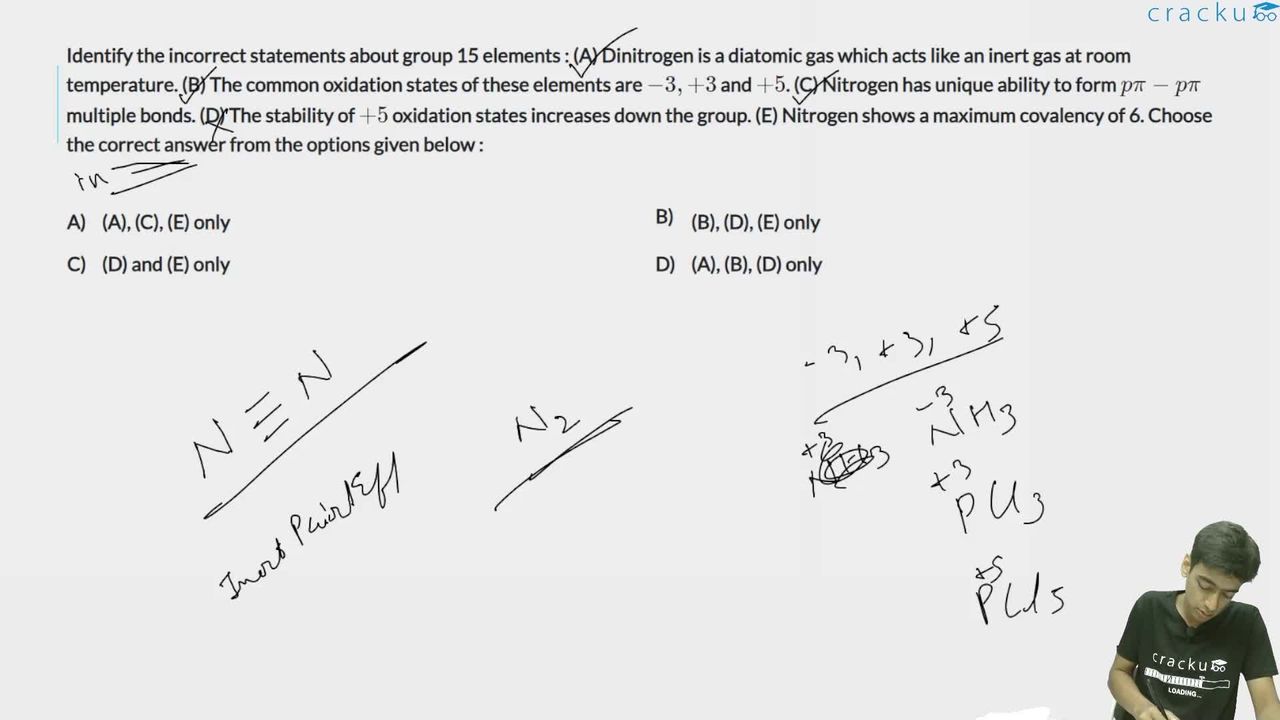
Identify the incorrect statements about group 15 elements : (A) Dinitrogen is a diatomic gas which acts like an inert gas at room temperature. (B) The common oxidation states of these elements are $$-3, +3$$ and $$+5$$. (C) Nitrogen has unique ability to form $$p\pi - p\pi$$ multiple bonds. (D) The stability of $$+5$$ oxidation states increases down the group. (E) Nitrogen shows a maximum covalency of 6. Choose the correct answer from the options given below :
Approach: Evaluate each statement about Group 15 elements and identify the incorrect ones.
Statement (A): Dinitrogen is a diatomic gas which acts like an inert gas at room temperature.
$$N_2$$ has a very strong triple bond (bond energy $$\approx 941$$ kJ/mol), making it unreactive at room temperature. It behaves like an inert gas under normal conditions. Statement A is correct.
Statement (B): The common oxidation states of these elements are $$-3, +3,$$ and $$+5$$.
Group 15 elements (N, P, As, Sb, Bi) commonly exhibit oxidation states of $$-3$$ (e.g., $$NH_3$$), $$+3$$ (e.g., $$PCl_3$$), and $$+5$$ (e.g., $$PCl_5$$). Statement B is correct.
Statement (C): Nitrogen has a unique ability to form $$p\pi - p\pi$$ multiple bonds.
Due to its small size, nitrogen can form effective lateral overlap of $$p$$-orbitals, enabling $$p\pi - p\pi$$ bonding (as in $$N_2$$, $$NO_2$$). Heavier elements of Group 15 cannot form such bonds effectively. Statement C is correct.
Statement (D): The stability of $$+5$$ oxidation state increases down the group.
Due to the inert pair effect, the stability of the $$+5$$ oxidation state actually decreases down the group (Bi prefers +3 over +5). Statement D is incorrect.
Statement (E): Nitrogen shows a maximum covalency of 6.
Nitrogen has no $$d$$-orbitals available for bonding (it is a second-period element). Its maximum covalency is 4 (e.g., $$NH_4^+$$). Statement E is incorrect.
The incorrect statements are (D) and (E) only, which corresponds to Option 3.
Was this solution helpful?
Click on the Email ☝️ to Watch the Video Solution
Create a FREE account and get:
_1.webp)

Educational materials for JEE preparation

Ask our AI anything

AI can make mistakes. Please verify important information.
AI can make mistakes. Please verify important information.
