
Join Our JEE Preparation Group
Prep with like-minded aspirants; Get access to free daily tests and study material.
Sign in
Please select an account to continue using cracku.in
↓ →
Join Our JEE Preparation Group
Prep with like-minded aspirants; Get access to free daily tests and study material.
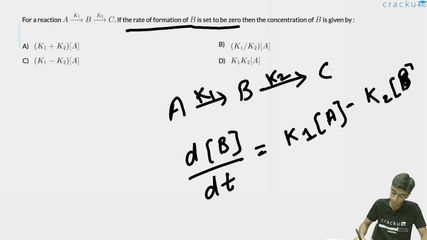
For a reaction $$A \xrightarrow{K_1} B \xrightarrow{K_2} C$$. If the rate of formation of $$B$$ is set to be zero then the concentration of $$B$$ is given by :
We need to find the concentration of intermediate $$B$$ in the consecutive reaction $$A \xrightarrow{K_1} B \xrightarrow{K_2} C$$, using the steady-state approximation.
The intermediate $$B$$ is formed from $$A$$ (with rate constant $$K_1$$) and is consumed to form $$C$$ (with rate constant $$K_2$$). The rate of change of $$[B]$$ is:
$$\frac{d[B]}{dt} = K_1[A] - K_2[B]$$
The first term represents formation of $$B$$ from $$A$$, and the second term represents consumption of $$B$$ to form $$C$$.
The steady-state approximation assumes that after an initial transient period, the concentration of the intermediate $$B$$ remains approximately constant. This means:
$$\frac{d[B]}{dt} = 0$$
Setting the rate equation to zero:
$$K_1[A] - K_2[B] = 0$$
$$K_2[B] = K_1[A]$$
$$[B] = \frac{K_1}{K_2}[A]$$
The correct answer is Option (2): $$(K_1/K_2)[A]$$.
Was this solution helpful?
Click on the Email ☝️ to Watch the Video Solution
Create a FREE account and get:
_1.webp)

Educational materials for JEE preparation

Ask our AI anything

AI can make mistakes. Please verify important information.
AI can make mistakes. Please verify important information.
