Join Our JEE Preparation Group
Prep with like-minded aspirants; Get access to free daily tests and study material.
Sign in
Please select an account to continue using cracku.in
↓ →
Join Our JEE Preparation Group
Prep with like-minded aspirants; Get access to free daily tests and study material.
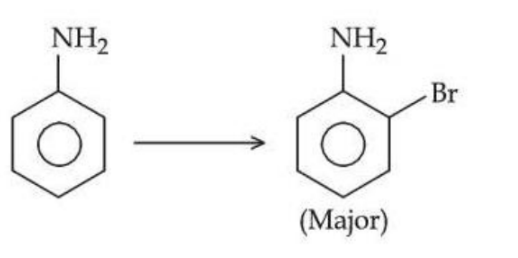
The starting compound is aniline ($$C_6H_5NH_2$$) and the target is a mono-brominated aniline. Because the -$$NH_2$$ group is a very strong ortho/para-directing activator, direct treatment of aniline with $$Br_2$$ would give mainly 2,4,6-tribromoaniline. Hence we must first protect the amino group, then carry out controlled bromination, and finally remove the protecting group.
Step 1 : Protonation
Concentrated $$H_2SO_4$$ converts aniline into its anilinium hydrogen-sulphate salt
$$C_6H_5NH_3^+HSO_4^-$$.
This salt is less reactive toward electrophilic substitution and also dissolves readily so that acetylation takes place smoothly in the next step.
Step 2 : Acetylation (protection of $$NH_2$$)
With acetic anhydride ($$Ac_2O$$) the anilinium ion is converted to acetanilide:
$$C_6H_5NHCOCH_3$$.
The -$$NHCOCH_3$$ group is only moderately activating and mainly directs incoming electrophiles to the para position because the ortho positions are sterically hindered by the bulky $$-NHCOCH_3$$.
Step 3 : Controlled bromination
Bromine ($$Br_2$$) now reacts with acetanilide to give almost exclusively p-bromoacetanilide:
$$C_6H_4Br(NHCOCH_3)$$.
Step 4 : Hydrolysis of the protecting group
Heating with water ($$H_2O,\,\Delta$$) hydrolyses p-bromoacetanilide back to p-bromoanilinium ion, releasing acetic acid:
$$C_6H_4BrNH_3^+$$.
Step 5 : Liberation of free amine
Finally, aqueous $$NaOH$$ neutralises the anilinium ion and furnishes the free base, p-bromoaniline ($$C_6H_4BrNH_2$$).
Thus the only sequence that carries out protection → bromination → deprotection in the correct order is:
$$H_2SO_4,\; Ac_2O,\; Br_2,\; H_2O(\Delta),\; NaOH$$.
Option B is therefore the correct answer.
Was this solution helpful?
Create a FREE account and get:
_1.webp)

Educational materials for JEE preparation

Ask our AI anything

AI can make mistakes. Please verify important information.
AI can make mistakes. Please verify important information.