Join WhatsApp Icon JEE WhatsApp Group
Question 68

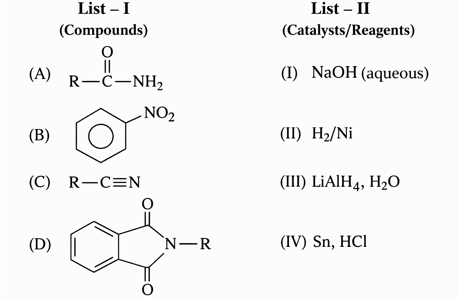
Match the Compounds (List - I) with the appropriate Catalyst/Reagents (List - II) for their reduction into corresponding amines.
image


Choose the correct answer from the options given below :

(A) Amide $$\rightarrow$$ (III) $$LiAlH_4$$

  • Why this reagent: $$LiAlH_4$$ is a powerful nucleophilic reducing agent capable of reducing the highly stable $$C=O$$ bond of an amide all the way to a $$CH_2$$ group to yield a primary amine.
  • Why others fail: $$H_2/Ni$$ is usually not strong enough to reduce amides efficiently under standard conditions. $$Sn/HCl$$ is specifically used for nitro groups and won't touch the amide carbonyl. $$NaOH$$ would simply cause hydrolysis to a carboxylate salt and ammonia, not reduction.

(B) Nitrobenzene $$\rightarrow$$ (IV) $$Sn, HCl$$

  • Why this reagent: This is a classic laboratory method for preparing aniline. The metal/acid combination ($$Sn/HCl$$ or $$Fe/HCl$$) provides the protons and electrons necessary to reduce $$-NO_2$$ to $$-NH_2$$.
  • Why others fail: While $$H_2/Ni$$ could technically work, $$Sn/HCl$$ is the preferred "textbook" match for aromatic nitro compounds in this list. $$LiAlH_4$$ is avoided for aromatic nitro compounds because it can lead to azo compounds (coupling) rather than pure amines.

(C) Nitrile $$\rightarrow$$ (II) $$H_2/Ni$$

  • Why this reagent: Catalytic hydrogenation is the most efficient way to add four hydrogen atoms across the $$C\equiv N$$ triple bond to produce a primary amine ($$R-CH_2NH_2$$).
  • Why others fail: $$NaOH$$ would hydrolyze the nitrile to an amide and then a carboxylic acid. $$Sn/HCl$$ is not the standard reagent for full nitrile reduction (it is used in the Stephen reduction to stop at the aldehyde, but only with $$SnCl_2$$).

(D) Phthalimide $$\rightarrow$$ (I) $$NaOH$$

  • Why this reagent: This refers to the final step of the Gabriel Phthalimide Synthesis. Once an alkyl group is attached to the nitrogen, base-catalyzed hydrolysis ($$NaOH$$) is used to break the cyclic imide bonds and release the primary amine.
  • Why others fail: The goal here is "cleavage" to release the amine, not "reduction" of the aromatic ring or carbonyls. Reducing agents like $$LiAlH_4$$ or $$H_2/Ni$$ would attack the carbonyl groups of the phthalimide ring itself, destroying the starting material instead of releasing the desired amine.

Get AI Help

Video Solution

video

Create a FREE account and get:

  • Free JEE Mains Previous Papers PDF
  • Take JEE Mains paper tests

Free JEE Topicwise Questions

JEE Hydrocarbons - AlkenesJEE SolutionsJEE EquilibriumJEE Chemical Bonding & Molecular StructureJEE Quadratic EquationsJEE Electromagnetic WavesJEE Laws of ThermodynamicsJEE CirclesJEE StatisticsJEE Rotational MotionJEE Periodic Table & PeriodicityJEE BiomoleculesJEE Kinetic Theory of GasesJEE Electric Potential & CapacitanceJEE Laboratory Experiments - XIJEE Differential EquationsJEE Binomial TheoremJEE Carboxylic AcidsJEE Applications of DerivativesJEE Vector AlgebraJEE Alcohols, Phenols & EthersJEE Nitrogen-Containing CompoundsJEE Sets, Relations & FunctionsJEE Electronic DevicesJEE Work, Energy & PowerJEE Definite IntegrationJEE DeterminantsJEE d and f-Block ElementsJEE Complex NumbersJEE MatricesJEE Magnetism & Magnetic MaterialsJEE Number SystemJEE Indefinite IntegrationJEE Permutations & CombinationsJEE Fluid MechanicsJEE Sequences & SeriesJEE Inverse Trigonometric FunctionsJEE Three Dimensional GeometryJEE Aldehydes & KetonesJEE Basic Concepts in ChemistryJEE Alternating CurrentsJEE Kinematics - 2D MotionJEE Current & ResistanceJEE Hydrocarbons - AlkanesJEE Simple Harmonic MotionJEE Dual Nature of Matter & RadiationJEE ElectrochemistryJEE Electric Charges & FieldsJEE Magnetic Effects of CurrentJEE GravitationJEE Heat TransferJEE Atoms & NucleiJEE Redox ReactionsJEE Chemical ThermodynamicsJEE DifferentiationJEE Practical Organic ChemistryJEE Wave OpticsJEE Atomic StructureJEE Units & MeasurementsJEE Trigonometric FunctionsJEE WavesJEE Straight LinesJEE Basic Principles of Organic ChemistryJEE EMF & Circuit AnalysisJEE Hydrocarbons - AromaticJEE ProbabilityJEE Ray OpticsJEE Coordination CompoundsJEE p-Block Elements (Groups 13-18)JEE Organic Compounds with HalogensJEE Electromagnetic InductionJEE Surface TensionJEE Purification & CharacterisationJEE Conic SectionsJEE Continuity & DifferentiabilityJEE JEE 2D GeometryJEE Laws of MotionJEE LimitsJEE Kinematics - 1D MotionJEE Chemical KineticsJEE ElasticityJEE Hydrocarbons - Alkynes
Ask AI