
 Group
Group
 Group
Group
JEE Practical Organic Chemistry PYQ
Solving JEE Practical Organic Chemistry PYQ problems helps students understand the laboratory techniques used to identify, separate, purify and analyse organic compounds. Questions from this topic commonly involve functional-group tests, elemental detection, purification methods, chromatography and quantitative analysis.
Most questions are concept-based and do not require lengthy calculations. Students are usually asked to identify the correct reagent, experimental condition, observation or conclusion. For example, a question may describe a silver mirror, a coloured precipitate, or a characteristic smell and ask which functional group is present.
The chapter becomes easier when each reagent is connected to its purpose and observations rather than being memorised as an isolated fact. Regularly solving JEE Practical Organic Chemistry Questions helps students distinguish between similar tests and remember the required experimental conditions.
JEE Practical Organic Chemistry Important PYQ PDF
The JEE Practical Organic Chemistry Important PYQ PDF provided below contains selected previous-year questions for focused chapter-wise practice. It covers functional-group identification, Lassaigne’s test, chromatography, crystallisation, distillation and quantitative analysis of organic compounds.
Attempt every question independently before checking the answer. When reviewing an incorrect response, determine whether you confused the reagent, missed an experimental condition, recalled the wrong observation or incorrectly identified the functional group.
Students should also solve questions from JEE Mains Previous Papers to understand how practical organic chemistry is combined with concepts such as reaction mechanisms and the chemical properties of functional groups. After completing the PDF, attempt the difficult questions again without referring to their solutions.
Important Topics Covered in Practical Organic Chemistry PYQs
Practical Organic Chemistry questions test whether students can apply theoretical organic chemistry to laboratory identification and analysis. A single question may provide a reagent and observation or ask students to choose a suitable test for distinguishing two compounds.
Important topics include:
- Preliminary examination of organic compounds
- Detection of extra elements
- Lassaigne’s sodium fusion test
- Detection of nitrogen
- Detection of sulphur
- Detection of nitrogen and sulphur together
- Detection of halogens
- Functional-group identification
- Tests for unsaturation
- Tests for alcohols and phenols
- Tests for aldehydes and ketones
- Tests for carboxylic acids
- Tests for primary amines
- Tollens’ and Fehling’s tests
- 2,4-DNP test
- Iodoform test
- Carbylamine test
- Chromatography and retention factor
- Crystallisation, sublimation and distillation
- Quantitative elemental analysis
How to Solve Practical Organic Chemistry PYQs Effectively
Begin by identifying the purpose of the experiment. Determine whether the question involves detecting an element, identifying a functional group, separating a mixture or estimating the percentage of an element.
Follow these steps while solving JEE Questions from this chapter:
- Identify the compound or functional group mentioned.
- Note the reagent and experimental conditions.
- Recall the expected colour, precipitate, smell or other observation.
- Distinguish between tests that detect similar functional groups.
- Check whether heating or a particular medium is required.
- For Lassaigne’s test, identify the ion formed after sodium fusion.
- For chromatography, compare polarity and interaction with the stationary phase.
- For purification, examine solubility, volatility and boiling point.
- For numerical questions, write the measured quantity and relevant mass ratio.
- Verify whether the conclusion is valid for every compound listed.
List of JEE Practical Organic Chemistry PYQs
The questions listed below can be attempted as a timed chapter-wise test. They cover functional-group identification, elemental analysis, chromatography, purification methods and important laboratory observations.
Solve all the questions without checking the answers. After completing the test, review every incorrect, guessed and skipped question. Revise the related test or experimental principle and attempt the question again to strengthen long-term recall.
Question 1
The correct match between column-I and column-II is:
Column-I (drug) Column-II (test)
(A) Chloroxylenol (P) Carbylamine test
(B) Norethindrone (Q) Sodium hydrogen carbonate test
(C) Sulphapyridine (R) Ferric chloride test
(D) Penicillin (S) Baeyer's test
correct answer:- 4
Question 2
R$$_f$$ value for 2-methylpropene in a solvent system (Ethyl acetate + ether) is 0.42. 2-methylpropene is treated with dilute H$$_2$$SO$$_4$$ to give major organic product (X). R$$_f$$ value for (X) in the same solvent system under identical condition will be:
correct answer:- 4
Question 3
Ceric ammonium nitrate and $$CHCl_3$$ / alc. KOH are used for the identification of functional groups present in ______ and ______ respectively.
correct answer:- 2
Question 4
Match List I (Elements present in the organic compound) with List II (Observation/Color formed during their detection tests using Lassaigne's extract or specific reagents):
| List I | List II |
|---|---|
|
I.
Nitrogen |
P.
Blood red coloration with Fe3+ ions |
|
II.
Sulphur |
Q.
Prussian blue coloration with FeSO4 and conc. H2SO4 |
|
III.
Both Nitrogen and Sulphur together |
R.
Canary yellow precipitate with Ammonium molybdate |
|
IV.
Phosphorus |
S.
Violet coloration with Sodium nitroprusside |
correct answer:- 2
Question 5
A student has been given $$0.160\text{ g}$$ of an organic compound and asked to estimate Sulphur. During the experiment, the student has obtained $$0.4893\text{ g}$$ of barium sulphate. The percentage of sulphur present in the compound is _________.
(Enter your answer to the nearest integer.)
Given: Molar masses in $$\text{g mol}^{-1}$$ are $$S = 32$$ and $$BaSO_4 = 233$$.
correct answer:- 42

Question 6
In Carius tube, an organic compound 'X' is treated with sodium peroxide to form a mineral acid 'Y'. The solution of BaCl$$_2$$ is added to 'Y' to form a precipitate 'Z'. 'Z' is used for the quantitative estimation of an extra element. 'X' could be
correct answer:- 3
Question 7
An organic compound containing both Nitrogen and Sulfur is subjected to Lassaigne's test. When the sodium fusion extract is acidified and treated directly with (FeCl_3) solution, a blood-red coloration is observed. However, if the same compound is fused with an excess of sodium metal, the extract does not give a blood-red colour with (FeCl_3). Instead, upon treatment with (FeSO_4) followed by (FeCl_3) and acid, a Prussian blue colour is observed. What is the primary reason for the disappearance of the blood-red colour when excess sodium is used?
correct answer:- 3
Question 8
Given below are two statements:
Statement-I: The gas liberated on warming a salt with dil $$H_2SO_4$$, turns a piece of paper dipped in lead acetate into black, it is a confirmatory test for sulphide ion.
Statement-II: In statement-I the colour of paper turns black because of formation of lead sulphite.
In the light of the above statements, choose the most appropriate answer from the options given below:
correct answer:- 3
Question 9
A student has been given 0.314 g of an organic compound and asked to estimate Sulphur. During the experiment, the student has obtained 0.4813 g of barium sulphate. The percentage of sulphur present in the compound is_______.{Given Molor mass in g $$mol^{-1}$$ S: 32, $$BaSO_{4}$$ : 233)
correct answer:- 4
Question 10
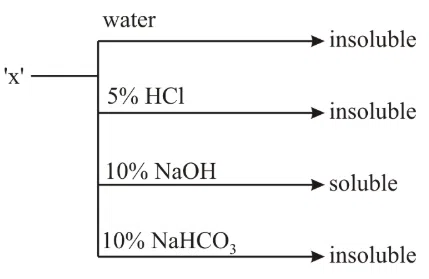
An organic compound 'X' showing the following solubility profile is:
correct answer:- 1

Question 11
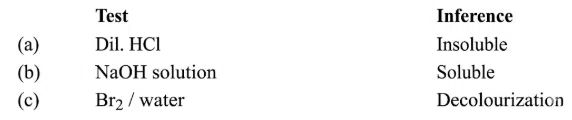
The organic compound that gives following qualitative analysis is:
correct answer:- 3
Question 12
$$0.94\text{ g}$$ of an organic compound $$C_xH_yBr_z$$ when heated with excess concentrated nitric acid and subsequently treated with silver nitrate gave $$0.94\text{ g}$$ of silver bromide precipitate. On combustion, $$1.00\text{ g}$$ of the compound produced $$1.76\text{ g}$$ of $$CO_2$$. Assuming the compound contains only carbon, hydrogen, and bromine, find the percentage of hydrogen in the compound. (Nearest Integer)
correct answer:- 12
Question 13
During the estimation of nitrogen present in an organic compound using Kjeldahl's method, $$0.5\text{ g}$$ of the compound was Kjeldahlized. The ammonia gas evolved was absorbed in $$50\text{ mL}$$ of $$0.5\text{ M }H_2SO_4$$. The residual acid required $$60\text{ mL}$$ of $$0.5\text{ M }NaOH$$ for complete neutralization. What is the percentage of nitrogen in the given organic compound?
correct answer:- 3
Question 14
In an estimation of bromine using the Carius method, exactly $$0.40\text{ g}$$ of a bromine-containing organic compound was heated with fuming nitric acid and silver nitrate in a sealed tube. The reaction yielded $$0.376\text{ g}$$ of a pure white-yellowish silver bromide ($$\text{AgBr}$$) precipitate.
Calculate the mass percentage of bromine present in the parent organic compound.
(Given atomic masses: $$\text{Ag} = 108\text{ g mol}^{-1}$$, $$\text{Br} = 80\text{ g mol}^{-1}$$)
correct answer:- 40
Question 15
In the wet tests for identification of various cations by precipitation, which transition element cation doesn't belong to group IV in qualitative inorganic analysis?
correct answer:- 1

Question 16
Among Fe$$^{3+}$$, Pb$$^{2+}$$, Cu$$^{2+}$$ and Mn$$^{2+}$$, identify the one that gets precipitated out while passing H$$_2$$S in presence of NH$$_4$$OH as group reagent. The highest possible oxidation state of the corresponding metal is
correct answer:- 4
Question 17
In sulphur estimation, $$2.0 \times 10^{-3}$$ mol of an organic compound (X) (molar mass 76 g mol$$^{-1}$$) gave 0.4813 g of barium sulphate (molar mass 233 g mol$$^{-1}$$). The percentage of sulphur in the compound (X) is _________ $$\times 10^{-1}$$ % (Nearest integer)
correct answer:- 435
Question 18
Kjeldahl's method, during this estimation process, the nitrogen present in the compound is quantitatively converted into which of the following chemical species in its initial digestion phase?
correct answer:- 1
Question 19
A mixture of three aromatic compounds—Benzaldehyde, Benzyl alcohol, and Methyl benzoate—is separated using thin-layer chromatography (TLC) on a silica-gel coated glass slide. The developing solvent (eluent) used is a moderately non-polar mixture of petroleum ether and ethyl acetate.Arrange these three compounds in the decreasing order of their retention factors $$(R_{f}$$ values), from highest to lowest:
correct answer:- 2
Question 20
Sodium Carbonate cannot be used in place of $$(NH_4)_2CO_3$$ for the identification of $$Ca^{2+}$$, $$Ba^{2+}$$ and $$Sr^{2+}$$ ions (in group V) during mixture analysis because :
correct answer:- 1

Question 21
Which of the following compounds is not expected to show Lassaignes' test for nitrogen?
correct answer:- 2
Question 22
Match List-I with List-II.
List-I (Element detected) List-II (Reagent used/Product formed)
A. Nitrogen I. Na$$_2$$FeCN$$_5$$NO
B. Sulphur II. AgNO$$_3$$
C. Phosphorus III. Fe$$_4$$FeCN$$_{6_{3}}$$
D. Halogen IV. NH$$_{4_{2}}$$MoO$$_4$$
correct answer:- 1
Question 23
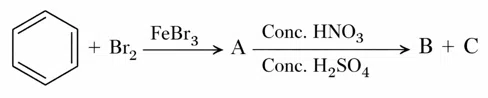
Method used for separation of mixture of products (B and C) obtained in the following reaction is
correct answer:- 1
Question 24
The Kjeldahl method of Nitrogen estimation fails for which of the following reaction products?

correct answer:- 1
Question 25
a
correct answer:- 1

Question 26
In Lassaigne's test for detection of elements in an organic compound, if both nitrogen and sulphur are present together, the sodium fusion extract gives a blood-red colour on addition of iron(III) chloride $$\mathrm{(FeCl_3)}$$.
The chemical species responsible for this blood-red colour is
correct answer:- 2
Question 27
In the Group analysis of cations, $$Ba^{2+}$$ & $$Ca^{2+}$$ are precipitated respectively as
correct answer:- 4
Question 28
The test performed on compound x and their inferences are:
Test Inference
(a) 2,4-DNP test Coloured precipitate yellow
(b) Iodoform test Yellow precipitate
(c) Azo-dye test No dye formation
Compound 'x' is:
correct answer:- 3
Question 29
a
correct answer:- 1
Question 30
During the qualitative analysis of an organic compound, Lassaigne's extract is prepared by fusing the compound with sodium metal. If the compound contains both nitrogen and sulphur, a blood-red coloration is observed upon adding freshly prepared $$\text{FeCl}_3$$ solution. Which complex ion is responsible for this characteristic blood-red color?
correct answer:- 3