
Join Our JEE Preparation Group
Prep with like-minded aspirants; Get access to free daily tests and study material.
Sign in
Please select an account to continue using cracku.in
↓ →
Join Our JEE Preparation Group
Prep with like-minded aspirants; Get access to free daily tests and study material.
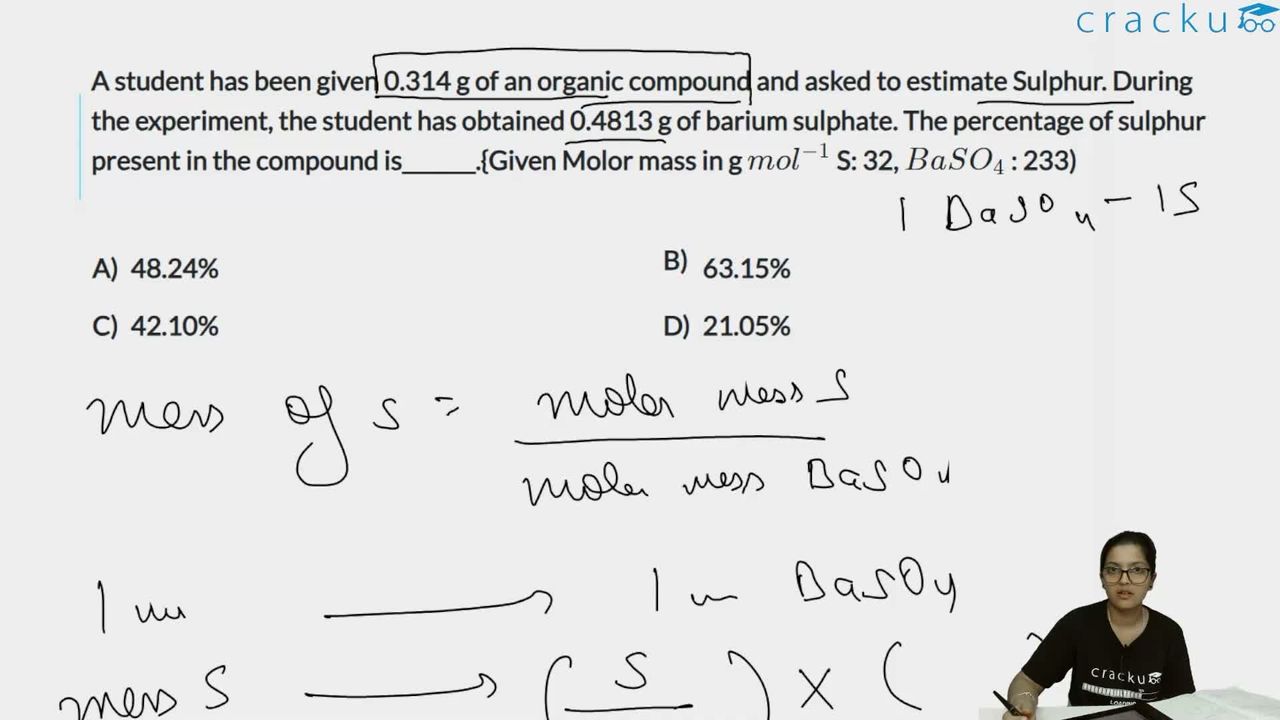
A student has been given 0.314 g of an organic compound and asked to estimate Sulphur. During the experiment, the student has obtained 0.4813 g of barium sulphate. The percentage of sulphur present in the compound is_______.{Given Molor mass in g $$mol^{-1}$$ S: 32, $$BaSO_{4}$$ : 233)
The sulphur in the organic compound is converted to barium sulphate (BaSO₄) during the experiment. Therefore, the mass of sulphur in the barium sulphate precipitate comes entirely from the organic compound.
The molar mass of BaSO₄ is 233 g/mol, and the molar mass of sulphur (S) is 32 g/mol. The mass of sulphur in the barium sulphate precipitate can be calculated using the proportion:
$$\text{Mass of sulphur} = \left( \frac{\text{Molar mass of S}}{\text{Molar mass of BaSO}_4} \right) \times \text{Mass of BaSO}_4$$
Substituting the given values:
$$\text{Mass of sulphur} = \left( \frac{32}{233} \right) \times 0.4813$$
First, compute the fraction:
$$\frac{32}{233} \approx 0.13733905579399142$$
Now multiply by the mass of BaSO₄:
$$0.13733905579399142 \times 0.4813 \approx 0.06610128$$
So, the mass of sulphur is approximately 0.06610128 g.
This sulphur originated from the organic compound with a mass of 0.314 g. The percentage of sulphur in the compound is:
$$\text{Percentage of sulphur} = \left( \frac{\text{Mass of sulphur}}{\text{Mass of compound}} \right) \times 100$$
Substituting the values:
$$\text{Percentage} = \left( \frac{0.06610128}{0.314} \right) \times 100$$
First, divide the masses:
$$\frac{0.06610128}{0.314} \approx 0.210514$$
Now multiply by 100:
$$0.210514 \times 100 = 21.0514\%$$
Rounding to two decimal places, the percentage is 21.05%.
Comparing with the options:
A. 48.24%
B. 63.15%
C. 42.10%
D. 21.05%
The correct answer is D. 21.05%.
Was this solution helpful?
Click on the Email ☝️ to Watch the Video Solution
Create a FREE account and get:
_1.webp)

Educational materials for JEE preparation

Ask our AI anything

AI can make mistakes. Please verify important information.
AI can make mistakes. Please verify important information.
