
Join Our JEE Preparation Group
Prep with like-minded aspirants; Get access to free daily tests and study material.
Sign in
Please select an account to continue using cracku.in
↓ →
Join Our JEE Preparation Group
Prep with like-minded aspirants; Get access to free daily tests and study material.
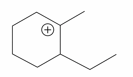
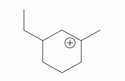
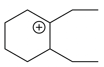
The cyclic cations having the same number of hyperconjugalion are :
A.
B.
C.

D.
Choose the correct answer from the options given below :
Hyperconjugation in a carbocation is possible only with the hydrogens present on the carbon atoms directly bonded to the positively-charged carbon (α-carbons). Each such α-hydrogen can be displaced into the empty $$p$$-orbital of the cation to give one hyperconjugative (no-bond resonance) structure.
Therefore,
Number of hyperconjugative structures $$=\,$$ total number of α-hydrogens
We must inspect each of the four cyclic carbocations, count their α-hydrogens and then compare.
Case A:The positively-charged carbon is bonded to two equivalent CH3 groups (each supplies three hydrogens) and one carbon of the ring that bears no hydrogens. Hence
total α-hydrogens in A $$= 3+3 = 6$$
The cationic centre here is bonded to one CH3 group (three hydrogens) and two ring carbons that carry no hydrogens. Hence
total α-hydrogens in B $$= 3$$
This structure is identical to A in the sense that the cationic carbon is again attached to two CH3 groups and one ring carbon without hydrogens. Therefore
total α-hydrogens in C $$= 6$$
The cationic centre is attached to one CH2 group (two hydrogens) and two ring carbons devoid of hydrogens. Thus
total α-hydrogens in D $$= 2$$
Comparing the counts, only A and C possess the same number of α-hydrogens (six each), i.e. the same number of hyperconjugative structures.
Hence the cyclic cations that have an equal extent of hyperconjugation are A and C.
Option C which is: A and C Only
Was this solution helpful?
Create a FREE account and get:
_1.webp)

Educational materials for JEE preparation

Ask our AI anything

AI can make mistakes. Please verify important information.
AI can make mistakes. Please verify important information.
