Join Our JEE Preparation Group
Prep with like-minded aspirants; Get access to free daily tests and study material.
Sign in
Please select an account to continue using cracku.in
↓ →
Join Our JEE Preparation Group
Prep with like-minded aspirants; Get access to free daily tests and study material.
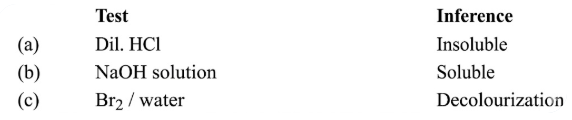
Based on the provided qualitative analysis tests, the unknown organic compound can be identified by evaluating each step logically. First, the compound's insolubility in dilute HCl indicates that it lacks strongly basic functional groups, such as aliphatic or aromatic amines, which would otherwise form soluble hydrochloride salts. Second, its solubility in an NaOH solution reveals that the compound possesses an acidic functional group capable of reacting with a strong base to form a water-soluble sodium salt. Since it does not specify solubility in weaker bases like sodium bicarbonate, this acidic nature points heavily toward a phenolic compound rather than a carboxylic acid. Finally, the Bromine Water test resulting in decolorization confirms the presence of highly electron-rich aromatic rings or carbon-carbon multiple bonds. Phenols have highly activated benzene rings due to the strong resonance electron-donation of the hydroxyl group, which allows them to undergo rapid electrophilic aromatic substitution with bromine water, decolorizing the orange-brown solution and typically forming a halogenated precipitate. Therefore, the qualitative analysis strongly demonstrates that the organic compound is a phenol
Was this solution helpful?
Click on the Email ☝️ to Watch the Video Solution
Create a FREE account and get:
_1.webp)

Educational materials for JEE preparation

Ask our AI anything

AI can make mistakes. Please verify important information.
AI can make mistakes. Please verify important information.