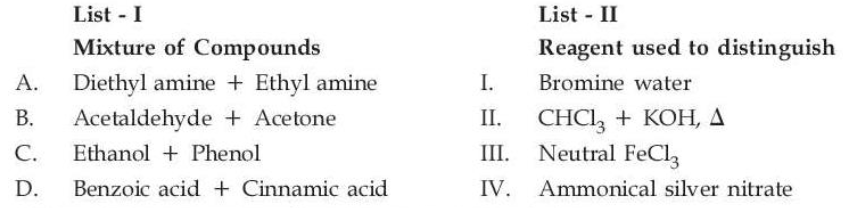
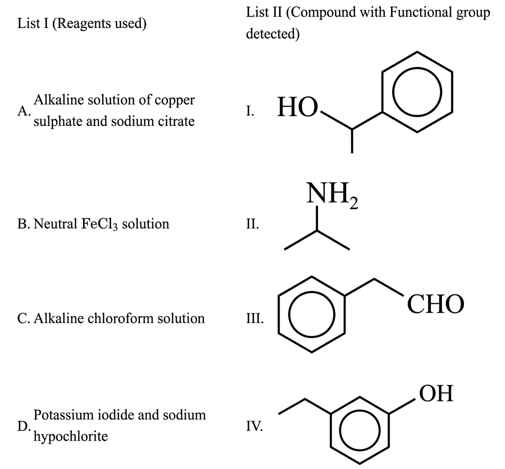
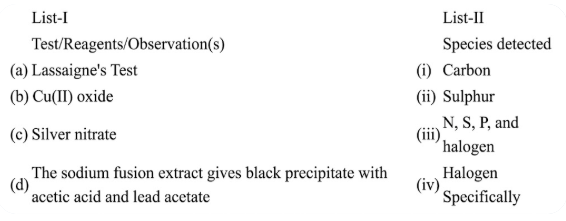
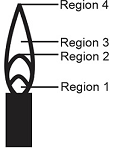
Match List - I with List - II.
choose the correct answer from the options given below :
Sign in
Please select an account to continue using cracku.in
↓ →
Join Our JEE Preparation Group
Prep with like-minded aspirants; Get access to free daily tests and study material.
Match List - I with List - II.
choose the correct answer from the options given below :
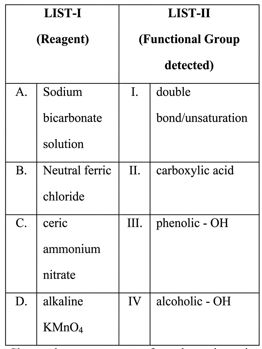
Baeyer's reagent is a cold, alkaline solution of potassium permanganate ($$\text{KMnO}_4$$), which is deep pink/purple. When it reacts with an alkene or alkyne, the $$\text{MnO}_4^-$$ ion is reduced to $$\text{MnO}_2$$ (a brown precipitate), causing the pink colour to disappear (decolourise).
Ceric ammonium nitrate ($$\text{CAN}$$) is an orange-yellow reagent. When added to an alcohol, it forms a alkoxy cerium(IV) complex, which results in a characteristic wine-red colouration.
Tollen's reagent contains the silver-ammonia complex $$[\text{Ag}(\text{NH}_3)_2]^+$$. Aldehydes reduce these silver ions to metallic silver, which deposits on the inner walls of the test tube, creating a shining silver mirror.
Phenols react with neutral ferric chloride to form a coordination complex with the iron. For simple phenol, this complex is typically violet or purple, though other phenols can produce green or blue colours.
A student performed analysis of aliphatic organic compound 'X' which on analysis gave C =61.01 % H =15.25%, N=23.74%.
This compound, on treatment with $$HNO_{2}/H_{2}O$$ produced another compound 'Y' which did not contain any nitrogen atom However, the compound 'Y' upon controlled oxidation produced another compound 'Z' that responded to iodoform test.
The structure of 'X' is :
Consider three metal chlorides x, y and z, where x is water soluble at room temperature, y is sparingly soluble in water at room temperature and z is soluble in hot water. x, y and z are respectively
We need to identify three metal chlorides based on their solubility properties.
x: Water soluble at room temperature
y: Sparingly soluble in water at room temperature
z: Soluble in hot water
Option 2: $$CuCl_2, AgCl, PbCl_2$$
- $$CuCl_2$$: Copper(II) chloride is readily soluble in water at room temperature. ✓ (matches x)
- $$AgCl$$: Silver chloride is sparingly soluble (nearly insoluble) in water at room temperature. ✓ (matches y)
- $$PbCl_2$$: Lead(II) chloride is sparingly soluble in cold water but dissolves readily in hot water. ✓ (matches z)
This perfectly matches all three conditions.
Checking other options:
- Option 1: $$AlCl_3$$ is soluble, $$AgCl$$ is sparingly soluble, but $$AlCl_3$$ doesn't specifically need hot water to dissolve.
- Option 3: $$BaCl_2$$ is freely soluble in water at room temperature, not specifically requiring hot water.
- Option 4: The notation $$AlCl$$ is unusual, and $$Hg_2Cl_2$$ is insoluble even in hot water.
Therefore, the correct answer is Option 2: $$CuCl_2, AgCl, PbCl_2$$.
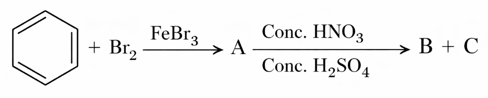
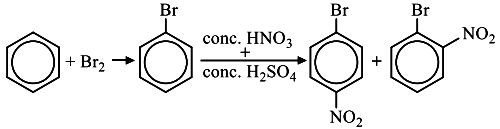
Method used for separation of mixture of products (B and C) obtained in the following reaction is
R$$_f$$ value for 2-methylpropene in a solvent system (Ethyl acetate + ether) is 0.42. 2-methylpropene is treated with dilute H$$_2$$SO$$_4$$ to give major organic product (X). R$$_f$$ value for (X) in the same solvent system under identical condition will be:
In the Group analysis of cations, $$Ba^{2+}$$ & $$Ca^{2+}$$ are precipitated respectively as
We need to identify how Ba²⁺ and Ca²⁺ are precipitated in group analysis of cations.
Group V cations include Ba²⁺, Ca²⁺, and Sr²⁺.
In the systematic qualitative analysis:
Ba²⁺ and Ca²⁺ both belong to Group V and are precipitated using ammonium carbonate ((NH₄)₂CO₃) as the group reagent.
Ba²⁺ → BaCO₃ (white precipitate)
Ca²⁺ → CaCO₃ (white precipitate)
Both are precipitated as carbonates.
Therefore, the answer is Option 4: carbonate & carbonate.
In Carius method 0.2425 g of an organic compound gave 0.5253 g silver chloride.
The percentage of chlorine in the organic compound is
The Carius method involves converting the chlorine in an organic compound to silver chloride (AgCl). The mass of chlorine in the AgCl precipitate comes from the organic compound.
Given: - Mass of organic compound = 0.2425 g - Mass of AgCl obtained = 0.5253 g
The molar mass of AgCl is calculated using atomic masses: Ag = 108 g/mol, Cl = 35.5 g/mol. Thus, molar mass of AgCl = 108 + 35.5 = 143.5 g/mol.
In 143.5 g of AgCl, the mass of chlorine is 35.5 g. Therefore, the mass of chlorine in 0.5253 g of AgCl is found using proportion:
Mass of chlorine = $$\left( \frac{35.5}{143.5} \right) \times 0.5253$$
First, compute the ratio: $$\frac{35.5}{143.5} = \frac{355}{1435} = \frac{71}{287} \approx 0.2473867595818815$$
Then, multiply by the mass of AgCl: $$0.2473867595818815 \times 0.5253 = 0.1299522648083624 \text{ g}$$
This mass of chlorine comes from 0.2425 g of the organic compound. The percentage of chlorine is:
Percentage of chlorine = $$\left( \frac{\text{mass of chlorine}}{\text{mass of compound}} \right) \times 100 = \left( \frac{0.1299522648083624}{0.2425} \right) \times 100$$
Compute the division: $$\frac{0.1299522648083624}{0.2425} = 0.5358762886597938$$
Multiply by 100: $$0.5358762886597938 \times 100 = 53.58762886597938\%$$
Rounding to two decimal places gives 53.59%. However, comparing with the options, 53.58% is the closest match.
The options are: - A. 37.57% - B. 53.58% - C. 87.65% - D. 34.79%
Thus, the correct answer is option B, 53.58%.
A student has been given 0.314 g of an organic compound and asked to estimate Sulphur. During the experiment, the student has obtained 0.4813 g of barium sulphate. The percentage of sulphur present in the compound is_______.{Given Molor mass in g $$mol^{-1}$$ S: 32, $$BaSO_{4}$$ : 233)
The sulphur in the organic compound is converted to barium sulphate (BaSO₄) during the experiment. Therefore, the mass of sulphur in the barium sulphate precipitate comes entirely from the organic compound.
The molar mass of BaSO₄ is 233 g/mol, and the molar mass of sulphur (S) is 32 g/mol. The mass of sulphur in the barium sulphate precipitate can be calculated using the proportion:
$$\text{Mass of sulphur} = \left( \frac{\text{Molar mass of S}}{\text{Molar mass of BaSO}_4} \right) \times \text{Mass of BaSO}_4$$
Substituting the given values:
$$\text{Mass of sulphur} = \left( \frac{32}{233} \right) \times 0.4813$$
First, compute the fraction:
$$\frac{32}{233} \approx 0.13733905579399142$$
Now multiply by the mass of BaSO₄:
$$0.13733905579399142 \times 0.4813 \approx 0.06610128$$
So, the mass of sulphur is approximately 0.06610128 g.
This sulphur originated from the organic compound with a mass of 0.314 g. The percentage of sulphur in the compound is:
$$\text{Percentage of sulphur} = \left( \frac{\text{Mass of sulphur}}{\text{Mass of compound}} \right) \times 100$$
Substituting the values:
$$\text{Percentage} = \left( \frac{0.06610128}{0.314} \right) \times 100$$
First, divide the masses:
$$\frac{0.06610128}{0.314} \approx 0.210514$$
Now multiply by 100:
$$0.210514 \times 100 = 21.0514\%$$
Rounding to two decimal places, the percentage is 21.05%.
Comparing with the options:
A. 48.24%
B. 63.15%
C. 42.10%
D. 21.05%
The correct answer is D. 21.05%.
Match List - I with List - II.

Choose the correct answer from the options given below :
We have to find, for each pair of compounds in List - I, a reagent from List - II that produces a visible difference (colour change, precipitate, smell, etc.) with one component of the pair but not with the other. The reagent that can distinguish the two is the required match.
Case A: Mixture: Diethyl amine (a secondary amine) + Ethyl amine (a primary amine)
Reagents available: one of them must differentiate primary vs. secondary amines.
The carbylamine (isocyanide) test uses hot $$CHCl_3$$ and alcoholic $$KOH$$. A primary amine gives an extremely foul-smelling isocyanide; secondary and tertiary amines do not react.
Therefore only Ethyl amine responds, not Diethyl amine. Thus the mixture is distinguished by reagent II.
Case B: Mixture: Acetaldehyde (aldehyde) + Acetone (ketone)
Tollen’s reagent (ammoniacal $$AgNO_3$$) oxidises aldehydes to carboxylate ions while reducing $$Ag^+$$ to metallic silver (silver mirror). Ketones do not react under these mild conditions.
Hence acetaldehyde gives a silver mirror; acetone remains unchanged. Reagent IV is the correct choice.
Case C: Mixture: Ethanol (simple alcohol) + Phenol (aromatic alcohol with acidic -OH)
Neutral $$FeCl_3$$ reacts with phenols to form coloured (violet, blue, green) complexes, whereas ordinary alcohols such as ethanol show no colour change.
Thus reagent III distinguishes the two.
Case D: Mixture: Benzoic acid (no C=C) + Cinnamic acid (contains a C=C conjugated with the benzene ring)
Aqueous bromine (bromine water) is decolourised by compounds that add Br₂ across a carbon-carbon double bond. Cinnamic acid possesses such a double bond and rapidly decolourises bromine water; benzoic acid does not.
Therefore reagent I is the correct discriminator.
Collecting all matches:
A → II B → IV C → III D → I
Option D which is: A-II, B-IV, C-III, D-I
Among Fe$$^{3+}$$, Pb$$^{2+}$$, Cu$$^{2+}$$ and Mn$$^{2+}$$, identify the one that gets precipitated out while passing H$$_2$$S in presence of NH$$_4$$OH as group reagent. The highest possible oxidation state of the corresponding metal is
The classical qualitative analysis scheme for basic radicals (cations) divides them into groups according to the reagent that first precipitates them.
Recollection of the relevant groups
Group II cations (e.g., $$Pb^{2+}, Cu^{2+}$$) give sulphide precipitates with $$H_2S$$ in an acidic medium.
Group III cations (e.g., $$Fe^{3+}$$) are precipitated as hydroxides with $$NH_4OH$$ in the presence of $$NH_4Cl$$; they are no longer present when $$H_2S$$ is later passed through the basic medium.
Group IV cations (e.g., $$Co^{2+}, Ni^{2+}, Zn^{2+}, Mn^{2+}$$) are not precipitated in acid, but they do give sulphide precipitates when $$H_2S$$ is passed through an ammoniacal (basic) solution containing $$NH_4OH/NH_4Cl$$.
Now compare the given ions:
• $$Fe^{3+}$$ → Group III → precipitates earlier as $$Fe(OH)_3$$; it will not appear when $$H_2S$$ is passed in base.
• $$Pb^{2+}$$, $$Cu^{2+}$$ → Group II → already removed as $$PbS$$, $$CuS$$ in acidic medium.
• $$Mn^{2+}$$ → Group IV → remains in solution until the ammoniacal stage and then precipitates as $$MnS$$ with $$H_2S$$.
Hence, the only ion that precipitates with $$H_2S$$ in the presence of $$NH_4OH$$ is $$Mn^{2+}$$.
The question then asks for the highest oxidation state of this corresponding metal, i.e., of manganese. Manganese exhibits oxidation states from $$+2$$ up to $$+7$$; the highest, $$+7$$, is found in compounds like $$KMnO_4$$ and $$Mn_2O_7$$.
Therefore, the required highest oxidation state is $$+7$$.
Option D which is: $$+7$$
In Carius method, 0.75 g of an organic compound gave 1.2 g of barium sulphate, find percentage of sulphur (molar mass 32 g $$mol^{-1}$$ ) Molar mass of barium sulphate is 233 g $$mol^{-1}$$
This problem uses the Carius method for estimating sulphur in an organic compound. In this method, the organic compound is heated with fuming nitric acid in a sealed tube, which oxidises sulphur to sulphate ions. These sulphate ions are then precipitated as barium sulphate ($$BaSO_4$$) by adding barium chloride solution.
Mass of organic compound = 0.75 g
Mass of $$BaSO_4$$ obtained = 1.2 g
Molar mass of S = 32 g/mol
Molar mass of $$BaSO_4$$ = 233 g/mol
Using the formula: moles = mass / molar mass
$$\text{Moles of } BaSO_4 = \frac{1.2}{233} = 0.005150 \text{ mol}$$
Since each molecule of $$BaSO_4$$ contains exactly one sulphur atom, the stoichiometric relationship is:
$$\text{Moles of S} = \text{Moles of } BaSO_4 = 0.005150 \text{ mol}$$
$$\text{Mass of S} = \text{Moles of S} \times \text{Molar mass of S} = 0.005150 \times 32 = 0.16481 \text{ g}$$
$$\% S = \frac{\text{Mass of S}}{\text{Mass of compound}} \times 100 = \frac{0.16481}{0.75} \times 100$$
$$= 21.97\%$$
The correct answer is Option 4: 21.97%.
A paper is dipped in a dil. $$\text{H}_2\text{SO}_4$$ solution of 'X' upon treatment with $$\text{SO}_2$$ gas turns into green.The compound 'X' is :
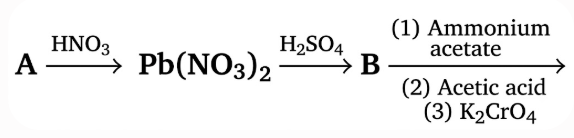
A salt with few drops of conc. HCl gives apple green colour in flame test. The group precipitate of the salt is dissolved in acetic acid and treated with K$$_2$$CrO$$_4$$ to give yellow precipitate. When the sodium carbonate extract of the salt solution is heated with conc. HNO$$_3$$ and ammonium molybdate, it resulted a canary yellow precipitate. The cation and anion present in the salt are respectively,
In salt analysis we first identify the cation.
Flame test : The solid moistened with conc. HCl gives an apple-green colour in the non-luminous flame. Among common cations only $$Ba^{2+}$$ imparts an apple-green colour (Ca$$^{2+}$$ gives brick-red, Sr$$^{2+}$$ gives crimson, Mn$$^{2+}$$ gives no characteristic colour). Hence the cation is very likely $$Ba^{2+}$$.
Confirmatory test for Ba2+ : The “group precipitate” (carbonate of the Group V cations Ba, Sr, Ca obtained with $$\left(NH_4\right)_2CO_3$$) is dissolved in dilute acetic acid and the solution is treated with $$K_2CrO_4$$. $$Ba^{2+}+CrO_4^{2-}\;\longrightarrow\;BaCrO_4\downarrow$$ Yellow precipitate of $$BaCrO_4$$ confirms the presence of $$Ba^{2+}$$ (SrCrO4 is light yellow but dissolves in acetic acid; CaCrO4 is white). Thus the cation is definitely $$Ba^{2+}$$.
Now test for the anion.
Test of the sodium-carbonate extract : The extract is boiled with conc. $$HNO_3$$ to oxidise/removal of interfering anions and then treated with ammonium molybdate solution. Formation of a canary-yellow precipitate indicates $$\left(NH_4\right)_3\left[PO_4\cdot12MoO_3\right]$$, the characteristic test for the phosphate ion $$PO_4^{3-}$$.
Thus, the salt contains the cation-anion pair $$Ba^{2+}$$ and $$PO_4^{3-}$$.
Checking the options, only Option B matches this pair.
Answer : Option B which is: $$Ba^{2+}$$ and $$PO_4^{3-}$$
Given below are two statements:
Statement I: Sodium dichromate and potassium dichromate are classified as primary standards in titrimetric analysis.
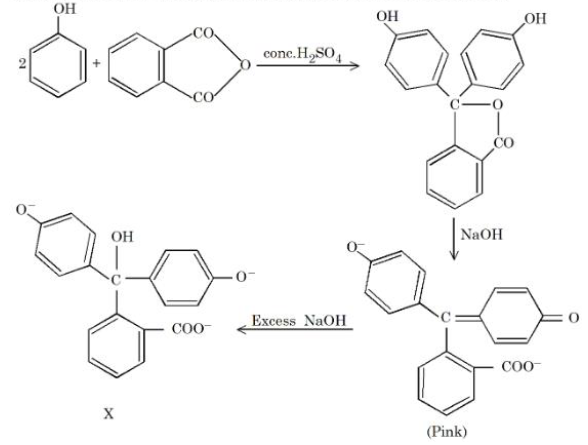
Statement II: Phenolphthalein is a weak base, therefore it dissociates in acidic medium.
In the light of the above statements, choose the correct answer from the options given below
Identify the colour of compound 'X' in the sequence of the reaction:
The purple permanganate ion $$MnO_4^-$$ is acting as an oxidising agent in the given sequence. In acidic medium it is reduced by hydrogen peroxide as follows:
$$2\,MnO_4^- + 5\,H_2O_2 + 6\,H^+ \;\longrightarrow\; 2\,Mn^{2+} + 8\,H_2O + 5\,O_2$$
The species produced after the reduction is $$Mn^{2+}$$ (compound ‘X’).
Electronic configuration of $$Mn^{2+}$$ is $$[Ar]\,3d^5$$. Although it possesses five unpaired d-electrons, d-d transitions are spin-forbidden (ΔS ≠ 0) and consequently the absorption of visible light is extremely weak; the aqueous ion appears almost colourless (very faint pink which is taken as colourless in qualitative tests).
Hence compound ‘X’ is colourless.
Option D which is: Colourless
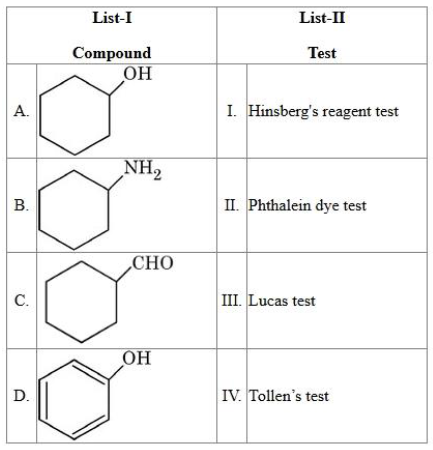
Match the List I with List II:

choose the correct answer from the options given below
The four qualitative tests named in the column on the right are routinely used for the following specific functional groups:
• Lucas test — used to distinguish primary, secondary and tertiary alcohols (appearance of turbidity).
• Hinsberg’s test — used to distinguish primary, secondary and tertiary amines (formation or non-formation of sulphonamide that dissolves in alkali).
• Tollen’s test — used to confirm the presence of an aldehyde group (formation of silver mirror/black precipitate of $$Ag$$).
• Phthalein dye test — used for phenols; phenol reacts with phthalic anhydride in the presence of conc. $$H_2SO_4$$ to give coloured phthalein dyes.
Now match each compound with the appropriate test:
Case A: Cyclohexanol contains the $$-OH$$ group on a secondary carbon, so it is identified by the Lucas test. Hence A → III.
Case B: Cyclohexylamine is a primary amine; primary amines respond to Hinsberg’s test. Hence B → I.
Case C: Cyclohexanecarbaldehyde has an aldehyde group, so it gives a positive Tollen’s test. Hence C → IV.
Case D: Phenol gives the phthalein dye (phenolphthalein) on reaction with phthalic anhydride and conc. $$H_2SO_4$$. Hence D → II.
Therefore the correct matching is:
A-III, B-I, C-IV, D-II.
Option A which is: A-III, B-I, C-IV, D-II
In an estimation of sulphur by Carius method 0.2 g of the substance gave 0.6 g of BaSO$$_4$$. The percentage of sulphur in the substance is _______%. (Given molar mass in g mol$$^{-1}$$ S: 32, BaSO$$_4$$: 231)
2.0 g of a bromo hydrocarbon $$(X)$$ was subjected to Carius analysis, gave 3.36 g of AgBr. The percentage of carbon in the compound $$(X)$$ is 26.7%. Total number of carbon atoms in the empirical formula for compound $$(X)$$ is _____.
( Given molar mass in g $$mol^{-1}H:1,C:12,O:80,Cl:108$$)
Mass of compound $$(X) = 2.0\;g$$. Under Carius halogen analysis bromine is converted to $$AgBr$$, so the moles of $$AgBr$$ produced equal the moles of $$Br$$ present.
Molar mass of $$AgBr = 108 + 80 = 188\;g\,mol^{-1}$$.
Moles of $$AgBr$$ obtained $$= \frac{3.36}{188} = 0.017872\;mol$$.
Since the ratio $$AgBr : Br$$ is $$1:1$$, moles of bromine in the sample are also $$0.017872\;mol$$.
Mass of bromine in the sample $$= 0.017872 \times 80 = 1.4298\;g$$.
Percentage of bromine $$= \frac{1.4298}{2.0}\times100 = 71.49\%$$.
Percentage of carbon is given as $$26.7\%$$, so mass of carbon in the sample $$= 0.267 \times 2.0 = 0.534\;g$$.
Moles of carbon $$= \frac{0.534}{12} = 0.0445\;mol$$.
The remaining mass is hydrogen: $$2.0 - 0.534 - 1.4298 = 0.0362\;g$$.
Moles of hydrogen $$= 0.0362\;mol$$ (atomic mass of $$H = 1$$).
Now write the mole ratio:
$$C : H : Br = 0.0445 : 0.0362 : 0.017872$$.
Divide by the smallest value $$0.017872$$:
$$C : H : Br = 2.49 : 2.03 : 1$$.
These are very close to $$2.5 : 2 : 1$$. Multiply each by $$2$$ to clear the fractional $$0.5$$ and obtain the simplest integer ratio:
$$C : H : Br = 5 : 4 : 2$$.
Therefore the empirical formula of the bromo-hydrocarbon is $$C_5H_4Br_2$$.
Hence, the total number of carbon atoms present in the empirical formula is 5.
Sodium fusion extract of an organic compound (Y) with $$CHCl_{3}$$ and chlorine water gives violet color to the $$CHCl_{3} $$ layer. 0.15g of $$(Y)$$ gave 0.12g of the silver halide precipitate in Carius method. Percentage of halogen in the compound $$(Y)$$ is _______ . (Nearest integer)
(Given : molar mass g $$mol^{-}$$ C : 12 , H : 1, Cl : 35.5, Br : 80 , I : 127)
We need to find the percentage of halogen in compound Y.
First, the halogen was identified by treating the sodium fusion extract with $$CHCl_3$$ and chlorine water, which gives a violet color to the $$CHCl_3$$ layer. This is the test for iodine, since iodine dissolves in $$CHCl_3$$ giving a violet/purple color. Hence the halogen is iodine (I), with molar mass 127 g/mol.
Next, using the Carius method data for iodine, the precipitate formed is AgI (molar mass = 108 + 127 = 235 g/mol). The mass of the compound taken was 0.15 g and the mass of AgI obtained was 0.12 g.
Therefore, the mass of iodine can be calculated as $$\text{Mass of I} = \frac{127}{235} \times 0.12 = \frac{15.24}{235} = 0.06485 \text{ g}$$.
From this, the percentage of iodine in the compound is $$\% \text{ of I} = \frac{0.06485}{0.15} \times 100 = 43.23\%$$.
The percentage of halogen is approximately $$43\%$$ to the nearest integer.
Therefore, the answer is 43.
In sulphur estimation, $$2.0 \times 10^{-3}$$ mol of an organic compound (X) (molar mass 76 g mol$$^{-1}$$) gave 0.4813 g of barium sulphate (molar mass 233 g mol$$^{-1}$$). The percentage of sulphur in the compound (X) is _________ $$\times 10^{-1}$$ % (Nearest integer)
In the BaSO$$\_4$$ method, the sulphur present in the organic compound is completely converted to BaSO$$\_4$$. So, the amount of sulphur in the precipitate equals the amount of sulphur that was originally in the sample.
Step 1 Mass of the sample taken
Moles of compound $$X = 2.0 \times 10^{-3} \text{ mol}$$
Molecular weight of $$X = 76$$
$$\text{Mass of }X = 2.0 \times 10^{-3} \times 76 = 0.152\ \text{g}$$
Step 2 Moles of BaSO$$\_4$$ obtained
Mass of BaSO$$\_4$$ obtained $$= 0.4813\ \text{g}$$
Molecular weight of BaSO$$\_4 = 233$$
$$n(\text{BaSO}_4) = \frac{0.4813}{233} = 2.066 \times 10^{-3}\ \text{mol}$$ (keep four significant figures)
Step 3 Moles and mass of sulphur present
Each mole of BaSO$$\_4$$ contains one mole of sulphur.
$$n(S) = 2.066 \times 10^{-3}\ \text{mol}$$
Atomic mass of sulphur $$= 32$$
$$m(S) = 2.066 \times 10^{-3} \times 32 = 0.0661\ \text{g}$$
Step 4 Percentage of sulphur in the compound
$$\%S = \frac{m(S)}{\text{mass of }X} \times 100$$
$$\%S = \frac{0.0661}{0.152} \times 100 = 43.46\%$$
The question requires the answer in the form $$\_\_\_ \times 10^{-1}\%$$. Writing $$43.46\%$$ as $$4.346 \times 10^{1}\%$$ and then expressing with $$10^{-1}$$ exponent gives $$4.346$$ (rounded to three significant figures $$\approx 4.35$$).
Hence the required number is 4.35.
Predict your JEE Main percentile, rank & performance in seconds
Educational materials for JEE preparation