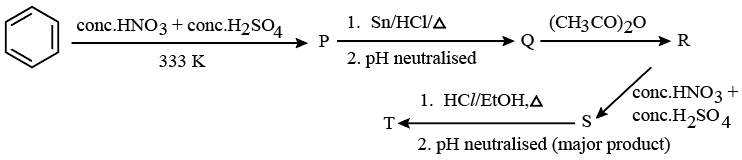
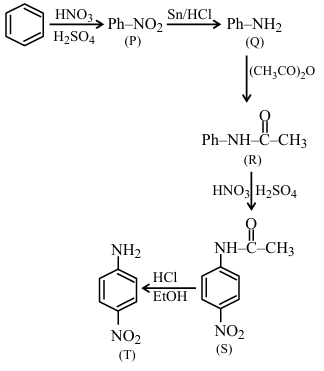
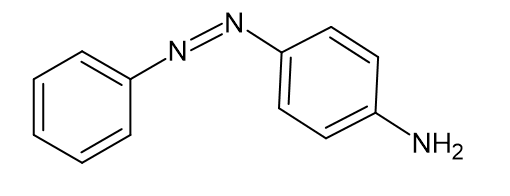
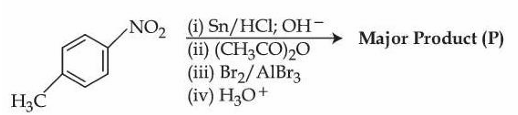
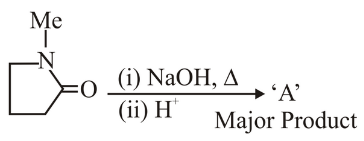
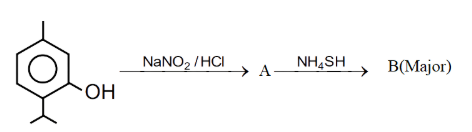
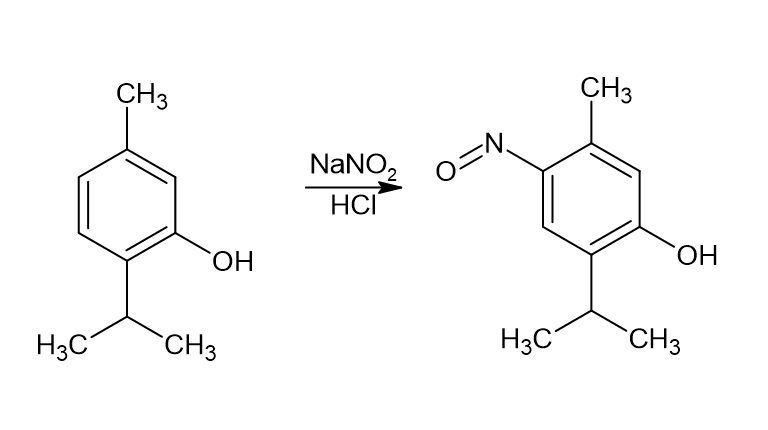
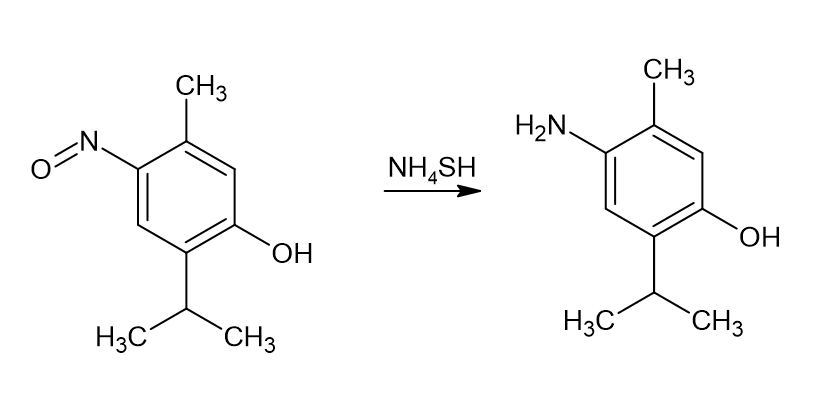
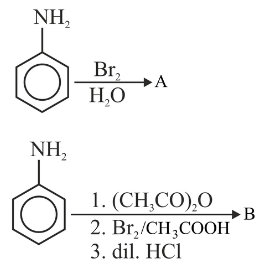
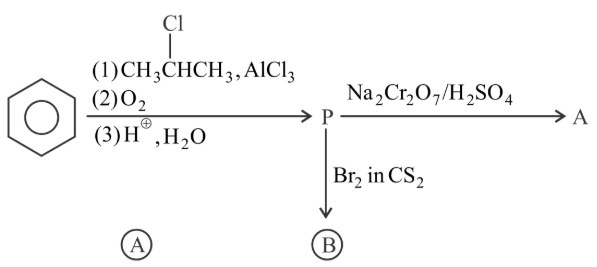
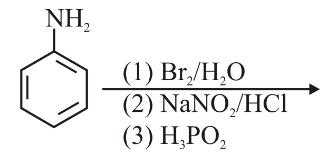
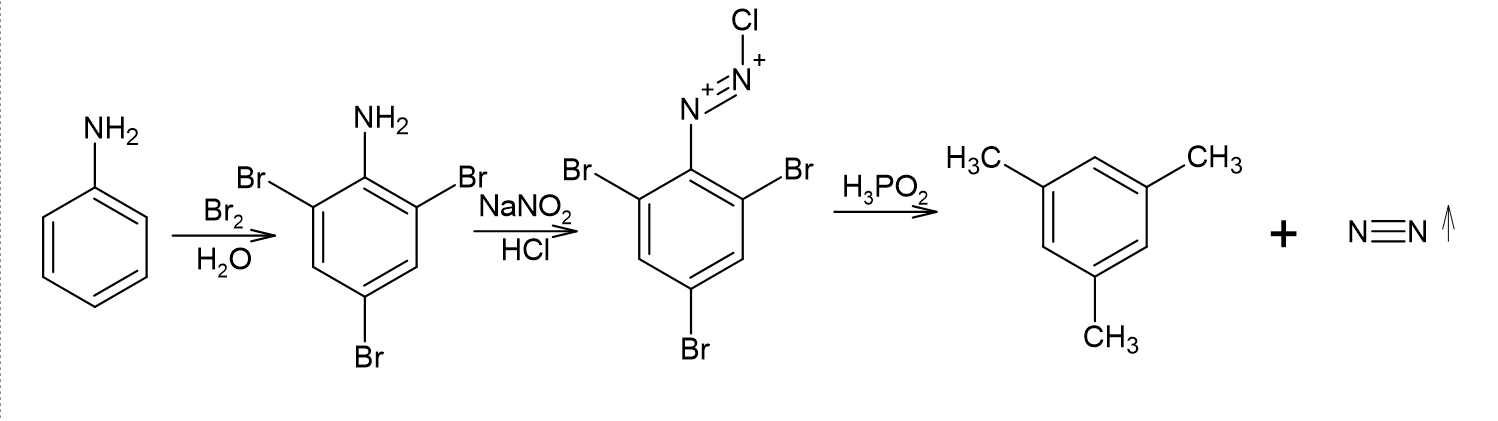
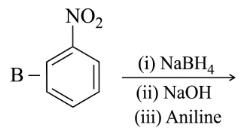
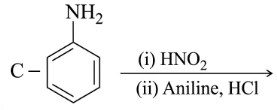
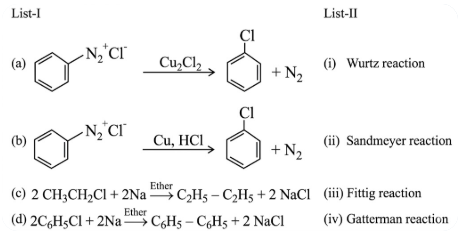
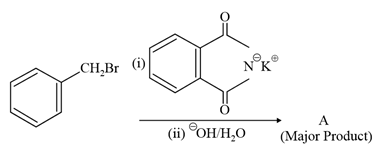
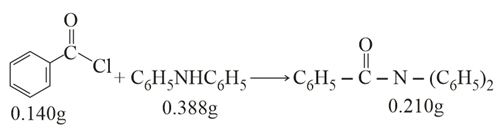
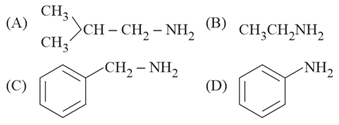
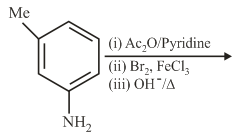
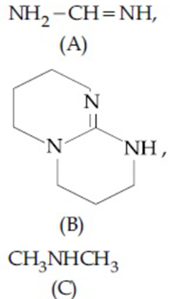
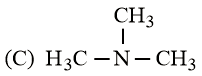
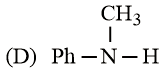
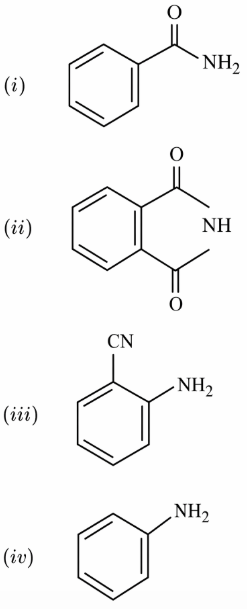
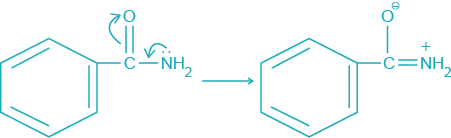
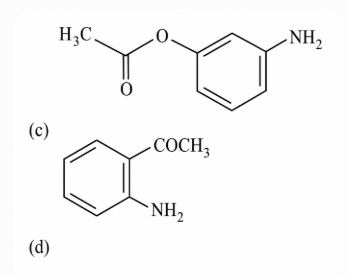
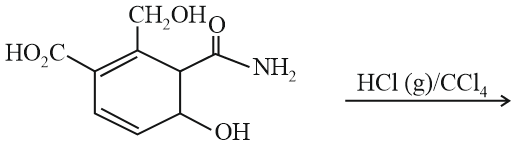
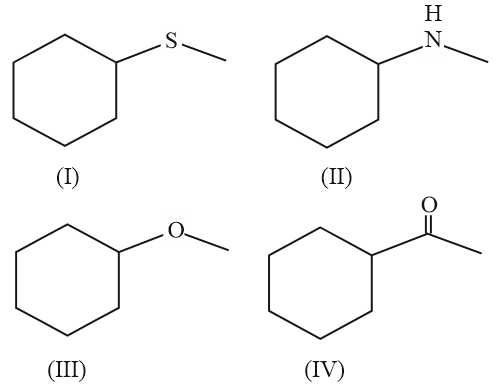
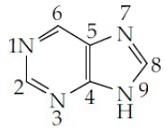
When 1 g of cmnpow1d (X) is subjected to Kjeldahl's method for estimation of nitrogen, 15 mL 1 M $$H_{2}SO_{4}$$ was neutrilized by ammonia evolved. The percentage of nitrogen in compound
(X) is :
JEE Nitrogen-Containing Compounds Questions
We need to find the percentage of nitrogen using Kjeldahl's method. Given 1 g of compound, 15 mL of 1 M $$H_2SO_4$$ is neutralised by the evolved $$NH_3$$.
In Kjeldahl's method, nitrogen in the compound is converted to ammonium sulphate, then ammonia is liberated and absorbed in excess $$H_2SO_4$$: $$2NH_3 + H_2SO_4 \rightarrow (NH_4)_2SO_4$$
Each mole of $$H_2SO_4$$ reacts with 2 moles of $$NH_3$$ (since $$H_2SO_4$$ is diprotic). Moles of $$H_2SO_4$$ = $$15 \times 10^{-3} \times 1 = 0.015$$ mol, which corresponds to Moles of $$NH_3$$ = $$2 \times 0.015 = 0.03$$ mol. Since each $$NH_3$$ contains one nitrogen atom, moles of N = 0.03 mol.
Substituting into the formula for mass gives $$\text{Mass of N} = 0.03 \times 14 = 0.42 \text{ g}$$
Therefore, the percentage of nitrogen is $$\% N = \frac{0.42}{1} \times 100 = 42\%$$
The correct answer is Option 1: 42.
A student has planned to prepare acetanilide from aniline using acetic anhydride. The student has started from 9.3 g of aniline. However, the student has managed to obtain 11 g of dry acetanilide.
The % yield of this reaction is :-
We need to find the percentage yield of acetanilide preparation from aniline.
The reaction is $$C_6H_5NH_2 + (CH_3CO)_2O \rightarrow C_6H_5NHCOCH_3 + CH_3COOH$$.
We are given that the mass of aniline is 9.3 g and its molar mass (C₆H₅NH₂) is 93 g/mol, which means the moles of aniline are 9.3/93 = 0.1 mol.
Since the stoichiometry is 1:1, the theoretical moles of acetanilide formed are also 0.1 mol. Using its molar mass (C₆H₅NHCOCH₃) of 135 g/mol, the theoretical mass of acetanilide is 0.1 × 135 = 13.5 g.
The actual yield obtained in the experiment is 11 g.
Calculating the percentage yield gives $$\% \text{ yield} = \frac{11}{13.5} \times 100 = 81.48\% \approx 81.5\%$$.
Therefore, the percentage yield is Option 2: 81.5%.
Total number of alkali insoluble solid sulphonamides obtained by reaction of given amines with Hinsberg's reagent is_______.
Aniline, N-Methylaniline, Methanamine, N,N-Dimethylmethanamine, N-Methyl methanamine, Phenylmethanamine, N-propylaniline, N-phenylaniline, N,N-Dimethylaniline, Allyl amine,Isopropyl amine
We need to find the total number of alkali‐insoluble solid sulphonamides formed by the Hinsberg reaction of the given amines.
In the Hinsberg test, primary amines (R-NH₂) react with benzenesulfonyl chloride to form sulphonamides that are soluble in alkali due to acidic N-H and are not counted; secondary amines (R₂NH) react to form sulphonamides that are insoluble in alkali because they lack an acidic N-H and are counted; tertiary amines (R₃N) do not react with Hinsberg's reagent and are not counted.
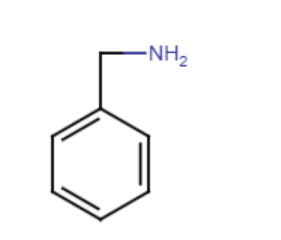
Classifying the amines, aniline (C₆H₅NH₂), methanamine (CH₃NH₂), phenylmethanamine (C₆H₅CH₂NH₂, benzylamine), allylamine (CH₂=CHCH₂NH₂), and isopropylamine ((CH₃)₂CHNH₂) are primary and form alkali‐soluble sulphonamides, so they are not counted. N,N-Dimethylmethanamine ((CH₃)₃N) and N,N-Dimethylaniline (C₆H₅N(CH₃)₂) are tertiary and do not react, and therefore are not counted. N-Methylaniline (C₆H₅NHCH₃), N-Methylmethanamine ((CH₃)₂NH), N-Propylaniline (C₆H₅NHCH₂CH₂CH₃), and N-Phenylaniline (diphenylamine, (C₆H₅)₂NH) are secondary and each gives an alkali‐insoluble sulphonamide, so they are counted.
The secondary amines N-Methylaniline, N-Methylmethanamine, N-Propylaniline, and N-Phenylaniline each give alkali‐insoluble sulphonamides, adding up to 4.
The answer is Option A: $$4$$.
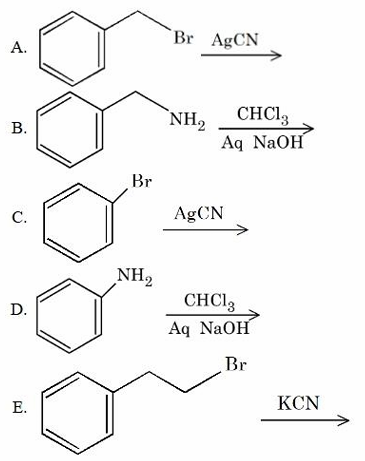
Consider the following reactions giving major product. Identify the correct reaction.
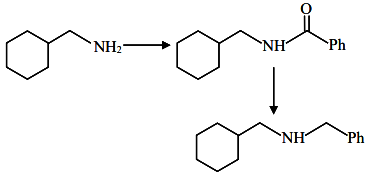
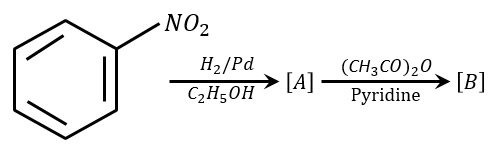
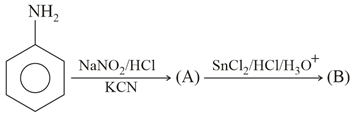
The final product [B] is :
Given compound: Cyclohexyl-CH₂-NH₂ (a primary amine)
Step 1: Reaction with C₆H₅COCl / NaOH
This is Schotten-Baumann Reaction (Acylation of amines)
What happens:
- Primary amine reacts with benzoyl chloride (C₆H₅COCl = PhCOCl)
- Forms an amide
Product [A]:
Cyclohexyl-CH₂-NHCOPh
(N-benzoyl derivative / amide)
Step 2: Reaction with LiAlH₄ / H₂O
This is Reduction of amides using LiAlH₄
What happens:
- Amides are reduced to amines
- The -CO- group is converted to -CH₂-
So:
-NHCOC₆H₅ → -NHCH₂C₆H₅
Final Product [B]:
Cyclohexyl-CH₂-CH₂-NH-CH₂-Ph
(This is a secondary amine)
Overall Reaction Summary:
- Amine → Amide
- Amide → Secondary amine
Final Answer:
B = Cyclohexyl-CH₂-NH-CH₂-Ph
A student has been given a compound "x" of molecular formula- $$C_{6}H_{7}N$$. 'x' is sparingly soluble in water. However, on addition of dilute mineral acid, 'x' becomes soluble in water. 'x' when treated with $$CHCl_{3}$$ and KOH(alc), 'Y' is produced. 'y' has a specific unpleasant smell. On treatment with benzenesulphonyl chloride, 'x' gives a compound 'z' which is soluble in alkali. The number of different "H" atoms present in 'z' is :-
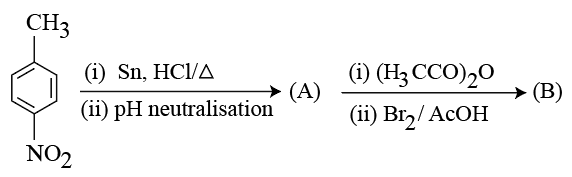
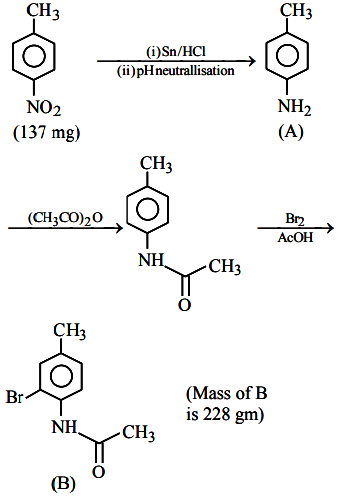
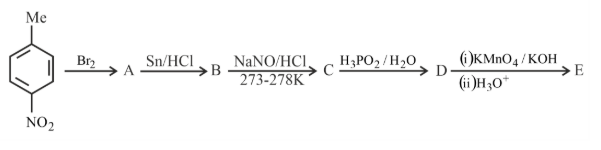
Consider the following sequence of reactions.
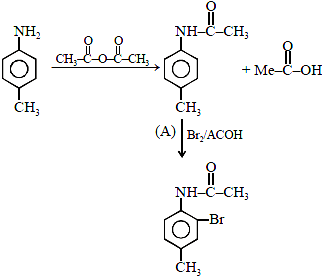
4-Nitrotoluene
Assuming that the reaction proceeds to completion, then 137 mg of 4-nitrotoluene will produce ____ mg of B.
(Given molar mass in g $$mol^{-1}$$ H : 1, C: 12, N: 14, 0: 16, Br : 80)
Moles of given compound = mass / molar mass
= $$\ \frac{\ 137\times\ 10^{-3}}{137}\ =\ 1\times\ 10^{-3}$$
= $$0.001$$ mol
All reactions (reduction → acetylation → bromination) are 1:1, so moles of product = 0.001 mol
Mass of product = moles × molar mass
= 0.001×228
= 0.228 g = 228 mg
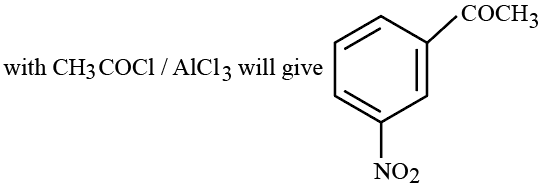
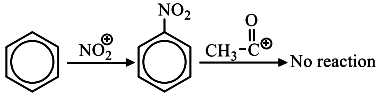
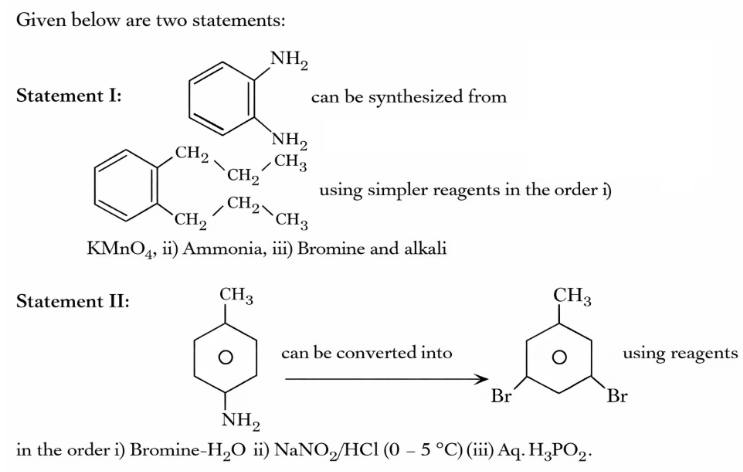
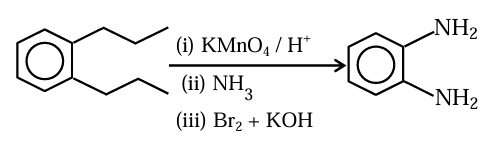
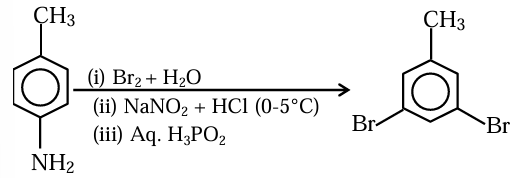
Given below are two statements:
Statement I: Benzene is nitrated to give nitrobenzene, which on further treatment
Statement II: -$$NO_{2}$$ group is a m-directing, and deactivating group.
In the light of the above statements, choose the most appropriate answer from the options given below
Satement 1
Statement 2
- $$NO_{2}$$ is strongly electron-withdrawing (-I and -M) → decreases ring electron density → deactivating
- Ortho/para attack puts + charge near -NO₂ (unstable)
- Meta avoids this instability → meta-directing
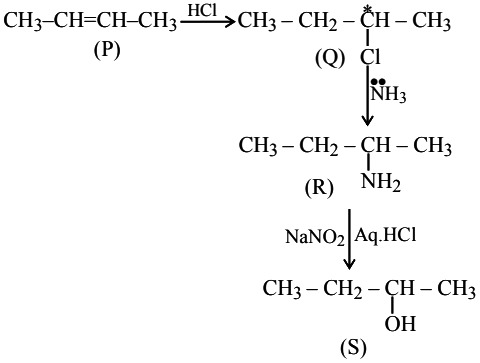
A hydrocarbon 'P' $$(C_{4}H_{8})$$ on reaction with HCl gives an optically active compound 'Cl' $$(C_{4}H_{9}Cl)$$ which on reaction with one mole of ammonia gives compound 'R' $$(C_{4}H_{11}N)$$ on diazolization followed by hydrolysis gives 'S'. Identify P, Q, Rand S.
Step 1: Identify P and Q
- P ($$C_4H_8$$) is an alkene.
- Reaction with HCl is an electrophilic addition. The product Q ($$C_4H_9Cl$$) is an alkyl chloride.
- The Clue: Q is optically active. This means Q must have a chiral center (a carbon bonded to four different groups).
- If P were But-1-ene or But-2-ene, addition of HCl would yield 2-chlorobutane.
- $$CH_3-CH_2-CHCl-CH_3$$ (2-chlorobutane) has a chiral center at $$C_2$$.
- If P were Isobutylene, it would form tert-butyl chloride, which is achiral.
- Therefore, Q is 2-chlorobutane.
Step 2: Identify R
- Q reacts with one mole of Ammonia ($$NH_3$$). This is a nucleophilic substitution ($$S_N2/S_N1$$).
- The chlorine atom is replaced by an amino group ($$-NH_2$$).
- R ($$C_4H_{11}N$$) is butan-2-amine: $$CH_3-CH_2-CH(NH_2)-CH_3$$.
Step 3: Identify S
- R undergoes diazotization ($$NaNO_2 + HCl$$), which converts the primary aliphatic amine into an unstable diazonium salt.
- Subsequent hydrolysis (reaction with water) replaces the diazonium group with a hydroxyl group ($$-OH$$), releasing nitrogen gas.
- S is butan-2-ol: $$CH_3-CH_2-CH(OH)-CH_3$$.
In the light of the above statements, choose the correct answer from the options given below
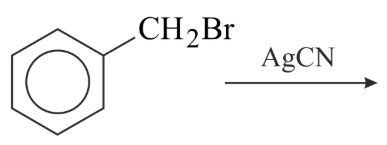
Benzyl isocyanide can be obtained from:

Choose the correct answer from the options given below:
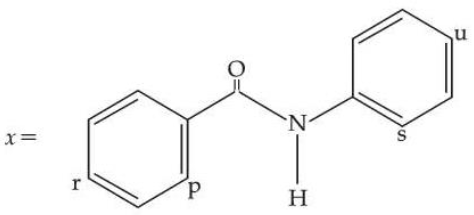
For the given molecule, "x", the preferred site for the attack of the electrophile is :
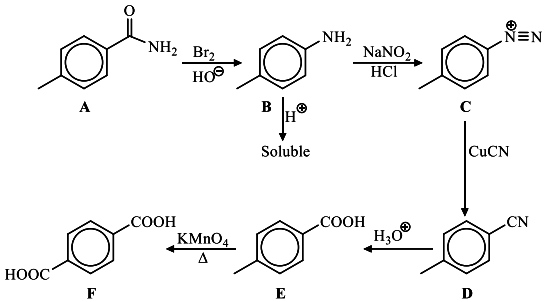
'A' is a neutral organic compound $$(M.F : C_{8}H_{9}ON)$$. On treatment with aqueous $$Br_{2}/Ho_{(-)}$$, 'A' forms a compound 'B' which is soluble in dilute acid. 'B' on treatment with aqueous $$NaNO_{2} / HCl (0-5^{o}C)$$ produces a compound 'C' which on treatment with $$CuCN/NaCN$$ produces 'D'. Hydrolysis of 'D' produces 'E' which is also obtainable from the hydrolysis of'A'. 'E' on treatment with acidified $$KMnO_{4}$$ produces 'F'. 'F' contains two different types of hydrogen atoms. The structure of 'A' is
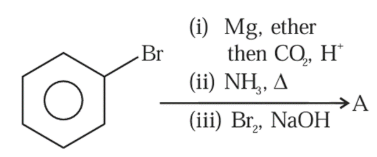
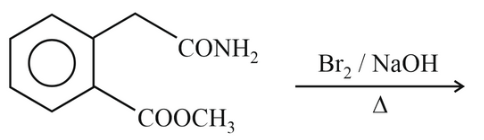
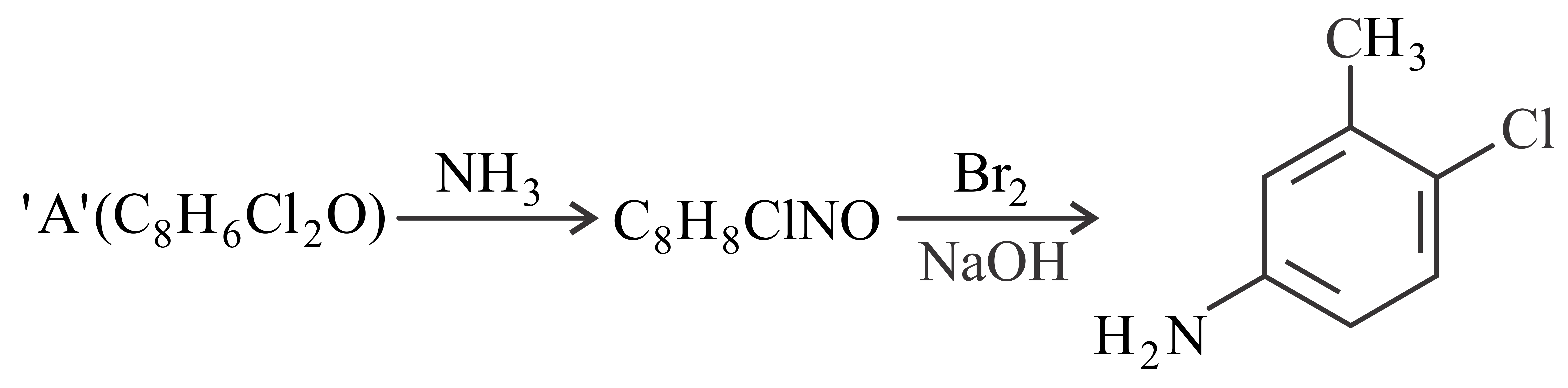
An organic compound (P) on treatment with aqueous ammonia under hot condition forms compound (Q) which on heating with $$Br_{2}$$ and KOH forms compound (R) having molecular formula $$C_{6}H_{7}N$$ Names of P, Q and R respectively are.
Organic compound P reacts with aqueous ammonia (hot) to form Q, which on Hofmann degradation (Br₂/KOH) gives R with molecular formula $$C_6H_7N$$. We need to identify P, Q, and R.
$$C_6H_7N$$ corresponds to aniline ($$C_6H_5NH_2$$): molecular formula check: 6C + 7H + 1N = $$C_6H_7N$$ $$\checkmark$$.
In Hofmann degradation, an amide ($$RCONH_2$$) is converted to an amine ($$RNH_2$$) with one fewer carbon atom:
$$ RCONH_2 + Br_2 + 4KOH \rightarrow RNH_2 + K_2CO_3 + 2KBr + 2H_2O $$
Since R is aniline ($$C_6H_5NH_2$$), Q must be benzamide ($$C_6H_5CONH_2$$), which has one more carbon than aniline.
Q (benzamide) is formed from P by reaction with aqueous ammonia under hot conditions. The reaction of a carboxylic acid with ammonia under heating produces an amide:
$$ C_6H_5COOH + NH_3 \rightarrow C_6H_5COONH_4 \xrightarrow{\Delta} C_6H_5CONH_2 + H_2O $$
Therefore, P is benzoic acid ($$C_6H_5COOH$$).
The correct answer is Option (4): Benzoic acid, benzamide, aniline.
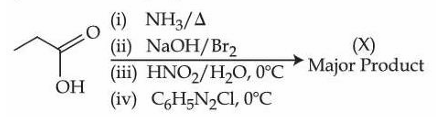
Consider the following organic reaction sequence. Choose the final product (X) from the following (consider the major product in all intermediate reactions)
Given below are two statements:
$$\textbf{Statement I :}$$ Heating benzamide with bromine in an ethanolic solution of sodium hydroxide will give benzylamine.
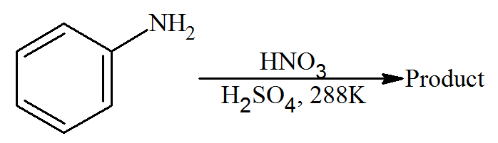
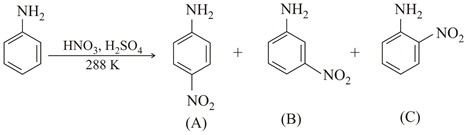
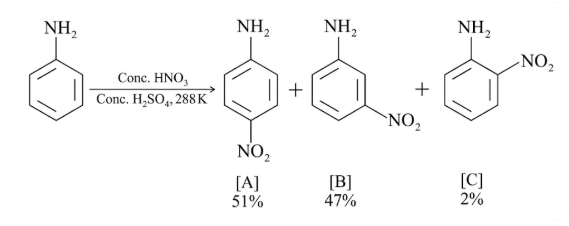
$$\textbf{Statement II :}$$ Nitration of aniline with $$\text{HNO}_3/\text{H}_2\text{SO}_4$$ at $$288\,\text{K}$$ produces $$m$$-nitroaniline in higher amount than $$o$$-nitroaniline (pH adjusted).
In the light of the above statements, choose the correct answer from the options given below:
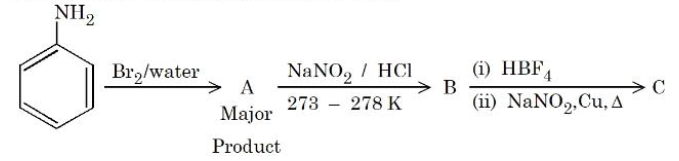
Product C of the following reaction sequence will be:
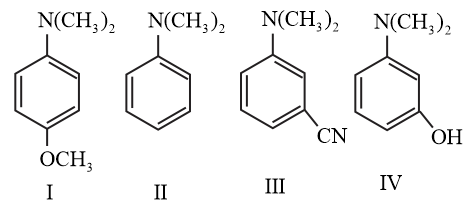
The strongest conjugate acid will result from:
The problem asks for the compound that “gives the strongest conjugate acid”.
In other words, after protonation on the nitrogen atom, which anilinium ion is most stabilised? The more stable the conjugate acid, the stronger it is, and the weaker will be its parent base.
For substituted anilines, two electronic effects decide the stability of the protonated form (the anilinium ion):
1. Inductive effect (−I or +I): An electron-withdrawing (−I) group pulls electron density away from the positively charged nitrogen, dispersing the charge and stabilising the cation.
2. Resonance (−M or +M): A group that can withdraw electrons by resonance (−M) also delocalises and stabilises the positive charge.
Let us examine each substituent in the para position:
Case A: Aniline (no substituent)
No extra stabilising effect beyond the benzene ring. So its conjugate acid serves as the reference.
Case B: p-Methoxyaniline (−OCH3)
−OCH3 has a strong +M (electron-donating) effect, pushing electron density toward the ring. This increases electron density on nitrogen in the neutral base; once the base is protonated, that extra electron density destabilises the positive charge. Hence the conjugate acid is weaker than that of aniline.
Case C: p-Nitroaniline (−NO2)
−NO2 is a very powerful −I and −M group. Both effects withdraw electron density from the ring and ultimately from the protonated nitrogen. This delocalises and stabilises the positive charge on nitrogen, making the conjugate acid highly stabilised and therefore very strong.
Case D: p-Methylaniline (−CH3)
−CH3 is weakly +I and weakly +M (hyperconjugation). These donating effects slightly increase electron density, which destabilises the cation relative to aniline. So its conjugate acid is weaker.
Comparing all four, the conjugate acid of p-nitroaniline receives the maximum stabilisation due to the strong −I and −M effects of the nitro group. Hence it is the strongest conjugate acid among the given options.
Therefore, the correct choice is:
Option C which is: p-Nitroaniline
Arrange the following compounds according to increasing order of boiling points.
n-C$$_4$$H$$_9$$OH (A), n-C$$_4$$H$$_9$$NH$$_2$$ (B), n-C$$_4$$H$$_{10}$$ (C) and C$$_2$$H$$_5$$NHC$$_2$$H$$_5$$ (D).
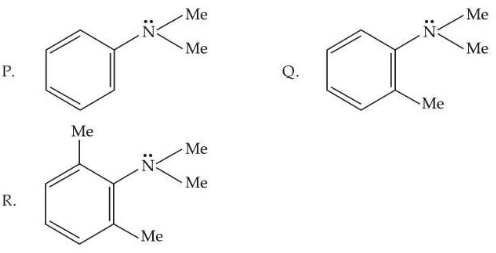
Consider the three aromatic molecules (P, Q and R) whose structures have been given below :

The correct order regarding the reactivity of these compounds with

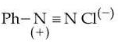
under optimum but slightly acidic medium is :
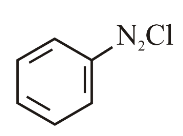
Azo-coupling with a diazonium ion $$Ph{-}N_2^+Cl^-$$ takes place at those aromatic rings which possess high electron density at the ortho / para positions.
Greater the donating power of the substituent present on the ring under the reaction conditions, faster is the coupling.
The medium recommended in the question is “optimum but slightly acidic”. Hence we must check whether the -NH2, -NMe2 and -OH groups present in compounds P, Q and R remain in their neutral (electron-donating) or protonated (electron-withdrawing) forms in such a medium.
Compound P : aniline ring (-NH2)
• pKa of anilinium ion $$\left(Ph{-}NH_3^+\right)$$ is about 4.6.
• Even in a mildly acidic solution, most molecules of P are protonated to $$Ph{-}NH_3^+$$, which is a strong meta-directing, electron-withdrawing group.
⇒ Electron density on the ring drops sharply ⇒ lowest coupling rate.
Compound Q : phenol ring (-OH)
• pKa of phenol is ≈ 10.
• In only slightly acidic medium, phenol remains largely in its neutral form $$Ph{-}OH$$ (not as $$Ph{-}OH_2^+$$).
• -OH in its neutral form exhibits a strong +M effect and activates the ring, although not as strongly as an unprotonated amino group.
⇒ Coupling rate is moderate.
Compound R : N,N-dimethylaniline ring (-NMe2)
• The lone pair on nitrogen is strongly released to the ring (+M) while two alkyl groups push electron density through +I effect.
• Protonation constant of a tertiary anilinium ion $$Ph{-}NMe_2H^+$$ is much lower than that of aniline because the electron-releasing Me groups stabilise the neutral base.
• Therefore, in slightly acidic medium, R remains mostly unprotonated and retains its very strong +M effect.
⇒ Highest electron density on ring ⇒ fastest coupling.
Putting the relative activation in order:
$$R \;(Ph{-}NMe_2) \; \gt \; Q \;(Ph{-}OH) \; \gt \; P \;(Ph{-}NH_2$$ mostly as $$Ph{-}NH_3^+)$$
Hence the reactivity sequence towards azo-coupling with $$Ph{-}N_2^+Cl^-$$ is
$$R \; \gt \; Q \; \gt \; P$$
Option C which is: R > Q > P
Identify compounds A and E in the following reaction sequence.
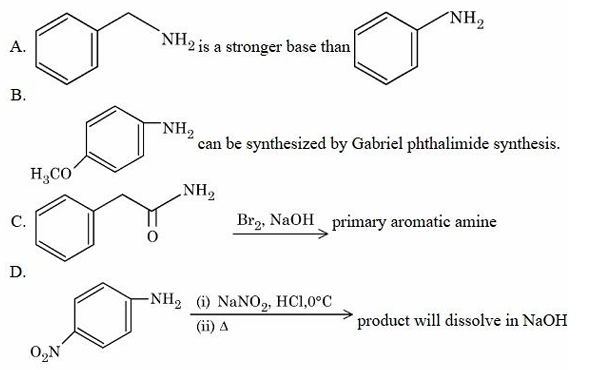
Identify the incorrect statements.

Choose the correct answer from the options given below:
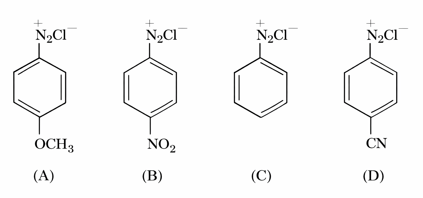
The correct stability order of the following diazonium salts is
Stability Factors
- -OCH₃ (Group A): A strong electron-donating group (+M effect). It provides the highest stability by shifting electron density toward the diazonium group.
- No substitution (Group C): Acts as the baseline for comparison.
- -CN (Group D): An electron-withdrawing group (-M, -I effect). It destabilizes the cation.
- -NO₂ (Group B): A very strong electron-withdrawing group (-M, -I effect). It causes the greatest destabilization.
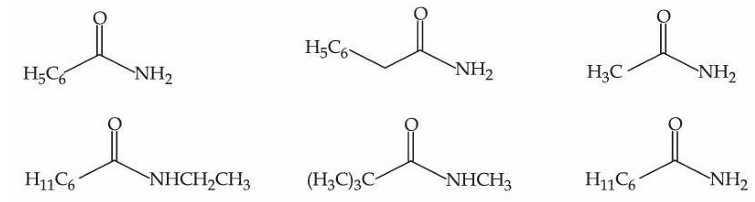
The number of compounds from the following which can undergo reaction with Br$$_2$$/KOH (alcoholic) to give respective products and these respective products can also be obtained separately by Gabriel phthalimide reaction is :
Which statements are True?
A. In Hoffmann bromamide degradation, 4 moles of NaOH and 2 moles of Br$$_2$$ are consumed per mole of an amide
B. Hoffmann bromamide reaction is not given by alkyl amides.
C. Primary amines can be synthesized by Hoffmann bromamide degradation.
D. Secondary amide on reaction with Br$$_2$$ and NaOH will give secondary amine.
E. The by-products of Hoffmann degradation are Na$$_2$$CO$$_3$$, NaBr and H$$_2$$O.
Choose the correct answer from the options given below :
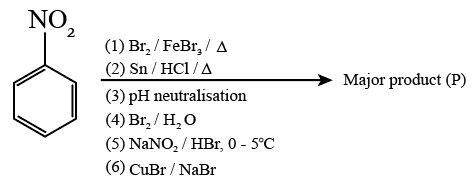
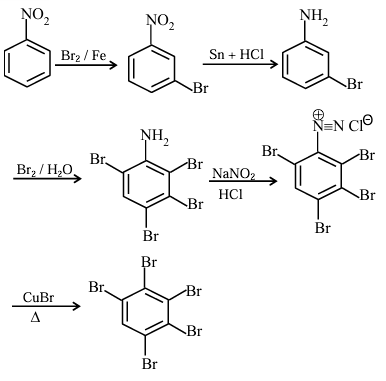
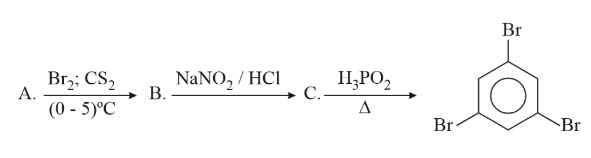
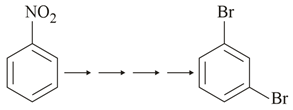
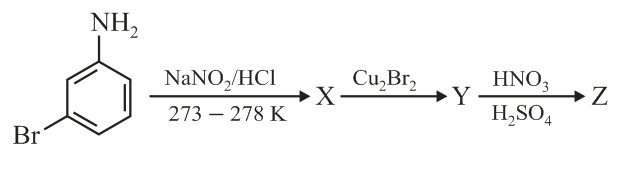
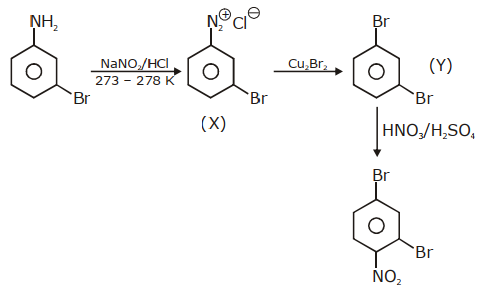
Consider the above sequence of reactions. The number of bromine atom(s) in the final product (P) will be:
Step 1: Bromination (Electrophilic Aromatic Substitution)
Reagent: Br₂ / FeBr₃
Reaction name: Halogenation
- NO₂ is meta-directing
- Bromine enters meta position
Product: m-bromonitrobenzene
Step 2: Reduction
Reagent: Sn / HCl
Reaction name: Reduction of nitro group
- NO₂ → NH₂
Product: m-bromoaniline
Step 3: Neutralisation
- Converts salt to free amine
Step 4: Bromination in water
Reagent: Br₂ / H₂O
Reaction name: Bromination of aniline
- NH₂ is strongly activating → ortho & para substitution
- Already one Br present → total becomes 3 Br added
Product: tribromoaniline derivative
Step 5: Diazotization
Reagent: NaNO₂ / HBr (0-5°C)
Reaction name: Diazotization
- NH₂ → N₂⁺
Step 6: Sandmeyer Reaction
Reagent: CuBr / NaBr
Reaction name: Sandmeyer reaction
- N₂⁺ → Br
Final Product (P):
- Initially 1 Br
- After step 4 → +3 Br = 4 Br
- After Sandmeyer → +1 Br
Total bromine atoms = 5
Final Answer:
Number of bromine atoms = 5
Consider the following reaction sequence
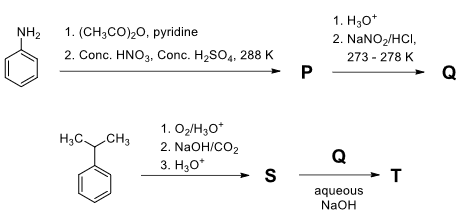
The percentage of nitrogen in product 'T' formed is ____ %. (Nearest integer)
(Given molar mass in g $$mol^{-1}$$ H : 1, C: 12, N : 14, 0: 16)
Mol. wt. = $$6\times\ 12+(6\times\ 1)+(2\times\ 14)+(2\times\ 16)=138$$
% N =$$\frac{\ 28}{138}\times\ 100$$ = 20.29 %
Nearest integer = 20%
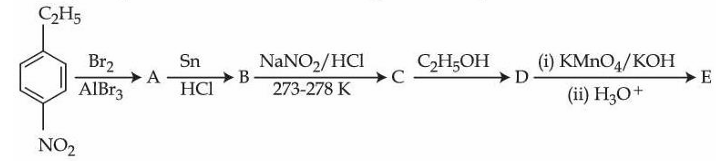
Consider the following sequence of reactions.
The percentage of nitrogen in the yellow product (X) formed is _______ %. (Nearest Integer)
(Given Molar mass in g mol$$^{-1}$$ H:1, C:12, N:14)
In Dumas method for estimation of nitrogen, 0.50 g of an organic compound gave 70 mL of nitrogen collected at 300 K and 715 mm pressure. The percentage of nitrogen in the organic compound is __ %.
(Aqueous tension at 300 K is 15 mm).
We need to find the percentage of nitrogen in an organic compound using Dumas method.
Given mass of compound = 0.50 g, volume of $$N_2$$ collected = 70 mL, temperature = 300 K, pressure = 715 mm Hg, aqueous tension at 300 K = 15 mm Hg.
The actual pressure of dry nitrogen is obtained by subtracting the aqueous tension from the total pressure: $$P_{N_2} = P_{total} - P_{water} = 715 - 15 = 700 \text{ mm Hg}$$.
To convert the collected volume to STP conditions, we use the relation $$\frac{P_1V_1}{T_1} = \frac{P_2V_2}{T_2}$$ with $$P_2 = 760$$ mm Hg and $$T_2 = 273$$ K. Thus, $$V_{STP} = \frac{700 \times 70 \times 273}{760 \times 300} = \frac{13377000}{228000} = 58.67 \text{ mL}$$.
At STP, 22400 mL of $$N_2$$ has a mass of 28 g, so the mass of the collected nitrogen is $$\text{Mass of } N_2 = \frac{28 \times 58.67}{22400} = \frac{1642.76}{22400} = 0.07333 \text{ g}$$.
The percentage of nitrogen in the compound is then $$\% N = \frac{0.07333}{0.50} \times 100 = 14.67\%$$.
Rounding to the nearest integer: $$\% N \approx$$ 15%.
Consider the following reactions sequence.

When the product (P) is subjected to Carius analysis using AgNO$$_3$$, 1.0 g of the product (P) will produce _____ g of the precipitate of AgBr. (Nearest Integer)
(Given: molar mass in g mol$$^{-1}$$ C: 12, H: 1, O: 16, N: 14, Br: 80, Ag: 108)
Step 1 : Reduction of the nitro group
$$4\text{-methyl-}NO_2\text{-benzene}
\xrightarrow[\;OH^-]{Sn/HCl} 4\text{-methyl aniline }(p\text{-toluidine})$$
Step 2 : Acetylation of the amino group (protection)
$$p\text{-toluidine}\xrightarrow{(CH_3CO)_2O}
p\text{-methyl acetanilide }( -NHCOCH_3 )$$
Step 3 : Electrophilic bromination
In acetanilide the $$-NHCOCH_3$$ group is ortho-/para-directing.
The para position is already occupied by $$-CH_3$$, so bromine enters one of the two ortho positions; steric factors give the single major product.
Major brominated product after step 3:
$$\text{2-bromo-4-methyl acetanilide}$$
Step 4 : Hydrolytic deprotection
$$\text{2-bromo-4-methyl acetanilide} \xrightarrow{H_3O^+}
\text{2-bromo-4-methyl aniline}$$
Thus the final compound (P) is 2-bromo-4-methyl aniline.
Step 5 : Molecular formula and molar mass of (P)
Ring carbons: 6, extra methyl carbon: 1 ⇒ $$C_7$$
Ring hydrogens: 3 (after three substitutions) + methyl H: 3 + amino H: 2 ⇒ $$H_8$$
One nitrogen and one bromine ⇒ $$N_1Br_1$$
Molecular formula: $$C_7H_8BrN$$
Molar mass (g mol$$^{-1}$$): $$7(12) + 8(1) + 80 + 14 = 84 + 8 + 80 + 14 = 186$$
Step 6 : Carius (halogen) analysis
Each mole of compound has one Br atom, giving one mole of $$AgBr$$.
Molar mass of $$AgBr = 108 + 80 = 188\text{ g mol}^{-1}$$
Moles of (P) in 1.0 g sample:
$$n = \frac{1.0}{186} = 5.38\times10^{-3}\;\text{mol}$$
Mass of $$AgBr$$ formed:
$$m = n \times 188 = (5.38\times10^{-3})\times188 \approx 1.01\text{ g}$$
Nearest integer = 1 g.
Final Answer: 1
The mass of benzanilide obtained from the benzoylation reaction of 5.8 g of aniline, if yield of product is 82%, is ____ g (nearest integer) .
(Given molar mass in g $$mol^{-1}$$ H : 1, C: 12, N: 14, O : 16)
We are asked to find the mass of benzanilide obtained from the benzoylation of 5.8 g of aniline with 82% yield.
The benzoylation of aniline (Schotten-Baumann reaction) produces benzanilide according to the equation $$\text{C}_6\text{H}_5\text{NH}_2 + \text{C}_6\text{H}_5\text{COCl} \rightarrow \text{C}_6\text{H}_5\text{CONHC}_6\text{H}_5 + \text{HCl}$$ and since one mole of aniline yields one mole of benzanilide, the stoichiometry is 1:1.
The molar mass of aniline ($$\text{C}_6\text{H}_5\text{NH}_2$$) is calculated as $$6(12) + 5(1) + 14 + 2(1) = 72 + 5 + 14 + 2 = 93 \, \text{g/mol}$$ and the molar mass of benzanilide ($$\text{C}_6\text{H}_5\text{CONHC}_6\text{H}_5$$) is $$13(12) + 11(1) + 14 + 16 = 156 + 11 + 14 + 16 = 197 \, \text{g/mol}$$.
The number of moles of aniline is given by $$\text{Moles of aniline} = \frac{5.8}{93} = 0.06237 \, \text{mol}$$.
Since the reaction is 1:1, the theoretical moles of benzanilide are also 0.06237 mol, and the theoretical mass is $$\text{Theoretical mass} = 0.06237 \times 197 = 12.287 \, \text{g}$$.
Applying the 82% yield gives an actual mass of $$\text{Actual mass} = \text{Theoretical mass} \times \frac{\text{yield}}{100} = 12.287 \times \frac{82}{100}$$ and thus $$\text{Actual mass} = 12.287 \times 0.82 = 10.075 \, \text{g}$$.
Finally, rounding to the nearest integer gives $$\approx 10 \, \text{g}$$.
The answer is 10.
The heating of NH$$_4$$NO$$_2$$ at 60-70 $$^\circ$$C and NH$$_4$$NO$$_3$$ at 200-250 $$^\circ$$C is associated with the formation of nitrogen containing compounds X and Y, respectively. X and Y, respectively, are
When an ammonium salt contains the oxidising anion of the same oxidation state as the reducing cation (NH$$^{+}_{4}$$), gentle heating often brings about an internal redox (disproportionation) in which nitrogen changes its oxidation state and water is expelled. The exact product depends on the anion present.
Case 1 : Heating NH$$_{4}$$NO$$_{2}$$ at 60-70 $$^\circ$$C
The anion here is nitrite, $$NO_{2}^{-}$$. When warmed, ammonium nitrite undergoes complete internal oxidation-reduction forming molecular nitrogen and water:
$$\mathrm{NH_{4}NO_{2} \;\xrightarrow[\;60\;-\;70^\circ C\;]\; N_{2} + 2\,H_{2}O}$$
Thus compound X is $$\mathbf{N_{2}}$$.
Case 2 : Heating NH$$_{4}$$NO$$_{3}$$ at 200-250 $$^\circ$$C
The anion is nitrate, $$NO_{3}^{-}$$. At about 200-250 $$^\circ$$C, ammonium nitrate similarly decomposes, but because the nitrate ion is a stronger oxidising agent, the oxidation state change stops at +1, producing nitrous oxide (laughing gas) instead of $$N_{2}$$:
$$\mathrm{NH_{4}NO_{3} \;\xrightarrow[\;200\;-\;250^\circ C\;]\; N_{2}O + 2\,H_{2}O}$$
Therefore compound Y is $$\mathbf{N_{2}O}$$.
Comparing with the given options, X = $$N_{2}$$ and Y = $$N_{2}O$$ correspond to Option A.
Answer : Option A which is: $$N_{2}$$ and $$N_{2}O$$
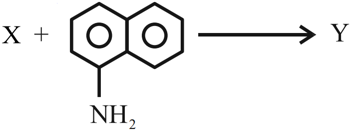
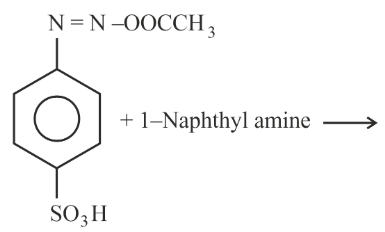
When a concentrated solution of sulphanilic acid and 1-naphthylamine is treated with nitrous acid (273 K) and acidified with acetic acid, the mass (g) of 0.1 mole of product formed is :
(Given molar mass in g mol$$^{-1}$$ H : 1, C : 12, N : 14, O : 16, S : 32)
When Ethane-1,2-diamine is added progressively to an aqueous solution of Nickel (II) chloride, the sequence of colour change observed will be :
When ethane-1,2-diamine (ethylenediamine, abbreviated as "en") is added progressively to an aqueous solution of nickel(II) chloride ($$NiCl_2$$), the following stepwise complexation occurs:
$$NiCl_2$$ dissolves in water to form $$[Ni(H_2O)_6]^{2+}$$, which is green in colour. This is an octahedral complex where the d-d transitions in $$Ni^{2+}$$ ($$d^8$$) with weak-field water ligands produce a green colour.
$$[Ni(H_2O)_6]^{2+} + en \rightarrow [Ni(en)(H_2O)_4]^{2+} + 2H_2O$$
As the stronger field ligand "en" replaces two water molecules, the crystal field splitting increases slightly, shifting the absorption and producing a pale blue colour.
$$[Ni(en)(H_2O)_4]^{2+} + en \rightarrow [Ni(en)_2(H_2O)_2]^{2+} + 2H_2O$$
With further increase in field strength, the complex turns blue.
$$[Ni(en)_2(H_2O)_2]^{2+} + en \rightarrow [Ni(en)_3]^{2+} + 2H_2O$$
The tris(ethylenediamine)nickel(II) complex has the highest crystal field splitting in this series, producing a violet colour.
The observed colour sequence is: Green $$\rightarrow$$ Pale Blue $$\rightarrow$$ Blue $$\rightarrow$$ Violet.
The correct answer is Option 3.
Identify correct statements : (A) Primary amines do not give diazonium salts when treated with $$NaNO_{2}$$ in acidic condition. (B) Aliphatic and aromatic primary amines on heating with $$CHCl_{3}$$and ethanolic KOH form carbylamines. (C) Secondary and tertiary amines also give carbylamine test. (D) Benzenesulfonyl chloride is known as Hinsberg's reagent. (E) Tertiary amines reacts with benzenesulfonyl chloride very easily. Choose the correct answer from the options given below :
We examine each statement in turn.
Statement (A): “Primary amines do not give diazonium salts when treated with $$NaNO_{2}$$ in acidic condition.”
An aromatic primary amine undergoes diazotization as follows:
$$ArNH_{2} + NaNO_{2} + 2HCl \xrightarrow{0-5^\circ C} ArN_{2}^{+}Cl^{-} + 2H_{2}O \quad-(1)$$
Aliphatic primary amines give unstable diazonium salts that decompose immediately, but aromatic primary amines do give stable diazonium salts under cold acidic conditions. Therefore the blanket statement “primary amines do not give diazonium salts” is false.
Statement (B): “Aliphatic and aromatic primary amines on heating with $$CHCl_{3}$$ and ethanolic KOH form carbylamines.”
The carbylamine (isocyanide) test is:
$$RNH_{2} + CHCl_{3} + 3KOH \xrightarrow{heat} RNC + 3KCl + 3H_{2}O \quad-(2)$$
Both aliphatic and aromatic primary amines give the foul-smelling isocyanide, so statement (B) is correct.
Statement (C): “Secondary and tertiary amines also give carbylamine test.”
Only primary amines have an N-H proton to form the isocyanide. Secondary and tertiary amines do not give this test. Thus statement (C) is false.
Statement (D): “Benzenesulfonyl chloride is known as Hinsberg’s reagent.”
By definition, benzenesulfonyl chloride (PhSO₂Cl) is the Hinsberg reagent used to distinguish amine classes. Hence statement (D) is correct.
Statement (E): “Tertiary amines react with benzenesulfonyl chloride very easily.”
Tertiary amines lack an N-H proton and therefore do not form sulfonamides with PhSO₂Cl. They only form ammonium salts with HCl byproduct:
$$R_{3}N + HCl \rightarrow R_{3}NH^{+}Cl^{-} \quad-(3)$$
Thus statement (E) is false.
Therefore the only correct statements are (B) and (D).
The correct answer is Option C: (B) and (D) only.
The steam volatile compounds among the following are :
(A)

(B)

(C)

(D)

Choose the correct answer from the options given below :
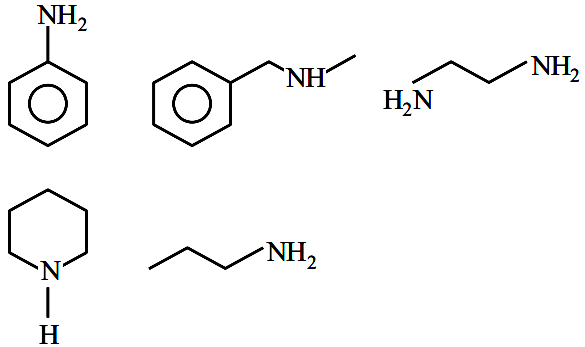
Which among the following react with Hinsberg's reagent?
Choose the correct answer from the options given below:
Which one of the following reaction sequences will give an azo dye?
The major product (A) formed in the following reaction sequence is:
Nitrobenzene $$\xrightarrow{(i) Sn, HCl}$$ $$\xrightarrow{(ii) Ac_2O, Pyridine}$$ $$\xrightarrow{(iii) Br_2, AcOH}$$ $$\xrightarrow{(iv) NaOH(aq)}$$ A
The descending order of basicity of following amines is :

Choose the correct answer from the options given below :
The basicity of an amine depends on how easily the lone pair on the nitrogen can accept a proton. Greater electron density on N and better stabilization of the resulting ammonium ion both increase basicity.
Important effects that decide electron density on nitrogen are:
(i) Inductive effect ($$+I$$ or $$-I$$) from alkyl/aryl substituents.
(ii) Resonance (mesomeric) effect ($$+M$$ or $$-M$$) that may delocalize or donate electron density.
(iii) Hybridisation of the nitrogen (sp$$^3$$ in aliphatic > sp$$^2$$ in aromatic for basicity).
Case 1: Aliphatic amines
$$CH_3NH_2$$ (D) is a primary aliphatic amine.
$$(CH_3)_2NH$$ (E) is a secondary aliphatic amine.
Alkyl groups exhibit a $$+I$$ effect. Two alkyl groups in E push more electron density toward N than one alkyl group in D. In aqueous medium, secondary > primary for basicity (tertiary suffers from poor solvation).
Hence $$\text{basicity: } E \gt D$$.
Case 2: Aromatic amines (anilines)
In aniline, the lone pair on N is partly delocalised into the benzene ring by resonance, making it less available for protonation; therefore aniline is less basic than aliphatic amines.
(A) Aniline - no extra substituent.
(B) p-MeO-Aniline - $$\text{MeO}$$ group shows a strong $$+M$$ (electron-donating) effect, increasing electron density on the ring and on N through resonance, so it is more basic than aniline.
(C) p-NO$$_2$$-Aniline - $$NO_2$$ group shows a powerful $$-M$$ (electron-withdrawing) effect, withdrawing electron density from the ring and N, thus making the amine much less basic.
Therefore, among the three anilines: $$\text{basicity: } B \gt A \gt C$$.
Combining both sets
Overall descending basicity order becomes:
$$(CH_3)_2NH \;(E) \gt CH_3NH_2 \;(D) \gt p\text{-}MeO\text{-Aniline} \;(B) \gt \text{Aniline} \;(A) \gt p\text{-}NO_2\text{-Aniline} \;(C)$$
This matches Option B.
Answer: Option B (E > D > B > A > C).
Identify [A], [B], and [C], respectively in the following reaction sequence :
Given below are two statements I and II. Statement I: Dumas method is used for estimation of "Nitrogen" in an organic compound. Statement II: Dumas method involves the formation of ammonium sulphate by heating the organic compound with conc $$H_2 SO_4 $$. In the light of the above statements, choose the correct answer from the options given below
Statement I: Dumas method is used for estimation of nitrogen in an organic compound.
This is true. The Dumas method involves heating the organic compound with copper oxide (CuO) in an atmosphere of $$CO_2$$, which converts nitrogen in the compound to $$N_2$$ gas. The volume of $$N_2$$ collected is measured to estimate the nitrogen content.
Statement II: Dumas method involves the formation of ammonium sulphate by heating the organic compound with concentrated $$H_2SO_4$$.
This is false. The description in Statement II corresponds to the Kjeldahl method, not the Dumas method. In the Kjeldahl method, the organic compound is heated with concentrated $$H_2SO_4$$, which converts nitrogen to ammonium sulphate. The Dumas method uses CuO, not $$H_2SO_4$$.
The answer is Option A: Statement I is true but Statement II is false.
In the following reactions, which one is NOT correct?
The correct order of basic nature on aqueous solution for the bases $$NH_3$$, $$H_2N-NH_2$$, $$CH_3CH_2NH_2$$, $$(CH_3CH_2)_2NH$$ and $$(CH_3CH_2)_3N$$ is:
We need to arrange the following bases in increasing order of basic nature in aqueous solution: $$NH_3$$, $$H_2N-NH_2$$, $$CH_3CH_2NH_2$$, $$(CH_3CH_2)_2NH$$, and $$(CH_3CH_2)_3N$$.
The basicity of amines in aqueous solution depends on two main factors:
(i) The inductive effect (+I effect) of alkyl groups, which increases electron density on nitrogen and increases basicity.
(ii) The solvation of the conjugate acid (ammonium ion) by water molecules through hydrogen bonding, which stabilises the conjugate acid and increases basicity.
Step 1: Compare $$H_2N-NH_2$$ (hydrazine) and $$NH_3$$
In hydrazine, the lone pair on one nitrogen is partially withdrawn by the adjacent electronegative $$NH_2$$ group (due to the -I effect of the $$-NH_2$$ group). This makes hydrazine a weaker base than ammonia.
So: $$H_2N-NH_2 \lt NH_3$$
Step 2: Compare alkylamines with $$NH_3$$
All ethylamines (primary, secondary, and tertiary) are more basic than $$NH_3$$ because the ethyl group donates electron density to nitrogen via the +I effect.
So: $$NH_3 \lt CH_3CH_2NH_2$$, $$(CH_3CH_2)_2NH$$, $$(CH_3CH_2)_3N$$
Step 3: Order among the ethylamines in aqueous solution
In aqueous solution, the observed basicity order among ethylamines is:
$$(CH_3CH_2)_2NH \gt CH_3CH_2NH_2 \gt (CH_3CH_2)_3N$$
This is because:
- Secondary amines like $$(CH_3CH_2)_2NH$$ have a good balance of +I effect (two alkyl groups) and solvation ability (one N-H bond available for hydrogen bonding).
- Primary amines like $$CH_3CH_2NH_2$$ have fewer alkyl groups but better solvation (two N-H bonds).
- Tertiary amines like $$(CH_3CH_2)_3N$$ have the strongest +I effect (three alkyl groups) but poor solvation of the conjugate acid due to steric hindrance and only one site for H-bonding, which reduces their basicity in water.
Step 4: Final order
Combining all comparisons, the increasing order of basic nature in aqueous solution is:
$$$H_2N-NH_2 \lt NH_3 \lt (CH_3CH_2)_3N \lt CH_3CH_2NH_2 \lt (CH_3CH_2)_2NH$$$Hence, the correct answer is Option C.
The products formed in the following reaction sequence are :
For reaction
The correct order of set of reagents for the above conversion is :
The sequence from the following that would result in giving predominantly 3,4,5-Tribromoaniline is:
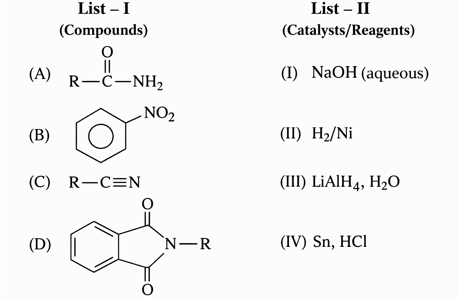
Match the Compounds (List - I) with the appropriate Catalyst/Reagents (List - II) for their reduction into corresponding amines.
Choose the correct answer from the options given below :
(A) Amide $$\rightarrow$$ (III) $$LiAlH_4$$
- Why this reagent: $$LiAlH_4$$ is a powerful nucleophilic reducing agent capable of reducing the highly stable $$C=O$$ bond of an amide all the way to a $$CH_2$$ group to yield a primary amine.
- Why others fail: $$H_2/Ni$$ is usually not strong enough to reduce amides efficiently under standard conditions. $$Sn/HCl$$ is specifically used for nitro groups and won't touch the amide carbonyl. $$NaOH$$ would simply cause hydrolysis to a carboxylate salt and ammonia, not reduction.
(B) Nitrobenzene $$\rightarrow$$ (IV) $$Sn, HCl$$
- Why this reagent: This is a classic laboratory method for preparing aniline. The metal/acid combination ($$Sn/HCl$$ or $$Fe/HCl$$) provides the protons and electrons necessary to reduce $$-NO_2$$ to $$-NH_2$$.
- Why others fail: While $$H_2/Ni$$ could technically work, $$Sn/HCl$$ is the preferred "textbook" match for aromatic nitro compounds in this list. $$LiAlH_4$$ is avoided for aromatic nitro compounds because it can lead to azo compounds (coupling) rather than pure amines.
(C) Nitrile $$\rightarrow$$ (II) $$H_2/Ni$$
- Why this reagent: Catalytic hydrogenation is the most efficient way to add four hydrogen atoms across the $$C\equiv N$$ triple bond to produce a primary amine ($$R-CH_2NH_2$$).
- Why others fail: $$NaOH$$ would hydrolyze the nitrile to an amide and then a carboxylic acid. $$Sn/HCl$$ is not the standard reagent for full nitrile reduction (it is used in the Stephen reduction to stop at the aldehyde, but only with $$SnCl_2$$).
(D) Phthalimide $$\rightarrow$$ (I) $$NaOH$$
- Why this reagent: This refers to the final step of the Gabriel Phthalimide Synthesis. Once an alkyl group is attached to the nitrogen, base-catalyzed hydrolysis ($$NaOH$$) is used to break the cyclic imide bonds and release the primary amine.
- Why others fail: The goal here is "cleavage" to release the amine, not "reduction" of the aromatic ring or carbonyls. Reducing agents like $$LiAlH_4$$ or $$H_2/Ni$$ would attack the carbonyl groups of the phthalimide ring itself, destroying the starting material instead of releasing the desired amine.
In The following substitution reaction :

product 'P'formed is :
Given below are some nitrogen containing compounds

Each of them is treated with HCl separately. 1.0 g of the most basic compound will consume _______ mg of HCl. (Given molar mass in $$gmol^{-1}$$ C : 12, H : 1, O : 16, Cl : 35.5)
Consider the following sequence of reactions :

Molar mass of the product formed (A) is ______$$gmol^{-1}$$.
Consider the following sequence of reactions to produce major product (A)
Molar mass of product (A) is $$gmol^{-1}$$. (Given molar mass in $$gmol^{-1}$$ of C : 12, H : 1, O : 16, Br : 80, N : 14, P : 31)
Consider the following sequence of reactions.

Total number of $$sp^{3}$$ hybridised carbon atoms in the major product C formed is________
Identify the correct statements about p-block elements and their compounds. (A) Non metals have higher electronegativity than metals. (B) Non metals have lower ionisation enthalpy than metals. (C) Compounds formed between highly reactive nonmetals and highly reactive metals are generally ionic. (D) The non-metal oxides are generally basic in nature. (E) The metal oxides are generally acidic or neutral in nature. Choose the correct answer from the options given below :
We need to identify the correct statements about p-block elements and their compounds from the given list.
Analysis of each statement:
(A) Non-metals have higher electronegativity than metals.
This is TRUE. Electronegativity is the tendency of an atom to attract shared electrons towards itself. Non-metals, being on the right side of the periodic table, have higher electronegativity because they need fewer electrons to complete their octet and have smaller atomic sizes.
(B) Non-metals have lower ionisation enthalpy than metals.
This is FALSE. Non-metals generally have higher ionisation enthalpy than metals. Non-metals hold their electrons more tightly due to their smaller atomic size and higher effective nuclear charge, making it harder to remove an electron.
(C) Compounds formed between highly reactive non-metals and highly reactive metals are generally ionic.
This is TRUE. Highly reactive metals (like Na, K) have very low ionisation enthalpies and readily lose electrons, while highly reactive non-metals (like F, Cl) have high electron affinity and readily gain electrons. The large electronegativity difference between them leads to the formation of ionic bonds through complete transfer of electrons.
(D) The non-metal oxides are generally basic in nature.
This is FALSE. Non-metal oxides are generally acidic in nature. For example, $$CO_2$$ forms carbonic acid, $$SO_3$$ forms sulphuric acid, $$P_4O_{10}$$ forms phosphoric acid when dissolved in water.
(E) The metal oxides are generally acidic or neutral in nature.
This is FALSE. Metal oxides are generally basic in nature. For example, $$Na_2O$$, $$CaO$$, $$MgO$$ are all basic oxides that form hydroxides when dissolved in water.
The correct statements are (A) and (C) only.
The correct answer is Option (2): (A) and (C) only.
Given below are two statements :
Statement I : In group 13, the stability of +1 oxidation state increases down the group.
Statement II : The atomic size of gallium is greater than that of aluminium.
In the light of the above statements, choose the most appropriate answer from the options given below :
Statement I: In group 13, the stability of +1 oxidation state increases down the group.
This is correct due to the inert pair effect. As we go down the group, the $$ns^2$$ electrons become less available for bonding, making the +1 state more stable. Tl predominantly shows +1 state. ✓
Statement II: The atomic size of gallium is greater than that of aluminium.
Due to d-block contraction (poor shielding by 3d electrons), Ga has a smaller atomic radius than Al. The actual order is Al (143 pm) > Ga (135 pm). Statement II is incorrect. ✗
The correct answer is Option (4): Statement I is correct but Statement II is incorrect.
Match List - I with List - II.
Choose the correct answer from the options given below :
The number of ions from the following that are expected to behave as oxidising agent is : $$Sn^{4+}, Sn^{2+}, Pb^{2+}, Tl^{3+}, Pb^{4+}, Tl^{+}$$
We need to identify how many ions from $$Sn^{4+}, Sn^{2+}, Pb^{2+}, Tl^{3+}, Pb^{4+}, Tl^{+}$$ behave as oxidising agents.
Key Concept: Inert Pair Effect and Oxidising Behaviour
An oxidising agent is a species that readily accepts electrons (gets reduced). Due to the inert pair effect, the higher oxidation states of heavier p-block elements are less stable, making them strong oxidising agents as they tend to get reduced to the lower oxidation state.
Analysis of each ion:
- $$Sn^{4+}$$: Tin in +4 state. While $$Sn^{2+}$$ is more stable for heavier members, $$Sn^{4+}$$ is actually quite stable for tin (Period 5), so it is not a particularly strong oxidising agent.
- $$Sn^{2+}$$: This is a reducing agent (gets oxidised to $$Sn^{4+}$$), not an oxidising agent.
- $$Pb^{2+}$$: Lead in +2 state is the more stable oxidation state of lead. It is not an oxidising agent in this context.
- $$Tl^{3+}$$: Thallium in +3 state is unstable due to the strong inert pair effect in Period 6. $$Tl^{3+}$$ readily gets reduced to $$Tl^{+}$$, making it a strong oxidising agent.
- $$Pb^{4+}$$: Lead in +4 state is unstable due to the inert pair effect. $$Pb^{4+}$$ readily gets reduced to $$Pb^{2+}$$ (e.g., $$PbO_2$$ is a strong oxidising agent). Strong oxidising agent.
- $$Tl^{+}$$: This is the more stable state of thallium. It is not an oxidising agent.
The ions that act as oxidising agents are $$Tl^{3+}$$ and $$Pb^{4+}$$ -- a total of 2 ions.
The correct answer is Option 2: 2.
Evaluate the following statements related to group 14 elements for their correctness. (A) Covalent radius decreases down the group from C to Pb in a regular manner. (B) Electronegativity decreases from C to Pb down the group gradually. (C) Maximum covalance of C is 4 whereas other elements can expand their covalance due to presence of d orbitals. (D) Heavier elements do not form $$p\pi - p\pi$$ bonds. (E) Carbon can exhibit negative oxidation states. Choose the correct answer from the options given below :
We evaluate statements about Group 14 elements (C, Si, Ge, Sn, Pb):
(A) Covalent radius decreases down the group from C to Pb in a regular manner.
This is incorrect. The covalent radius generally increases down the group, not decreases. Also, the increase from Si to Ge is less pronounced due to the d-orbital contraction (scandide contraction).
(B) Electronegativity decreases from C to Pb down the group gradually.
This is incorrect. While the general trend is a decrease in electronegativity going down the group, it does not decrease gradually/uniformly. There are irregularities due to d- and f-orbital effects.
(C) Maximum covalence of C is 4 whereas other elements can expand their covalence due to presence of d-orbitals.
This is correct. Carbon has no d-orbitals in its valence shell, so its maximum covalence is 4. Si, Ge, Sn, and Pb have vacant d-orbitals and can expand their covalence beyond 4 (e.g., $$SiF_6^{2-}$$).
(D) Heavier elements do not form $$p\pi - p\pi$$ bonds.
This is correct. Due to their large atomic sizes, Si, Ge, Sn, and Pb cannot form effective $$p\pi - p\pi$$ multiple bonds, unlike carbon which readily forms $$C=C$$ and $$C \equiv C$$ bonds.
(E) Carbon can exhibit negative oxidation states.
This is correct. Carbon can show negative oxidation states, such as $$-4$$ in $$CH_4$$, $$-1$$ in $$C_2H_6$$, etc.
The correct statements are (C), (D), and (E) only.
The answer is Option B: (C), (D) and (E) Only.
The number of neutrons present in the more abundant isotope of boron is '$$x$$'. Amorphous boron upon heating with air forms a product, in which the oxidation state of boron is '$$y$$'. The value of $$x + y$$ is ______
Find x (neutrons in more abundant isotope of boron).
Boron has two isotopes: $$^{10}B$$ (19.9%) and $$^{11}B$$ (80.1%). The more abundant isotope is $$^{11}B$$.
Number of neutrons in $$^{11}B = 11 - 5 = 6$$. So $$x = 6$$.
Find y (oxidation state of boron in the product with air).
When amorphous boron is heated with air, it forms boron trioxide ($$B_2O_3$$):
$$ 4B + 3O_2 \rightarrow 2B_2O_3 $$
In $$B_2O_3$$, the oxidation state of boron is $$+3$$. So $$y = +3$$.
Therefore, $$x + y = 6 + 3 = 9$$.
The correct answer is Option (2): 9.
Given below are two statements: One is labelled as Assertion A and the other is labelled as Reason R: Assertion A: The stability order of +1 oxidation state of Ga, In and Tl is $$Ga < In < Tl$$. Reason R: The inert pair effect stabilizes the lower oxidation state down the group. In the light of the above statements, choose the correct answer from the options given below:
Given below are two statements: Statement (I): Aminobenzene and aniline are same organic compounds. Statement (II): Aminobenzene and aniline are different organic compounds. In the light of the above statements, choose the most appropriate answer from the options given below:
We need to determine whether aminobenzene and aniline are the same compound.
What is aniline?
Aniline is an aromatic amine with the molecular formula $$C_6H_5NH_2$$. It consists of a benzene ring ($$C_6H_5-$$) directly bonded to an amino group ($$-NH_2$$).
What is aminobenzene?
The name "aminobenzene" literally means a benzene ring with an amino ($$-NH_2$$) group attached. Breaking down the name: "amino" = $$-NH_2$$ group, "benzene" = $$C_6H_6$$ ring. The structure is $$C_6H_5NH_2$$.
Comparison:
Both names refer to the same compound with structure $$C_6H_5NH_2$$:
- "Aniline" is the common (trivial) name.
- "Aminobenzene" is the substitutive IUPAC-style name (also called benzenamine in strict IUPAC nomenclature).
Therefore, Statement I is correct (they are the same compound) and Statement II is incorrect (they are NOT different compounds).
The correct answer is Option B: Statement I is correct but Statement II is incorrect.
Given below are two statements : one is labelled as Assertion (A) and the other is labelled as Reason (R). Assertion (A) : Both rhombic and monoclinic sulphur exist as $$S_8$$ while oxygen exists as $$O_2$$. Reason (R) : Oxygen forms $$p\pi - p\pi$$ multiple bonds with itself and other elements having small size and high electronegativity like C, N, which is not possible for sulphur. In the light of the above statements, choose the most appropriate answer from the options given below :
Assertion (A): Both rhombic and monoclinic sulphur exist as $$S_8$$ while oxygen exists as $$O_2$$.
This is correct. Both allotropes of sulphur (rhombic and monoclinic) contain $$S_8$$ molecules in a puckered ring structure, whereas oxygen naturally exists as $$O_2$$.
Reason (R): Oxygen forms $$p\pi - p\pi$$ multiple bonds with itself and other elements having small size and high electronegativity like C, N, which is not possible for sulphur.
The first part about oxygen forming $$p\pi - p\pi$$ bonds is correct. However, the statement "which is not possible for sulphur" is too absolute. Sulphur can form some degree of $$p\pi - p\pi$$ bonding in certain compounds (e.g., in SO$$_2$$, SO$$_3$$). The key distinction is that sulphur cannot form effective $$p\pi - p\pi$$ bonds with itself due to the larger size of 3p orbitals, which is why it forms $$S_8$$ rings with single bonds. Thus, the Reason as stated is not entirely correct.
Since (A) is correct but (R) is not correct, the answer is Option A.
Given below are two statements: Statement I : Gallium is used in the manufacturing of thermometers. Statement II : A thermometer containing gallium is useful for measuring the freezing point of brine solution (256 K). In the light of the above statements, choose the correct answer from the options given below :
Statement I: Gallium has a wide liquid range (m.p. 29.76°C, b.p. 2204°C), making it useful for high-temperature thermometers. True.
Statement II: Gallium melts at ~303 K (29.76°C), so it would be solid below this temperature. A Ga thermometer cannot measure 256 K since Ga is solid there. False.
The correct answer is Option (4): Statement I is true but Statement II is false.
On reaction of Lead Sulphide with dilute nitric acid which of the following is not formed?
We need to identify which product is NOT formed when lead sulphide (PbS) reacts with dilute nitric acid ($$HNO_3$$).
First, the balanced chemical equation for this reaction is:
$$ 3PbS + 8HNO_3(\text{dilute}) \rightarrow 3Pb(NO_3)_2 + 3S + 2NO\uparrow + 4H_2O $$
Next, we examine why these products form.
In this reaction:
- $$PbS$$ is oxidized: $$S^{2-}$$ in PbS is oxidized to elemental sulphur $$S^0$$ (oxidation state changes from $$-2$$ to $$0$$).
- $$HNO_3$$ acts as the oxidizing agent: $$N^{+5}$$ in $$HNO_3$$ is reduced to $$N^{+2}$$ in $$NO$$ (nitric oxide).
- $$Pb^{2+}$$ combines with $$NO_3^-$$ to form lead nitrate $$Pb(NO_3)_2$$.
Now, we identify which products are formed and which are not.
The products of this reaction are:
- Lead nitrate ($$Pb(NO_3)_2$$) — formed
- Sulphur ($$S$$) — formed
- Nitric oxide ($$NO$$) — formed
- Water ($$H_2O$$) — formed
Nitrous oxide ($$N_2O$$) is NOT a product of this reaction. Nitrous oxide would require nitrogen to be reduced to the $$+1$$ oxidation state, but with dilute $$HNO_3$$ and PbS, the reduction product is nitric oxide ($$NO$$, where nitrogen is in the $$+2$$ state).
The correct answer is Option (2): Nitrous oxide.
The arenium ion which is not involved in the bromination of Aniline is
Identify the incorrect statements about group 15 elements : (A) Dinitrogen is a diatomic gas which acts like an inert gas at room temperature. (B) The common oxidation states of these elements are $$-3, +3$$ and $$+5$$. (C) Nitrogen has unique ability to form $$p\pi - p\pi$$ multiple bonds. (D) The stability of $$+5$$ oxidation states increases down the group. (E) Nitrogen shows a maximum covalency of 6. Choose the correct answer from the options given below :
Approach: Evaluate each statement about Group 15 elements and identify the incorrect ones.
Statement (A): Dinitrogen is a diatomic gas which acts like an inert gas at room temperature.
$$N_2$$ has a very strong triple bond (bond energy $$\approx 941$$ kJ/mol), making it unreactive at room temperature. It behaves like an inert gas under normal conditions. Statement A is correct.
Statement (B): The common oxidation states of these elements are $$-3, +3,$$ and $$+5$$.
Group 15 elements (N, P, As, Sb, Bi) commonly exhibit oxidation states of $$-3$$ (e.g., $$NH_3$$), $$+3$$ (e.g., $$PCl_3$$), and $$+5$$ (e.g., $$PCl_5$$). Statement B is correct.
Statement (C): Nitrogen has a unique ability to form $$p\pi - p\pi$$ multiple bonds.
Due to its small size, nitrogen can form effective lateral overlap of $$p$$-orbitals, enabling $$p\pi - p\pi$$ bonding (as in $$N_2$$, $$NO_2$$). Heavier elements of Group 15 cannot form such bonds effectively. Statement C is correct.
Statement (D): The stability of $$+5$$ oxidation state increases down the group.
Due to the inert pair effect, the stability of the $$+5$$ oxidation state actually decreases down the group (Bi prefers +3 over +5). Statement D is incorrect.
Statement (E): Nitrogen shows a maximum covalency of 6.
Nitrogen has no $$d$$-orbitals available for bonding (it is a second-period element). Its maximum covalency is 4 (e.g., $$NH_4^+$$). Statement E is incorrect.
The incorrect statements are (D) and (E) only, which corresponds to Option 3.
The $$F^-$$ ions make the enamel on teeth much harder by converting hydroxyapatite (the enamel on the surface of teeth) into much harder fluoroapatite having the formula.
Hydroxyapatite, the enamel on teeth, has the formula $$[3(Ca_3(PO_4)_2) \cdot Ca(OH)_2]$$ or $$Ca_{10}(PO_4)_6(OH)_2$$.
When $$F^-$$ ions replace $$OH^-$$, the much harder fluoroapatite is formed according to the reaction:
$$Ca_{10}(PO_4)_6(OH)_2 + 2F^- \rightarrow Ca_{10}(PO_4)_6F_2 + 2OH^-$$
The formula of fluoroapatite is $$[3(Ca_3(PO_4)_2) \cdot CaF_2]$$ or equivalently $$Ca_{10}(PO_4)_6F_2$$.
The correct answer is Option 4: $$[3(Ca_3(PO_4)_2) \cdot CaF_2]$$.
Following is a confirmatory test for aromatic primary amines. Identify reagent (A) and (B)
Identify B formed in the reaction.
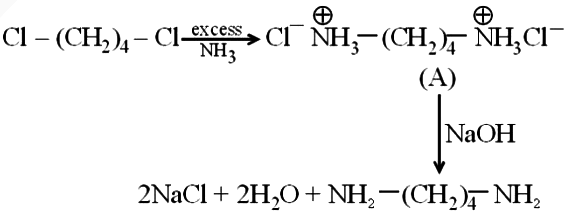
$$Cl-(CH_2)_4-Cl \xrightarrow{excess\ NH_3} A \xrightarrow{NaOH} B + H_2O + NaCl$$
Match List I with List II:
Choose the correct answer from the options given below:
A. Br2 water test
This is a test for unsaturation (alkenes or alkynes). The reddish-orange colour of bromine water disappears (decolorizes) as the bromine reacts across the double or triple bond to form a colourless di-bromoalkane.
B. Ceric ammonium nitrate (CAN)
This test is used to detect the Alcoholic group . When CAN is added to an alcohol, it forms a complex through an alkoxy exchange, resulting in a distinct pink or red colour.
C. Ferric chloride test
This is a specific test for Phenols or enols. Neutral ferric chloride reacts with phenols to form complex coordination compounds that exhibit characteristic colours ranging from violet and blue to green or red, depending on the specific phenol present.
D. 2, 4 - DNP (Brady’s Reagent) test
This test identifies the Carbonyl group (>C=O) found in aldehydes and ketones. The reagent reacts with the carbonyl carbon to form a hydrazone, which is a poorly soluble solid appearing as a yellow, orange, or red precipitate.
Which of the following reaction is correct?
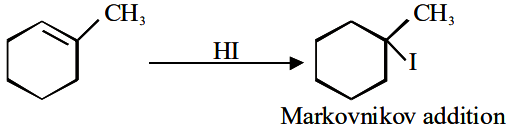
Correct Reaction: Option B
- Reaction: Addition of HI to 1-methylcyclohexene.
- Mechanism: This follows Markovnikov’s rule. The electrophile ($$H^+$$) adds to the double-bonded carbon with more hydrogens, and the nucleophile ($$I^-$$) adds to the more substituted tertiary ($$3^\circ$$) carbon.
- Product: 1-iodo-1-methylcyclohexane is correctly formed.
Incorrect Reactions
- Option A: Aliphatic primary amines ($$R-NH_2$$) react with $$HNO_2$$ to form alcohols ($$R-OH$$), but the carbon chain length must remain constant. The reactant has 3 carbons (propylamine), but the product shown (ethanol) only has 2.
- Option C: Reaction with $$Br_2$$ under UV light or Heat ($$\Delta$$) favors allylic substitution, not addition across the double bond.
- Option D: This is the Hoffmann Bromamide Degradation. It should result in an amine with one less carbon ($$C_2H_5NH_2$$) than the starting amide ($$C_2H_5CONH_2$$). The product shown incorrectly retains the original carbon count.
The final product $$A$$, formed in the following multistep reaction sequence is:
Given below are two statements: Statement (I): The $$-NH_2$$ group in Aniline is ortho and para directing and a powerful activating group. Statement (II): Aniline does not undergo Friedel-Craft's reaction (alkylation and acylation). In the light of the above statements, choose the most appropriate answer from the options given below:
Statement I: The $$-NH_2$$ group in aniline is ortho and para directing and a powerful activating group.
Analysis: The $$-NH_2$$ group is indeed an ortho/para director due to the lone pair on nitrogen which donates electron density to the ring via resonance. It is a powerful activating group — it strongly activates the benzene ring toward electrophilic aromatic substitution.
Statement I is correct.
Statement II: Aniline does not undergo Friedel-Craft's reaction (alkylation and acylation).
Analysis: Aniline does NOT undergo Friedel-Craft's reaction because the lone pair on the $$-NH_2$$ group coordinates with the Lewis acid catalyst ($$AlCl_3$$), forming a salt. This effectively deactivates the catalyst and also makes the ring electron-poor (as the nitrogen lone pair is no longer available for resonance with the ring).
Statement II is correct.
Conclusion: Both statements are correct.
The answer is Option A: Both Statement I and Statement II are correct.
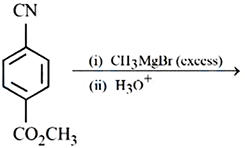
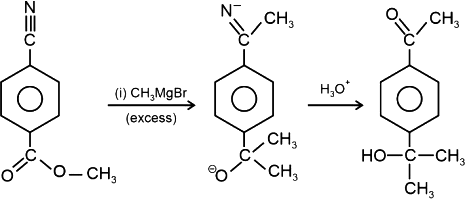
Major product of the following reaction is: A compound with $$CO_2CH_3$$ group reacts with (i) $$CH_3MgBr$$ (excess) (ii) $$H_3O^+$$
In excess CH3-MgBr, firstly the ester group gets reduced to substituted alcohol then the Grignard's reagent attacks on the CN group first converting it to imine and then upon addition of water the result is formation of ketone. Since, the aforementioned imine salt is stable it does not undergo further Grignard reagent attacks and upon hydrolysis Oxygen being more electronegative takes up the double bond resulting in removal of -NH2 group in form of Ammonia.
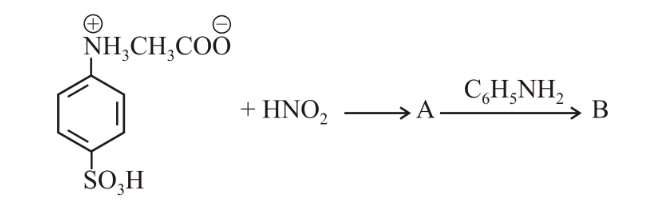
The azo-dye $$Y$$ formed in the following reactions is: Sulphanilic acid + NaNO$$_2$$ + CH$$_3$$COOH $$\rightarrow$$ X
Given below are two statements:
Statement I: Aniline reacts with con. $$H_2SO_4$$ followed by heating at 453-473 K gives p-aminobenzene sulphonic acid, which gives blood red colour in the 'Lassaigne's test.
Statement II: In Friedel-Craft's alkylation and acylation reactions, aniline forms salt with the $$AlCl_3$$ catalyst. Due to this, nitrogen of aniline acquires a positive charge and acts as deactivating group.
In the light of the above statements, choose the correct answer from the options given below:
Statement I deals with the sulfonation of aniline and the Lassaigne’s test for sulfur. Sulfonation of aniline with conc. $$H_2SO_4$$ at 453-473 K proceeds as follows:
$$C_6H_5NH_2 + H_2SO_4 \xrightarrow{453-473\,K} p\text{-}H_2NC_6H_4SO_3H$$
The product is p-aminobenzenesulfonic acid (sulfanilic acid).
In the Lassaigne’s test for sulfur, the sodium fusion extract is treated with sodium nitroprusside reagent. The presence of sulfur gives a blood-red coloration. Since p-aminobenzenesulfonic acid contains a sulfonic acid group (-SO₃H), it yields a blood-red color in this test. Therefore, Statement I is true.
Statement II concerns Friedel-Crafts reactions of aniline. Aniline’s -lone pair forms a complex with the Lewis acid catalyst $$AlCl_3$$:
$$C_6H_5NH_2 + AlCl_3 \longrightarrow [C_6H_5NH_2\cdot AlCl_3] \longrightarrow [C_6H_5NH_3]^+ + AlCl_4^-$$
In this complex, the nitrogen carries a positive charge, withdrawing electron density from the benzene ring and making it less reactive toward electrophilic substitution. Hence aniline acts as a deactivating group under Friedel-Crafts conditions, and no alkylation or acylation occurs. Therefore, Statement II is true.
Both Statement I and Statement II are true. The correct answer is Option D.
9.3 g of aniline is subjected to reaction with excess of acetic anhydride to prepare acetanilide. The mass of acetanilide produced if the reaction is 100% completed is _____ $$\times 10^{-1}$$ g.
(Given molar mass in g mol$$^{-1}$$: N = 14, O = 16, C = 12, H = 1)
The reaction of aniline with acetic anhydride:
$$C_6H_5NH_2 + (CH_3CO)_2O \to C_6H_5NHCOCH_3 + CH_3COOH$$
Molar mass of aniline = $$6(12) + 7(1) + 14 = 93$$ g/mol.
Molar mass of acetanilide = $$8(12) + 9(1) + 14 + 16 = 135$$ g/mol.
Moles of aniline = $$\frac{9.3}{93} = 0.1$$ mol.
Moles of acetanilide = 0.1 mol (1:1 ratio).
Mass of acetanilide = $$0.1 \times 135 = 13.5$$ g = $$135 \times 10^{-1}$$ g.
The answer is $$\boxed{135}$$.
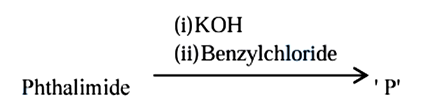
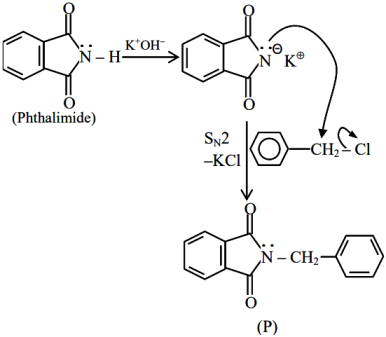
Phthalimide is made to undergo following sequence of reactions:
Total number of $$\pi$$ bonds present in product 'P' is/are ______

A compound $$x$$ with molar mass 108 g mol$$^{-1}$$ undergoes acetylation to give product with molar mass 192 g mol$$^{-1}$$. The number of amino groups in the compound $$x$$ is
In this reaction, an H atom (mass 1) on the $$-\text{NH}_2$$ group is replaced by an acetyl group $$-\text{COCH}_3$$ (mass 43). The net increase in molar mass per amino group is $$43 - 1 = 42$$ g/mol.
Since the product’s molar mass increases from 108 to 192, the total increase in molar mass is $$\Delta M = 192 - 108 = 84 \, \text{g/mol}$$.
Substituting into the relation for the number of amino groups gives $$n = \frac{\Delta M}{42} = \frac{84}{42} = 2$$.
Therefore, the compound $$X$$ has 2 amino groups, corresponding to Option 2.
From $$6.55$$ g of aniline, the maximum amount of acetanilide that can be prepared will be ______ $$\times 10^{-1}$$ g.
Aniline is first converted to acetanilide by acetylation. The balanced equation is
$$C_6H_5NH_2 + CH_3COOH \;(\text{or } (CH_3CO)_2O)\;\rightarrow\; C_6H_5NHCOCH_3 + H_2O$$
One mole of aniline gives one mole of acetanilide, so the reaction follows a 1 : 1 molar ratio.
Step 1 - Molar mass of aniline
$$M_{\text{aniline}} = 6(12) + 7(1) + 14 = 72 + 7 + 14 = 93 \text{ g mol}^{-1}$$
Step 2 - Moles of aniline taken
Given mass of aniline = $$6.55\text{ g}$$
$$n_{\text{aniline}} = \frac{6.55}{93} = 0.07043 \text{ mol}$$ (keep four significant figures for accuracy)
Step 3 - Molar mass of acetanilide
Acetanilide formula: $$C_8H_9NO$$
$$M_{\text{acetanilide}} = 8(12) + 9(1) + 14 + 16 = 96 + 9 + 14 + 16 = 135 \text{ g mol}^{-1}$$
Step 4 - Maximum (theoretical) mass of acetanilide
Moles of acetanilide produced = moles of aniline (1 : 1 ratio): $$0.07043 \text{ mol}$$
$$m_{\text{acetanilide}} = 0.07043 \times 135 = 9.517 \text{ g}$$
Step 5 - Expressing the answer as “×10−1 g”
Write 9.517 g as a multiple of $$10^{-1}$$ g:
$$9.517 \text{ g} = 95.17 \times 10^{-1} \text{ g}$$
Rounded to the nearest whole number (as required in JEE integer-type answers), the coefficient is $$95$$.
Therefore, the maximum amount of acetanilide obtainable is $$\boxed{95 \times 10^{-1}\text{ g}}$$.
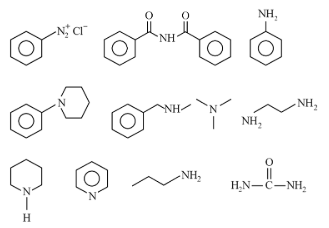
Number of compounds which give reaction with Hinsberg's reagent is ______.
Hinsberg's reagent reacts with primary ($$1^{\circ }$$) and secondary ($$2^{\circ }$$ amines). It does not react with tertiary ($$3^{\circ }$$ amines), amides, or diazonium salts under standard conditions.Analysis of the Compounds:
- Benzene diazonium chloride: Does not react.
- Benzimide (Amide): Does not react.
- Aniline ($$1^{\circ }$$ amine): Reacts.
- $$(N)$$-phenylpiperidine ($$3^{\circ }$$ amine): Does not react.
- Benzyl methyl amine ($$2^{\circ }$$ amine): Reacts.
- Ethane-1,2-diamine ($$1^{\circ }$$ amine): Reacts.
- Piperidine ($$2^{\circ }$$ amine): Reacts.
- Pyridine ($$3^{\circ }$$ amine): Does not react.
- Propan-1-amine ($$1^{\circ }$$ amine): Reacts.
- Urea (Amide): Does not react
$$X$$ g of ethanamine was subjected to reaction with $$NaNO_2/HCl$$ followed by hydrolysis to liberate $$N_2$$ and HCl. The HCl generated was completely neutralised by 0.2 moles of NaOH. $$X$$ is ______ g.
X g of ethylamine is subjected to reaction with NaNO₂/HCl followed by water; evolved dinitrogen gas which occupied 2.24 L volume at STP. X is ______ × 10⁻¹ g.
Ethylamine + NaNO₂/HCl → Diazonium salt → N₂ + Ethanol
C₂H₅NH₂ → N₂
At STP: Volume of N₂ = 2.24 L, so moles of N₂ = 2.24/22.4 = 0.1 mol
Moles of ethylamine = 0.1 mol (1:1 ratio)
Mass = 0.1 × 45 = 4.5 g = 45 × 10⁻¹ g
The answer is 45.
Given below are two statements:
Statement I: Sulphanilic acid gives esterification test for carboxyl group.
Statement II: Sulphanilic acid gives red colour in Lassigne's test for extra element detection.
In the light of the above statements, choose the most appropriate answer from the options given below:
We need to evaluate two statements about sulphanilic acid ($$H_2N-C_6H_4-SO_3H$$, also known as 4-aminobenzenesulphonic acid).
The first statement claims that sulphanilic acid gives the esterification test for a carboxyl group. This is incorrect. Sulphanilic acid contains a sulphonic acid group ($$-SO_3H$$), not a carboxyl group ($$-COOH$$). The esterification test involves reacting a carboxyl group with an alcohol in the presence of an acid catalyst to form a fruity-smelling ester, a reaction that sulphonic acid groups do not undergo. Therefore, sulphanilic acid will not give a positive esterification test for a carboxyl group.
The second statement asserts that sulphanilic acid gives a red colour in Lassaigne’s test for extra element detection. This is correct. Sulphanilic acid contains both nitrogen (in the $$-NH_2$$ group) and sulphur (in the $$-SO_3H$$ group). When subjected to sodium fusion (Lassaigne’s) test, these elements form sodium thiocyanate according to:
$$ Na + C + N + S \to NaSCN $$
Upon adding ferric chloride (FeCl$$_3$$) solution to the extract, the reaction is:
$$ 3NaSCN + FeCl_3 \to Fe(SCN)_3 + 3NaCl $$
Ferric thiocyanate, Fe(SCN)$$_3$$, imparts a characteristic blood-red colour, confirming the presence of both nitrogen and sulphur.
Thus, the correct answer is Option 4: Statement I is incorrect but Statement II is correct.
Consider the following molecules: Br$$_3$$O$$_8$$, F$$_2$$O, H$$_2$$S$$_4$$O$$_6$$, H$$_2$$S$$_5$$O$$_6$$, and C$$_3$$O$$_2$$.
Count the number of atoms existing in their zero oxidation state in each molecule. Their sum is ____.
Oxidation number (O.N.) is obtained by assigning the bonding electrons of every hetero-atomic bond to the more electronegative partner and adding the formal charge. Whenever an atom is bonded only to atoms of the same element, that bond contributes $$0$$ to its O.N.
Case 1: $$\mathbf{Br_3O_8}$$
Let the oxidation number of the three bromine atoms be $$x_1,x_2,x_3$$ (they need not be identical). Oxygen (except in peroxides and superoxides) has $$-2$$.
Total charge is zero, so
$$x_1+x_2+x_3+8(-2)=0\;\;\Longrightarrow\;\;x_1+x_2+x_3=+16$$
Whatever individual values the three bromine atoms possess, none of them can be $$0$$ because their sum is $$+16$$.
Number of atoms in O.N. $$0 = 0$$.
Case 2: $$\mathbf{F_2O}$$
Fluorine is the most electronegative element, so $$\text{O.N.(F)}=-1$$.
Let O.N.(O) = $$x$$.
$$x+2(-1)=0\;\;\Longrightarrow\;\;x=+2$$
No atom has O.N. $$0$$ here.
Number of atoms in O.N. $$0 = 0$$.
Case 3: $$\mathbf{H_2S_4O_6}$$ (tetrathionic acid)
This molecule contains a chain $$HO_3S\!-\!S\!-\!S\!-\!SO_3H$$.
• The two terminal sulphur atoms are each bonded to three oxygens and one sulphur. Such an environment is the same as in the dithionate ion, whose sulphur is known to be $$+5$$.
Assign O.N.(terminal S) = $$+5$$.
• Let the O.N. of each internal sulphur be $$y$$.
For the whole neutral acid (with $$2$$ hydrogens at $$+1$$):
$$2(+1)+2(+5)+2y+6(-2)=0$$
$$2+10+2y-12=0\;\;\Longrightarrow\;\;2y=0\;\;\Longrightarrow\;\;y=0$$
Thus both internal sulphur atoms are in the zero oxidation state.
Number of atoms in O.N. $$0 = 2$$.
Case 4: $$\mathbf{H_2S_5O_6}$$ (pentathionic acid)
Structure: $$HO_3S\!-\!S\!-\!S\!-\!S\!-\!SO_3H$$ (a five-sulphur chain).
• Terminal sulphur atoms again have O.N. $$+5$$.
• Let the three internal sulphur atoms have O.N.s $$y_1,y_2,y_3$$.
Overall charge $$0$$ gives
$$2(+1)+2(+5)+(y_1+y_2+y_3)+6(-2)=0$$
$$2+10+(y_1+y_2+y_3)-12=0\;\;\Longrightarrow\;\;y_1+y_2+y_3=0$$
In a pure $$S\!-\!S$$ chain an individual sulphur is normally either $$0$$ or $$-1$$.
A convenient integral solution is $$y_1=0,\;y_2=0,\;y_3=0$$ - fully consistent with the bonding scheme (each of those three S atoms is attached only to other sulphurs).
Hence all three internal sulphur atoms are in O.N. $$0$$.
Number of atoms in O.N. $$0 = 3$$.
Case 5: $$\mathbf{C_3O_2}$$ (carbon sub-oxide, $$O=C=C=C=O$$)
Let the oxidation numbers of the three carbons be $$x_1,x_2,x_3$$ (left to right).
Each oxygen is $$-2$$, so total for both oxygens is $$-4$$:
$$x_1+x_2+x_3-4=0\;\;\Longrightarrow\;\;x_1+x_2+x_3=+4$$
The two terminal carbonyl carbons (each double-bonded to an oxygen and singly to another carbon) are in O.N. $$+2$$.
Therefore $$x_1=+2,\;x_3=+2 \;\;\Rightarrow\;\;x_2=0$$ for the central carbon.
Number of atoms in O.N. $$0 = 1$$.
Total count of atoms in oxidation state 0:
$$0\;(Br_3O_8) + 0\;(F_2O) + 2\;(H_2S_4O_6) + 3\;(H_2S_5O_6) + 1\;(C_3O_2) = 6$$
Hence, the required sum is 6.
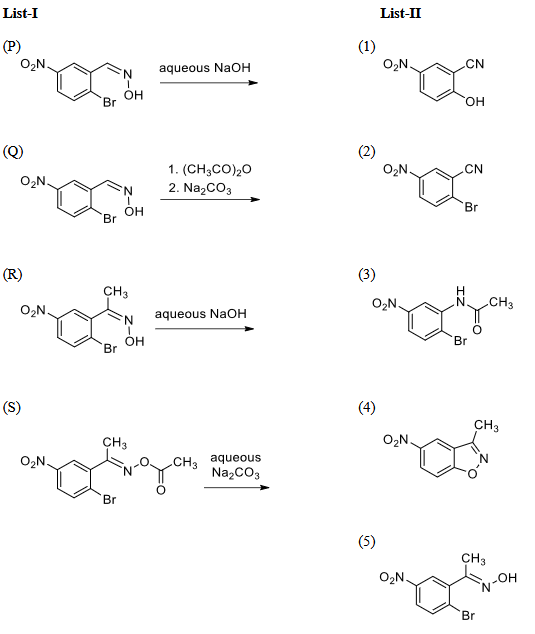
The incorrect statement regarding the reaction given below is
Benzyl isocyanide can be obtained by:
(A)
(B)
(C)
(D)

Choose the correct answer from the options given below:
Given below are two statements:
Statement I: Pure Aniline and other arylamines are usually colourless.
Statement II: Arylamines get coloured on storage due to atmospheric reduction.
In the light of the above statements, choose the most appropriate answer from the options given below:
The correct order in aqueous medium of basic strength in case of methyl substituted amines is:
Order of basic strength of methyl substituted amines in aqueous medium.
Basicity in aqueous solution depends on both the inductive effect of methyl groups, which increases basicity, and steric or solvation effects, since bulky groups hinder solvation of the conjugate acid and thus lower basicity.
The experimentally observed order in aqueous medium is:
$$ \text{Me}_2\text{NH} > \text{MeNH}_2 > \text{Me}_3\text{N} > \text{NH}_3 $$Me$$_2$$NH has a strong inductive effect and its conjugate acid is well solvated through two N-H bonds, MeNH$$_2$$ has a moderate inductive effect with good solvation, and although Me$$_3$$N has the strongest inductive effect, its conjugate acid is poorly solvated due to having only one N-H bond.
The correct answer is Option A: $$\boxed{\text{Me}_2\text{NH} > \text{MeNH}_2 > \text{Me}_3\text{N} > \text{NH}_3}$$.
The major products A and B from the following reactions are:

(1)

(2)

(3)

(4)
Choose the correct colour of the product for the following reaction.
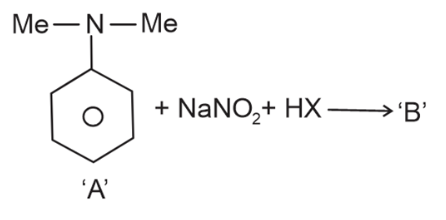
Consider the following sequence of reactions

The product 'B' is
Step 1: Aniline reacts with NaNO₂ at 0-5°C (diazotization):
$$C_6H_5NH_2 + NaNO_2 + HCl \xrightarrow{0-5°C} C_6H_5N_2^+Cl^-$$
Product 'A' is benzenediazonium chloride.
Step 2: Benzenediazonium salt couples with N,N-dimethylaniline (azo coupling):
The diazonium salt attacks the para position of N,N-dimethylaniline (which is a strongly activated ring).
Product 'B' is an azo compound: p-(N,N-dimethylamino)azobenzene (also known as butter yellow or methyl yellow).
Structure: C₆H₅-N=N-C₆H₄-N(CH₃)₂ (with the -N=N- azo bridge connecting the two aromatic rings, NMe₂ at para position).
This matches option 3.
Identify the product formed (A and E)
In the following reaction, 'A' is
Reaction of propanamide with Br$$_2$$ / KOH (aq) produces:
The major product formed in the following reaction is

Compound P is neutral, Q gives effervescence with NaHCO$$_3$$ while R reacts with Hinsberg's reagent to give solid soluble in NaOH. Compound P is

In the above conversion the correct sequence of reagents to be added is
Isomeric amines with molecular formula C$$_8$$H$$_{11}$$N give the following tests
Isomer P $$\Rightarrow$$ Can be prepared by Gabriel phthalimide synthesis
Isomer Q $$\Rightarrow$$ Reacts with Hinsberg's reagent to give solid insoluble in NaOH
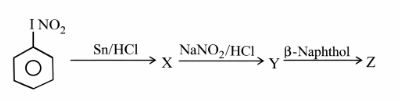
Isomer R $$\Rightarrow$$ Reacts with HONO followed by $$\beta$$-naphthol in NaOH to give red dye.
Isomers P, Q and R respectively are
Gabriel phthalimide synthesis:Look for a primary amine where the -NH2 group is attached to an aliphatic carbon chain instead of the benzene ring directly.
Hinsberg's reagent:Secondary amines react with Hinsberg's reagent to give a solid that is insoluble in NAOH.
primary aromatic amines give red dye.
hence answer would be D
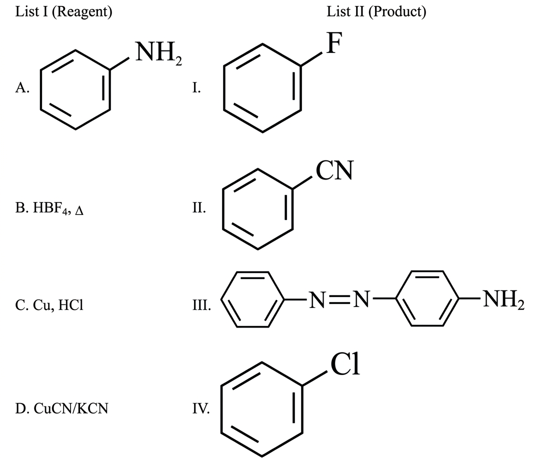
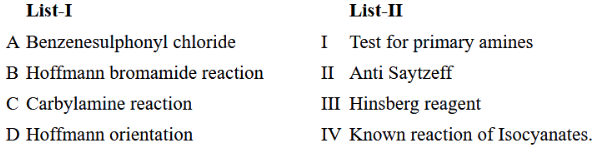
Match List I with List II:

is reacted with reagents in List I to form products in List II
Choose the correct answer from the options given below:
Reactions of diazonium salt with different reagents:
A. With ArNH₂ (amine): Diazonium coupling reaction with amine gives an azo dye (N=N linkage) → Match with III
B. With HBF₄, Δ: Balz-Schiemann reaction. ArN₂⁺ → ArF (Fluorobenzene) → Match with I
C. With Cu/HCl: Sandmeyer reaction. ArN₂⁺ → ArCl (Chlorobenzene) → Match with IV
D. With CuCN/KCN: Sandmeyer reaction (with cyanide). ArN₂⁺ → ArCN (Cyanobenzene) → Match with II
The correct matching is: A-III, B-I, C-IV, D-II.
Match List I with List II
List I (Amines) List II (pKb)
A. Aniline I. 3.25
B. Ethanamine II. 3.00
C. N-Ethylethanamine III. 9.38
D. N,N-Diethylethanamine IV. 3.29
Choose the correct answer from the options given below:-
We need to match each amine with its correct $$pK_b$$ value. From NCERT data the $$pK_b$$ values of common amines are: aniline ($$C_6H_5NH_2$$, primary aromatic) $$pK_b = 9.38$$; ethanamine ($$C_2H_5NH_2$$, primary aliphatic) $$pK_b = 3.29$$; N-ethylethanamine ($$(C_2H_5)_2NH$$, secondary aliphatic) $$pK_b = 3.00$$; and N,N-diethylethanamine ($$(C_2H_5)_3N$$, tertiary aliphatic) $$pK_b = 3.25$$.
List II gives I = 3.25, II = 3.00, III = 9.38, and IV = 3.29. Aniline $$\rightarrow$$ III ($$pK_b = 9.38$$) because resonance with the benzene ring weakens its basicity. Ethanamine $$\rightarrow$$ IV ($$pK_b = 3.29$$) as a primary aliphatic amine. N-ethylethanamine $$\rightarrow$$ II ($$pK_b = 3.00$$) since the +I effect of two alkyl groups and minimal steric hindrance makes it the strongest base here. N,N-diethylethanamine $$\rightarrow$$ I ($$pK_b = 3.25$$) because steric effects in the tertiary amine reduce its basicity compared to the secondary amine.
The complete matching is A-III, B-IV, C-II, D-I, so the correct answer is Option D.
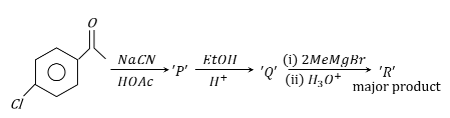
'R' formed in the following sequence of reaction is:
Firstly CN- nucleophile gets attached to the carbonyl reducing it to alcohol. In the next step EtOH in acidic medium on reaction with a Cyanide group results in the formation of Ethyl Ester. At last the 2 CH3- from Grignard Reagent get attached to the ester, firstly removing -OEt since it is a good leaving group then reducing the carbonyl carbon to -OH.
Compound 'B' is :
The major product 'P' for the following sequence of reactions is:
. 'X' is:
Reaction Mechanism:
- Diazotization: When an aromatic primary amine reacts with HNO2 it undergoes diazotization to form a highly reactive diazonium ion.
- Intramolecular Cyclization:
Since o-phenylenediamine has two amino groups ortho to each other, one of the $-\text{NH}_2$ groups is converted into a diazonium group ($-\text{N}_2^+$).
- Ring Closure:
The adjacent, unreacted primary amino group ($-\text{NH}_2$) acts as an internal nucleophile. The lone pair on its nitrogen atom attacks the neighboring diazonium group, causing a rapid intramolecular cyclization to close a stable 5-membered heterocyclic ring.
- Deprotonation:
After losing a proton ($\text{H}^+$), the stable heterocyclic compound Benzotriazole is formed.
Structure of the Product:
The resulting compound contains a benzene ring fused to a triazole ring (a 5-membered ring containing three nitrogen atoms), with the structure:
- A benzene core.
- Fused to a ring containing $-\text{N}=\text{N}-\text{NH}-$.
Given below are two statements: one is labelled as Assertion (A) and the other is labelled as Reason (R).
Assertion (A): $$\alpha$$-halocarboxylic acid on reaction with dil. NH$$_3$$ gives good yield of $$\alpha$$-amino carboxylic acid whereas the yield of amines is very low when prepared from alkyl halides.
Reason (R): Amino acids exist in zwitter ion form in aqueous medium.
In the light of the above statements, choose the correct answer from the options given below:
We need to evaluate the Assertion and Reason about amino acid synthesis.
Assertion: $$\alpha$$-halocarboxylic acid on reaction with dilute NH$$_3$$ gives good yield of $$\alpha$$-amino carboxylic acid, whereas the yield of amines is very low when prepared from alkyl halides.
This is correct. When alkyl halides react with NH$$_3$$, the product amine is more nucleophilic than NH$$_3$$ itself, leading to over-alkylation (polyalkylation) and low yield of primary amine. However, $$\alpha$$-halocarboxylic acids give good yield of amino acids because the product amino acid exists as a zwitter ion, which is much less nucleophilic than NH$$_3$$, preventing further reaction.
Reason: Amino acids exist in zwitter ion form in aqueous medium.
This is correct. Amino acids exist as $$^+\text{NH}_3\text{-CHR-COO}^-$$ in aqueous medium.
The reason (R) does explain the assertion (A). The zwitter ion form makes the amino group in the product positively charged ($$-\text{NH}_3^+$$), so it cannot act as a nucleophile to undergo further alkylation. This is why the yield is good for amino acid synthesis but poor for amine synthesis from alkyl halides.
Therefore, both (A) and (R) are correct, and (R) is the correct explanation of (A).
The correct answer is Option A: Both (A) and (R) are correct and (R) is the correct explanation of (A).
Consider the following reaction sequence:

The value of x in compound 'D' is _____
The product (P) formed from the following multistep reaction is:
How many of the transformation given below would result in aromatic amines?
Number of isomeric aromatic amines with molecular formula C$$_8$$H$$_{11}$$N, which can be synthesized by Gabriel Phthalimide synthesis is ______.
Gabriel phthalimide synthesis can only be used to prepare primary amines. It involves treating potassium phthalimide with an alkyl halide, followed by hydrolysis.
Molecular formula: C₈H₁₁N. Degrees of unsaturation = $$\frac{2(8)+2-11+1}{2} = 4$$ (indicating a benzene ring).
The aromatic primary amines with this formula that can be made by Gabriel synthesis (excluding arylamines where NH₂ is directly on the ring, as those cannot be made by Gabriel synthesis) are:
These are the methylbenzylamine isomers (where -CH₂NH₂ is the reactive part):
1. 2-Methylbenzylamine (o-CH₃C₆H₄CH₂NH₂)
2. 3-Methylbenzylamine (m-CH₃C₆H₄CH₂NH₂)
3. 4-Methylbenzylamine (p-CH₃C₆H₄CH₂NH₂)
The number of isomeric aromatic amines is 3.
The correct stability order of the following diazonium salts is
To determine the decreasing order of stability for the given benzenediazonium salts, we must evaluate the electronic effects of the substituents on the benzene ring. The stability of a diazonium ion depends heavily on how well the positive charge on the nitrogen atoms can be dispersed.
Electron-donating groups (+R effect) push electron density into the ring, which helps neutralize and delocalize the positive charge on the diazonium group, thereby increasing stability. Conversely, electron-withdrawing groups (-R effect) pull electron density away from the ring, which intensifies the positive charge and decreases stability.
In compound (A), the methoxy group (-OCH₃) exhibits a strong electron-donating +R effect, making the diazonium ion the most stable. Compound (C) has no substituent and serves as the neutral baseline. In compounds (D) and (B), the cyano (-CN) and nitro (-NO₂) groups act as powerful electron-withdrawing groups via the -R effect, highly destabilizing the ion. Because the nitro group exerts a stronger electron-withdrawing effect than the cyano group, compound (B) is the least stable of all.
Therefore, the decreasing order of stability is: (A) > (C) > (D) > (B).
Given below are two statements: one is labelled as Assertion (A) and the other is labelled as Reason (R).
Assertion (A): Experimental reaction of $$CH_3Cl$$ with aniline and anhydrous $$AlCl_3$$ does not give $$o$$ and $$p$$-methylaniline.
Reason (R): The $$-NH_2$$ group of aniline becomes deactivating because of salt formation with anhydrous $$AlCl_3$$ and hence yields $$m$$-methyl aniline as the product.
In the light of the above statements, choose the most appropriate answer from the options given below
We evaluate the assertion that the reaction of $$CH_3Cl$$ with aniline and anhydrous $$AlCl_3$$ does not give ortho- and para-methylaniline. This is true because when aniline is treated with $$CH_3Cl$$ in the presence of anhydrous $$AlCl_3$$ (Friedel-Crafts alkylation), the expected ortho- and para-methylanilines are not obtained.
The $$-NH_2$$ group reacts with $$AlCl_3$$ to form a salt:
$$C_6H_5NH_2 + AlCl_3 \rightarrow C_6H_5\overset{+}{N}H_2\text{-}AlCl_3^-$$
This salt formation converts the activating, ortho/para-directing $$-NH_2$$ group into the deactivating, meta-directing $$-\overset{+}{N}H_2AlCl_3^-$$ group, so the Friedel-Crafts reaction either does not proceed or gives poor yields.
The stated reason is that the $$-NH_2$$ group becomes deactivating because of salt formation with anhydrous $$AlCl_3$$ and hence yields meta-methylaniline. While the first part is true, the claim that it yields meta-methylaniline is false: the ring is so deactivated that the Friedel-Crafts reaction essentially does not occur, rather than giving the meta product, since Friedel-Crafts reactions do not work on strongly deactivated rings.
The assertion is true and the reason is false.
Hence, the correct answer is Option C: A is true, but R is false.

The major product of the above reactions is
Decarboxylation of all six possible forms of diaminobenzoic acids $$C_6H_3(NH_2)_2COOH$$ yields three products A, B and C. Three acids give a product 'A', two acids give a product 'B' and one acid give a product 'C'. The melting point of product 'C' is
We need to determine how many of the six diaminobenzoic acid isomers give each diaminobenzene product upon decarboxylation, and find the melting point of product C (obtained from only one acid).
Identify all six isomers of diaminobenzoic acid.
Diaminobenzoic acid has the formula $$C_6H_3(NH_2)_2COOH$$. On a benzene ring with a COOH group at position 1, the two $$NH_2$$ groups can be at:
1. Positions 2,3
2. Positions 2,4
3. Positions 2,5
4. Positions 2,6
5. Positions 3,4
6. Positions 3,5
Determine the decarboxylation product for each isomer.
Decarboxylation removes the COOH group. The relative positions of the two $$NH_2$$ groups determine the product:
1. (2,3)-diaminobenzoic acid $$\rightarrow$$ 1,2-diaminobenzene (o-phenylenediamine)
2. (2,4)-diaminobenzoic acid $$\rightarrow$$ 1,3-diaminobenzene (m-phenylenediamine)
3. (2,5)-diaminobenzoic acid $$\rightarrow$$ 1,4-diaminobenzene (p-phenylenediamine)
4. (2,6)-diaminobenzoic acid $$\rightarrow$$ 1,3-diaminobenzene (m-phenylenediamine) [positions 2,6 relative to removed COOH become 1,3]
5. (3,4)-diaminobenzoic acid $$\rightarrow$$ 1,2-diaminobenzene (o-phenylenediamine)
6. (3,5)-diaminobenzoic acid $$\rightarrow$$ 1,3-diaminobenzene (m-phenylenediamine)
Count the products.
Product A (from 3 acids): 1,3-diaminobenzene (m-phenylenediamine) — from isomers 2, 4, and 6. Melting point = 63°C.
Product B (from 2 acids): 1,2-diaminobenzene (o-phenylenediamine) — from isomers 1 and 5. Melting point = 104°C.
Product C (from 1 acid): 1,4-diaminobenzene (p-phenylenediamine) — from isomer 3 only. Melting point = 142°C.
The melting point of product C is 142°C.
The correct answer is Option D.
In Friedel-Crafts alkylation of aniline, one gets:
We need to identify what happens during Friedel-Crafts alkylation of aniline. Aniline (C₆H₅NH₂) has a lone pair on nitrogen, and in Friedel-Crafts alkylation, the Lewis acid catalyst (like AlCl₃) is used to generate a carbocation. The lone pair on the nitrogen atom of aniline reacts with the Lewis acid catalyst AlCl₃, forming a coordination complex where nitrogen donates its lone pair to the Lewis acid:
$$\text{C}_6\text{H}_5\text{NH}_2 + \text{AlCl}_3 \rightarrow \text{C}_6\text{H}_5\text{NH}_2^{+}-\text{AlCl}_3^{-}$$
This effectively puts a positive charge on the nitrogen atom, and the positively charged nitrogen acts as a strong deactivating group (meta-directing). The nitrogen withdraws electron density from the ring through its positive charge, making the ring highly electron-deficient. This deactivates the benzene ring so much that Friedel-Crafts reaction does not proceed on the ring. In fact, Friedel-Crafts reactions generally fail with aniline and other amines because the amine group gets protonated/complexed, deactivating the ring.
The answer is Option D: positively charged nitrogen at benzene ring.
Which statement is NOT correct for p-toluenesulphonyl chloride?
We need to identify the statement that is NOT correct about p-toluenesulphonyl chloride (Hinsberg's reagent).
p-Toluenesulphonyl chloride ($$CH_3C_6H_4SO_2Cl$$) is known as Hinsberg's reagent. It is used to distinguish between primary, secondary, and tertiary amines based on their different reactions with this reagent.
Option A: "It is Hinsberg's reagent" — This is correct. p-Toluenesulphonyl chloride is indeed Hinsberg's reagent.
Option B: "It is used to distinguish primary and secondary amines" — This is correct. Primary amines form N-alkyl sulphonamides that are soluble in alkali (due to the acidic N-H), while secondary amines form N,N-dialkyl sulphonamides that are insoluble in alkali (no N-H for salt formation).
Option C: "On treatment with secondary amine, it leads to a product that is soluble in alkali" — This is NOT correct. When a secondary amine reacts with Hinsberg's reagent, the product is $$CH_3C_6H_4SO_2NR_2$$, which has no acidic hydrogen on nitrogen. Therefore, it is insoluble in alkali. Only the product from primary amines ($$CH_3C_6H_4SO_2NHR$$) is soluble in alkali because the N-H hydrogen is acidic enough to form a sodium salt.
Option D: "It does not react with tertiary amine" — This is correct. Tertiary amines have no N-H bond, so they cannot undergo the sulphonamide reaction with Hinsberg's reagent.
Therefore, the correct answer is Option C.
An organic compound 'A' contains nitrogen and chlorine. It dissolves readily in water to give a solution that turns litmus red. Titration of compound 'A' with standard base indicates that the molecular weight of 'A' is $$131 \pm 2$$. When a sample of 'A' is treated with aq. NaOH, a liquid separates which contains N but not Cl. Treatment of the obtained liquid with nitrous acid followed by phenol gives orange precipitate. The compound 'A' is
An organic compound 'A' on reaction with $$NH_3$$ followed by heating gives compound B. Which on further strong heating gives compound C ($$C_8H_5NO_2$$). Compound C on sequential reaction with ethanolic KOH, alkyl chloride and hydrolysis with alkali gives a primary amine. The compound A is
Given below are two statements: one is labelled as Assertion A and the other is labelled as Reason R
Assertion A: Aniline on nitration yields ortho, meta & para nitro derivatives of aniline.
Reason R: Nitrating mixture is a strong acidic mixture.
In the light of the above statements, choose the correct answer from the options given below
Given below are two statements :
Statement - I : In Hofmann degradation reaction, the migration of only an alkyl group takes place from carbonyl carbon of the amide to the nitrogen atom.
Statement - II : The group is migrated in Hofmann degradation reaction to electron deficient atom.
In the light of the above statements, choose the most appropriate answer from the options given below
The Hofmann degradation (Hofmann rearrangement) converts a primary amide ($$RCONH_2$$) to a primary amine ($$RNH_2$$) with one fewer carbon atom, using $$Br_2$$ and a strong base such as NaOH or KOH. The mechanism begins with the amide reacting with $$Br_2$$ in the presence of NaOH, which brominates the nitrogen to form an N-bromoamide. The base then abstracts the N-H proton, and loss of bromide generates a nitrene intermediate in which the nitrogen atom is electron deficient, possessing only a sextet of electrons. Next, the R group migrates from the carbonyl carbon to the electron-deficient nitrogen in a 1,2-shift, yielding an isocyanate intermediate. Finally, hydrolysis of the isocyanate with water produces the primary amine and $$CO_2$$.
In analyzing Statement I, the claim is that in the Hofmann degradation only an alkyl group migrates from the carbonyl carbon to the nitrogen atom. In fact, the R group attached to the carbonyl carbon—whether it is alkyl or aryl—migrates to nitrogen, and no other group undergoes migration. Within the typical context of JEE-level examples involving alkyl amides, this statement is considered correct.
Analysis of Statement II reveals that the migrating group indeed moves to an electron-deficient atom. During the rearrangement, nitrogen becomes electron deficient in the nitrene intermediate (having only six electrons), and the R group shifts to this electron-poor nitrogen. This feature is characteristic of 1,2-rearrangement reactions.
Since both Statement I and Statement II are correct, the answer is Option A.
Identify the major product A and B for the below given reaction sequence.
Identify the major product formed in the following sequence of reactions :

Identify 'Z' among the following
Match List-I with List-II

Choose the correct answer from the options given below
We need to match List-I (chemical reactions/reagents) with List-II (their descriptions). To do this, each item is examined in turn.
(A) Benzenesulphonyl chloride: Benzenesulphonyl chloride ($$C_6H_5SO_2Cl$$) is known as the Hinsberg reagent. It is used in the Hinsberg test to distinguish between primary, secondary, and tertiary amines, so A matches with (III) Hinsberg reagent.
(B) Hoffmann bromamide reaction: In the Hoffmann bromamide degradation, a primary amide is treated with $$Br_2$$ and NaOH to form an amine with one fewer carbon atom. The intermediate in this reaction is an isocyanate (R-N=C=O), and thus B matches with (IV) Known reaction of Isocyanates.
(C) Carbylamine reaction: The carbylamine reaction (also called isocyanide test) involves heating a primary amine with chloroform and alcoholic KOH to form an isocyanide with a foul smell. Being a test for primary amines, C matches with (I) Test for primary amines.
(D) Hoffmann orientation: Hoffmann elimination (or Hoffmann orientation) gives the less substituted alkene as the major product when a quaternary ammonium salt undergoes elimination. This is opposite to Saytzeff’s rule, hence it is called Anti-Saytzeff elimination, and D matches with (II) Anti Saytzeff.
Accordingly, the final matching is A-III, B-IV, C-I, D-II, and the correct answer is Option C: A-III, B-IV, C-I, D-II.
The conversion of propan-1-ol to n-butylamine involves the sequential addition of reagents. The correct sequential order of reagents is
Which among the following is the strongest Bronsted base?
With respect to the following reaction, consider the given statements:

(A) o-Nitroaniline and p-nitroaniline are the predominant products.
(B) p-Nitroaniline and m-nitroaniline are the predominant products.
(C) HNO$$_3$$ acts as an acid.
(D) H$$_2$$SO$$_4$$ acts as an acid.
Choose the correct option.
A primary aliphatic amine on reaction with nitrous acid in cold (273 K) and there after raising temperature of reaction mixture to room temperature (298 K), gives a/an
When a primary aliphatic amine reacts with nitrous acid ($$HNO_2$$) in cold conditions (273 K) and the temperature is then raised to room temperature (298 K), the initial reaction at low temperature involves a primary aliphatic amine ($$R-NH_2$$) reacting with nitrous acid (prepared in situ from $$NaNO_2 + HCl$$) to form an aliphatic diazonium salt:
$$R-NH_2 + HNO_2 \rightarrow R-N_2^+Cl^- + H_2O$$
Aliphatic diazonium salts are extremely unstable and decompose immediately even at low temperatures. Upon warming to room temperature (298 K), the diazonium salt loses nitrogen:
$$R-N_2^+Cl^- \xrightarrow{298 K} R^+ + N_2 \uparrow$$
The resulting carbocation reacts with water to give an alcohol:
$$R^+ + H_2O \rightarrow R-OH + H^+$$
Overall, the primary aliphatic amine is converted into an alcohol with the evolution of nitrogen gas:
$$R-NH_2 \xrightarrow{NaNO_2/HCl, 273K \rightarrow 298K} R-OH + N_2 + HCl$$
This behavior contrasts with that of aromatic primary amines, which form stable diazonium salts at 273 K that can undergo coupling reactions. The correct answer is Option A: Alcohol.
Consider the above reaction, the compound 'A' is
The correct sequential order of the reagents for the given reaction is
This question asks about the correct sequential order of reagents for a given reaction. Since the question references a reaction diagram that is not available, we will reason based on the given answer.
The correct answer is Option B: $$HNO_2$$, KI, $$Fe/H^+$$, $$HNO_2$$, $$H_2O$$/warm
Since the starting amine group ($$-NH_2$$) is converted to a diazonium salt ($$-N_2^+$$), nitrous acid at 0-5 °C (from $$NaNO_2 + HCl$$) is used for diazotization:
$$Ar-NH_2 \xrightarrow{HNO_2} Ar-N_2^+Cl^-$$
After diazotization, the diazonium group is replaced by iodine using potassium iodide in a Sandmeyer-type reaction:
$$Ar-N_2^+Cl^- \xrightarrow{KI} Ar-I + N_2 + KCl$$
Next, a nitro group ($$-NO_2$$) present elsewhere on the ring is reduced to an amine group ($$-NH_2$$) with iron in acidic medium:
$$Ar-NO_2 \xrightarrow{Fe/H^+} Ar-NH_2$$
Since the newly formed $$-NH_2$$ group must be diazotized again, nitrous acid is once more employed:
$$Ar-NH_2 \xrightarrow{HNO_2} Ar-N_2^+Cl^-$$
Finally, hydrolysis by warming with water converts the diazonium salt into a phenol ($$-OH$$) group:
$$Ar-N_2^+Cl^- \xrightarrow{H_2O/\text{warm}} Ar-OH + N_2 + HCl$$
Therefore, the correct sequence is Option B: $$HNO_2$$, KI, $$Fe/H^+$$, $$HNO_2$$, $$H_2O$$/warm.
The Hinsberg reagent is
The reaction of

with bromine and KOH gives $$RNH_2$$ as the end product. Which one of the following is the intermediate product formed in this reaction?
Given below are two statements:
Statement I : Aniline is less basic than acetamide.
Statement II : In aniline, the lone pair of electrons on nitrogen atom is delocalised over benzene ring due to resonance and hence less available to a proton.
Choose the most appropriate option:
We begin by recalling the definition of basicity in organic molecules. A base is a species which can donate a lone pair of electrons to accept a proton ($$H^{+}$$). Hence, the more freely available the lone pair on nitrogen, the stronger is the basic character of the compound.
Now we consider the two compounds in the question:
(i) Acetamide : $$CH_{3}CONH_{2}$$
(ii) Aniline : $$C_{6}H_{5}NH_{2}$$
For acetamide, the nitrogen lone pair interacts with the adjacent carbonyl group. We write the resonance structures first, stating the resonance principle: “If a lone pair on an atom is adjacent to a multiple bond, $$\pi$$-electron delocalisation can occur.” Using this rule we obtain
$$CH_{3}CONH_{2}\; \longleftrightarrow \; CH_{3}C^{(-)}=O^{(+)}NH_{2}$$
Because of this $$n \rightarrow \pi^{*}$$ conjugation, the lone pair is pulled toward the more electronegative oxygen. Thus it is very poorly available for protonation. Quantitatively, the conjugate acid $$(CH_{3}CONH_{3}^{+})$$ has a $$pK_{a}$$ around 0, showing extreme weakness of the base.
For aniline, the nitrogen lone pair is adjacent to an aromatic ring. Again applying the same resonance principle, we write the resonance forms:
$$C_{6}H_{5}NH_{2}\; \longleftrightarrow \; C_{6}H_{5}^{(-)} \!-\! NH_{2}^{(+)}$$
symbolically extended over the ring as
$$\begin{aligned} &\; \;\; \; \; \; \; \; \; \; \; \; \; \; \; \; \; \; \; \; \; \; \; N \!H_{2}\\ C_{6}H_{5}NH_{2}&\; \longleftrightarrow \; C_{6}H_{5}^{(-)}\!=\!NH_{2}^{(+)} \end{aligned}$$
Thus the nitrogen lone pair is delocalised into the benzene ring, reducing its electron density and consequently its tendency to accept a proton. Nevertheless, the withdrawal in aniline is less severe than in acetamide, because in acetamide the electron-withdrawing carbonyl oxygen is far more electronegative than any carbon in the aromatic ring.
Therefore the experimentally observed order of basicity is
$$\text{acetamide} \; < \; \text{aniline}$$
or, equivalently,
$$\text{aniline is more basic than acetamide.}$$
This conclusion directly contradicts Statement I, which claims “Aniline is less basic than acetamide.” Hence Statement I is false.
Statement II says, “In aniline, the lone pair of electrons on nitrogen atom is delocalised over benzene ring due to resonance and hence less available to a proton.” The resonance structures shown above confirm exactly this reasoning, so Statement II is true.
We have now established:
$$\text{Statement I : false}, \qquad \text{Statement II : true}$$
Among the given options, the description “Statement I is false but statement II is true” corresponds to Option B.
Hence, the correct answer is Option B.
Correct statement about the given chemical reaction is:
Correct Option (First Choice):
“Reaction is possible and compound (A) will be major product.”
This statement is correct. Although a large amount of meta product is formed, the para product $$\mathrm{(A)}$$ is obtained slightly more, with approximately $$51\%$$ yield, making it the major product.
Option B is incorrect:
While the $$\mathrm{-NH_2}$$ group is normally an ortho/para-directing group, compound $$\mathrm{(B)}$$ is still formed in significant amount because, in the acidic nitrating medium, aniline gets protonated to form the anilinium ion.
The anilinium ion is meta-directing.
Option C is incorrect:
Compound $$\mathrm{(B)}$$ is formed in considerable quantity (approximately $$47\%$$), but it is not the major product since compound $$\mathrm{(A)}$$ is formed slightly more.
Option D is incorrect:
Sulphonation of aniline is possible under different reaction conditions such as heating with concentrated sulfuric acid. However, under standard nitration conditions at $$288\ \mathrm{K}$$, nitration is the dominant reaction pathway.
In the following reaction, the reason why meta-nitro product also formed is:
The formation of such a large amount of the meta-nitro product is due to the strongly acidic conditions used during the nitration process. Under normal circumstances, the amine group attached to the benzene ring is a powerful activating group. Because the nitrogen atom has a lone pair of electrons, it pushes those electrons into the ring through resonance, which naturally directs any incoming electrophiles, like the nitro group, to the ortho and para positions. This is why you still see a significant amount of the para product forming in the reaction mixture, as a portion of the molecules react in their standard state.
However, the reagents used for this nitration, concentrated nitric acid and concentrated sulfuric acid, create an intensely acidic environment. Because the amine group on the aniline molecule is basic, it rapidly reacts with the abundant protons in this acidic mixture. This acid-base reaction protonates the amine group, converting it into an anilinium ion. This transformation is the crucial key to the puzzle because the nitrogen atom now holds a positive charge and no longer has a free lone pair of electrons to donate to the benzene ring.
Once converted into the anilinium ion, the functional group entirely changes its chemical personality. Instead of pushing electrons into the ring, the positively charged nitrogen acts as a strong electron-withdrawing group, pulling electron density away from the benzene ring through the inductive effect. Electron-withdrawing groups inherently deactivate the ortho and para positions much more heavily than the meta position. Consequently, the anilinium ions in the mixture direct the incoming nitro groups almost exclusively to the meta position, which perfectly explains why you end up with a massive forty-seven percent yield of the meta-nitroaniline product alongside the expected para product.
Thus the right answer is the formation of anilinium ion, which is option A.
What is the correct sequence of reagents used for converting nitrobenzene into m-dibromobenzene?
Using $Br_2$ and an iron catalyst ($Fe$ or $FeBr_3$), a bromine atom is added to the ring. Because the $-NO_2$ group is a meta-director, the bromine attaches at the meta position, securing the required 1,3 relationship.
$$C_6H_5NO_2 \xrightarrow{Br_2/Fe} m\text{-}Br-C_6H_4-NO_2$$
Tin ($Sn$) and hydrochloric acid ($HCl$) act as a reducing agent to convert the nitro group ($-NO_2$) into a primary amine group ($-NH_2$), forming $m$-bromoaniline.
$$m\text{-}Br-C_6H_4-NO_2 \xrightarrow{Sn/HCl} m\text{-}Br-C_6H_4-NH_2$$
Reacting the primary aromatic amine with cold sodium nitrite and hydrochloric acid ($NaNO_2/HCl$) converts the amine into a highly reactive diazonium salt.
$$m\text{-}Br-C_6H_4-NH_2 \xrightarrow{NaNO_2/HCl} m\text{-}Br-C_6H_4-N_2^+Cl^-$$
Finally, treating the diazonium salt with cuprous bromide and hydrobromic acid ($CuBr/HBr$) displaces the diazonium group (releasing nitrogen gas) and replaces it with a second bromine atom, yielding the final product.
$$m\text{-}Br-C_6H_4-N_2^+Cl^- \xrightarrow{CuBr/HBr} m\text{-dibromobenzene}$$

Consider the given reaction, Identify X and Y:
In the chemical reactions given above A and B respectively are:
$$\mathrm{ArN_2^+Cl^- + H_3PO_2 + H_2O \rightarrow ArH + N_2 + H_3PO_3 + HCl}$$ (From Amines chapter in NCERT).
$$\mathrm{C_6H_6 + CH_3Cl \xrightarrow[\ ]{Anhyd.\ AlCl_3} C_6H_5CH_3 + HCl}$$ (From Hydrocarbons chapter in NCERT, Friedel-Crafts Alkylation Reaction)
Similarly if we use $$ CH_3CH_2Cl$$
$$\mathrm{C_6H_6 + CH_3CH_2Cl \xrightarrow[\ ]{Anhyd.\ AlCl_3} C_6H_5CH_2CH_3 + HCl}$$
Thus the right option is A.
The correct sequence of correct reagents for the following transformation is:-
Which of the following reaction/s will not give $$p$$-aminoazobenzene?


We need to determine which reaction(s) will not give $$p$$-aminoazobenzene.
Reaction A: Nitrobenzene is first reduced with Sn/HCl to give aniline. Then treatment with $$HNO_2$$ (i.e., $$NaNO_2 + HCl$$) converts aniline to benzenediazonium chloride. Finally, coupling with aniline (a weakly activating group) gives $$p$$-aminoazobenzene. This reaction works correctly.
Reaction B: Nitrobenzene is treated with $$NaBH_4$$. However, $$NaBH_4$$ is a mild reducing agent that cannot reduce nitrobenzene to aniline. $$NaBH_4$$ is typically used for reducing aldehydes, ketones, and acid chlorides, not nitro groups. Reduction of nitrobenzene requires stronger reducing agents like Sn/HCl, Fe/HCl, or catalytic hydrogenation. Since aniline is not formed, the subsequent steps to make $$p$$-aminoazobenzene will not proceed. This reaction does not give the desired product.
Reaction C: Aniline is treated with $$HNO_2$$ (diazotization) to form benzenediazonium chloride, which then undergoes coupling with aniline in the presence of HCl to give $$p$$-aminoazobenzene. This is the standard method and works correctly.
Therefore, only reaction B will not give $$p$$-aminoazobenzene, which corresponds to option (1).
Match List-I with List-II.
Choose the correct answer from the options given below :
$$C_6H_5N_2^+Cl^- \xrightarrow{Cu_2Cl_2} C_6H_5Cl + N_2$$
$$C_6H_5N_2^+Cl^- \xrightarrow{Cu, HCl} C_6H_5Cl + N_2$$
$$2CH_3CH_2Cl + 2Na \xrightarrow{\text{Ether}} C_2H_5-C_2H_5 + 2NaCl$$
$$2C_6H_5Cl + 2Na \xrightarrow{\text{Ether}} C_6H_5-C_6H_5 + 2NaCl$$
(a)→(ii), (b)→(iv), (c)→(i), (d)→(iii)
The correct match is the above. The correct option is option D.
Ammonolysis of Alkyl halides followed by the treatment with NaOH solution can be used to prepare primary, secondary and tertiary amines. The purpose of NaOH in the reaction is.
In the ammonolysis of alkyl halides, the alkyl halide reacts with ammonia to form an alkylammonium halide salt. For example, $$R-X + NH_3 \rightarrow R-NH_3^+X^-$$.
The product is an ammonium salt, not the free amine. The ammonium salt is formed because $$HX$$ (the hydrogen halide produced during the reaction) protonates the amine. To liberate the free amine from this salt, a strong base such as $$NaOH$$ is added.
The $$NaOH$$ neutralises the acid ($$HX$$) present in the salt: $$R-NH_3^+X^- + NaOH \rightarrow R-NH_2 + NaX + H_2O$$. This effectively removes the acidic impurity (hydrogen halide) and releases the free amine.
Therefore, the purpose of $$NaOH$$ in this reaction is to remove acidic impurities.
Given below are two statements, one is labelled as Assertion (A) and other is labelled as Reason (R).
Assertion (R) : Gabriel phthalimide synthesis cannot be used to prepare aromatic primary amines.
Reason : Aryl halides do not undergo nucleophilic substitution reaction.
In the light of the above statements, choose the correct answer from the options given below:
In the Gabriel phthalimide synthesis we first convert phthalimide into its potassium salt, represented as $$$\mathrm{C_{6}H_{4}(CO)_{2}NH + KOH \;\longrightarrow\; C_{6}H_{4}(CO)_{2}NK + H_{2}O}.$$$
This potassium phthalimide then reacts with an alkyl (or aryl) halide through a nucleophilic substitution (specifically an $$\mathrm{S_{N}2}$$ mechanism) to give an N-substituted phthalimide: $$$\mathrm{C_{6}H_{4}(CO)_{2}NK + R{-}X \;\longrightarrow\; C_{6}H_{4}(CO)_{2}N{-}R + KX}.$$$
Finally, basic or acidic hydrolysis of the N-substituted phthalimide liberates the corresponding primary amine: $$$\mathrm{C_{6}H_{4}(CO)_{2}N{-}R + 2\,H_{2}O \;\longrightarrow\; C_{6}H_{4}(COOH)_{2} + RNH_{2}.}$$$
For an aromatic primary amine we would need $$\mathrm{R = Ar},$$ i.e. the halide must be an aryl halide such as $$\mathrm{Ar{-}Cl}$$ or $$\mathrm{Ar{-}Br}.$$ Therefore the key reaction step would have to be
$$$\mathrm{C_{6}H_{4}(CO)_{2}NK + Ar{-}X \;\longrightarrow\; C_{6}H_{4}(CO)_{2}N{-}Ar + KX}.$$$
This step can occur only if the aryl halide undergoes nucleophilic substitution. However, aryl halides possess a carbon-halogen bond that is strengthened by resonance with the benzene ring, giving it partial double-bond character. They also lack the steric and electronic conditions required for the $$\mathrm{S_{N}1}$$ or $$\mathrm{S_{N}2}$$ mechanisms. Hence, aryl halides do not undergo nucleophilic substitution reactions under normal Gabriel-synthesis conditions.
Because this nucleophilic substitution does not take place, the intermediate $$\mathrm{C_{6}H_{4}(CO)_{2}N{-}Ar}$$ cannot be formed, and consequently aromatic primary amines cannot be prepared by the Gabriel method. Therefore the assertion that “Gabriel phthalimide synthesis cannot be used to prepare aromatic primary amines” is true, and the stated reason “Aryl halides do not undergo nucleophilic substitution reaction” is also true.
Moreover, the inability of aryl halides to participate in nucleophilic substitution is precisely the reason why the Gabriel synthesis fails for aromatic substrates. Thus the reason correctly explains the assertion.
Hence, the correct answer is Option 3.
What is A in the following reaction?

This is Gabriel Phthalimide synthesis.
What is the major product "P" of the following reaction?
In the general aliphatic reaction, when a primary aliphatic amine ($$R-NH_2$$) is treated with nitrous acid ($$HNO_2$$)—which is generated in situ by mixing sodium nitrite ($$NaNO_2$$) and hydrochloric acid ($$HCl$$)—it rapidly undergoes diazotization to form an aliphatic diazonium salt intermediate ($$[R-N_2^+Cl^-]$$). Unlike aromatic diazonium salts, these aliphatic diazonium salts are highly unstable even at very low temperatures. Nitrogen gas is an excellent leaving group and immediately departs, allowing the resulting carbocation to be instantly attacked by water ($$H_2O$$) from the aqueous solvent. This transformation is represented by the general equation:
$$R-NH_2 \xrightarrow{NaNO_2 + HCl} [R-N_2^+Cl^-] \xrightarrow{H_2O} R-OH + N_2 \uparrow + HCl$$
Consequently, as shown in the final step of the reaction sequence, the major compound formed is an aliphatic alcohol ($$R-OH$$), accompanied by the brisk effervescence of nitrogen gas ($$N_2$$). Therefore, this corresponds to Option D.
In the above reaction, the structural formula of (A), "X" and "Y" respectively are:
The correct structures of A and B formed in the following reactions are:
The correct answer is p-aminophenol for A and N-(4-hydroxyphenyl)acetamide for B.
According to NCERT Class 12 Chemistry, Chapter 13: Amines:
"Nitro compounds are reduced to amines by passing hydrogen gas in the presence of finely divided nickel, palladium or platinum." "Primary and secondary amines react with acid chlorides, anhydrides and esters by nucleophilic substitution reaction. This reaction is known as acylation."
The given reaction sequence proceeds through the following steps:
First, the starting material, p-nitrophenol, undergoes catalytic hydrogenation using H₂ and a palladium catalyst in ethanol. This reducing agent selectively reduces the nitro group (-NO₂) to an amino group (-NH₂). The phenolic hydroxyl group (-OH) is not reduced under these conditions. Thus, product A is p-aminophenol, a benzene ring with an -OH group and an -NH₂ group at para positions.
Next, intermediate A is treated with 1.0 equivalent of acetic anhydride. p-Aminophenol contains two nucleophilic functional groups: the amino group (-NH₂) and the phenolic hydroxyl group (-OH). Because nitrogen is less electronegative than oxygen, it holds its lone pair of electrons less tightly, making the -NH₂ group a stronger nucleophile than the -OH group.
Since only one equivalent of the acylating agent (acetic anhydride) is provided, selective acetylation occurs at the more reactive site. The stronger amine nucleophile attacks the acetic anhydride, converting the -NH₂ group into an acetamido group (-NHCOCH₃). The less reactive -OH group remains unaffected.
Therefore, the major product B is N-(4-hydroxyphenyl)acetamide, where the original nitro group has been fully transformed into an amide, while the starting hydroxyl group remains intact.
The major product of the following reaction is:
Which of the following is least basic?
The basicity of an amine depends on the availability of the lone pair of electrons on the nitrogen atom. When the lone pair is delocalised (especially into electron-withdrawing groups like carbonyl groups), the basicity decreases significantly.
Consider each compound: $$(C_2H_5)_3N$$ and $$(C_2H_5)_2NH$$ are simple aliphatic amines with alkyl groups that donate electron density to nitrogen through the inductive effect, making them reasonably basic.
$$(CH_3CO)NHC_2H_5$$ is an amide (N-ethylacetamide) where the nitrogen lone pair is delocalised into one carbonyl group through resonance: $$-N-C=O \leftrightarrow -N^+=C-O^-$$. This significantly reduces the basicity compared to simple amines.
$$(CH_3CO)_2NH$$ is a diacylamide (diacetamide) where the nitrogen lone pair is delocalised into two carbonyl groups. The presence of two electron-withdrawing acetyl groups causes even greater delocalisation of the lone pair compared to a mono-acylamide, making this compound the least basic of all the given options.
Therefore, $$(CH_3CO)_2NH$$ is the least basic compound among the given choices.
Which one of the products of the following reactions does not react with Hinsberg reagent to form sulphonamide?
A and B in the following reactions are:
The Reaction Name: The transformation of Product A into Product B using
$$SnCl_2$$, $$HCl$$, and $$H_3O^+$$ is a specific named reaction known as the Stephen reduction (or Stephen aldehyde synthesis).
- The Starting Material: Product A, formed from the first step (diazotization and reaction with $$KCN$$), is benzonitrile.
- Step 1 - Partial Reduction: Stannous chloride ($$SnCl_2$$) and hydrochloric acid ($$HCl$$) act as a reducing agent. They supply hydrogen to the carbon-nitrogen triple bond of benzonitrile. However, they only reduce it partially to a double bond, forming a stannic chloride byproduct and an intermediate salt called an imine hydrochloride.
- Equation for Reduction: $$C_6H_5-C\equiv N + 2[H] + HCl \xrightarrow{SnCl_2} C_6H_5-CH=NH \cdot HCl$$
- Step 2 - Acidic Hydrolysis: The imine hydrochloride is highly susceptible to hydrolysis. When the acidic water ($$H_3O^+$$) is added, it cleaves the carbon-nitrogen double bond. The nitrogen atom is removed (forming ammonium chloride) and is replaced by an oxygen atom.
- Equation for Hydrolysis: $$C_6H_5-CH=NH \cdot HCl + H_2O \xrightarrow{H_3O^+} C_6H_5-CHO + NH_4Cl$$
- The Final Product: Because the nitrile group ($$-C\equiv N$$) has been formally replaced by an aldehyde group ($$-CHO$$), your final Product B is benzaldehyde.
Compound A is converted to B on reaction with CHCl$$_3$$ and KOH. The compound B is toxic and can be decomposed by C. A, B and C respectively are:
The reaction described is the carbylamine reaction (isocyanide test): when a primary amine is treated with CHCl₃ and KOH (alcoholic), it gives an isocyanide (isonitrile), which has a characteristic foul smell and is highly toxic. The reaction is: R-NH₂ + CHCl₃ + 3KOH → R-N≡C: + 3KCl + 3H₂O.
This reaction is specific to primary amines — secondary and tertiary amines do not give this positive test. Therefore, compound A must be a primary amine.
Compound B is the isonitrile (isocyanide) formed, which is indeed toxic. This is R-N≡C (isocyanide / isonitrile), not a nitrile (which would be R-C≡N).
The isonitrile B can be destroyed (decomposed / hydrolyzed) by heating with concentrated HCl: R-N≡C + HCl + H₂O → R-NH₂ + HCO₂H (or HCOOH / formic acid). This converts the toxic isonitrile back to a primary amine and formic acid.
Thus: A is a primary amine, B is an isonitrile compound, and C is concentrated HCl. This corresponds to Option 3.
Consider the above reaction, the Product "P" is:
Hoffmann bromamide degradation of benzamide gives product A, which upon heating with CHCl$$_3$$ and NaOH gives product B. The structures of A and B are:
In the above chemical reaction, intermediate "X" and reagent/condition "A" are:
In the above reactions, product A and product B respectively are:
Hoffmann Bromamide Degradation: This reaction converts a primary amide $$(-(RCONH_{2}))$$ to a primary amine $$(-(RNH_{2}))$$.
The reduction of ketones using lithium aluminum hydride ($$LiAlH_4$$) produces secondary alcohols. It is a powerful, irreversible nucleophilic addition reaction.
In the reaction of hypobromite with amide, the carbonyl carbon is lost as:
The reaction of an amide with hypobromite is the Hofmann bromamide degradation (Hofmann rearrangement). In this reaction, an amide $$\text{RCONH}_2$$ is treated with $$\text{Br}_2$$ in aqueous $$\text{NaOH}$$ (which generates $$\text{OBr}^-$$, the hypobromite ion).
The mechanism proceeds through formation of an N-bromoamide, which undergoes base-induced rearrangement to an isocyanate $$\text{R-N=C=O}$$. In the aqueous alkaline medium, the isocyanate is hydrolysed to a carbamic acid intermediate that decomposes to give the primary amine $$\text{RNH}_2$$ and $$\text{CO}_2$$. Since the reaction is carried out in strongly basic (NaOH) solution, the $$\text{CO}_2$$ is immediately absorbed to form the carbonate ion $$\text{CO}_3^{2-}$$.
Thus the carbonyl carbon of the original amide is lost as $$\text{CO}_3^{2-}$$, which is option (1).
Primary, secondary and tertiary amines can be separated using:
The Hinsberg test, which uses para-toluenesulphonyl chloride ($$\text{TsCl}$$, also called tosyl chloride), is the standard method to distinguish and separate primary, secondary, and tertiary amines.
When a primary amine reacts with $$\text{TsCl}$$, it forms a sulphonamide $$\text{R-NH-Ts}$$ that still has an acidic N-H hydrogen. This product dissolves in aqueous NaOH to form a soluble sodium salt, and can be separated from the mixture.
A secondary amine also reacts with $$\text{TsCl}$$ to form a sulphonamide $$\text{R}_2\text{N-Ts}$$, but this product has no N-H hydrogen, so it does not dissolve in NaOH. It remains as an insoluble solid, which can be filtered off.
A tertiary amine does not react with $$\text{TsCl}$$ at all (it has no N-H bond), so it remains unchanged in solution.
Since all three classes of amines give different, physically separable products, para-toluenesulphonyl chloride can be used to separate primary, secondary, and tertiary amines. The correct answer is Option A.
The diazonium salt of which of the following compounds will form a coloured dye on reaction with $$\beta$$-Naphthol in NaOH?
To form a colored azo dye with $$\beta$$-naphthol in NaOH, the compound must be a primary aromatic amine. This means the amine group ($$-NH_2$$) must be attached directly to a benzene ring (for example, aniline or a substituted aniline). Thus the correct option is B.
Which one of the following compounds will liberate CO$$_2$$, when treated with NaHCO$$_3$$?
We know that sodium hydrogencarbonate, written as $$\text{NaHCO}_3$$, is a salt of a weak acid $$\text{H}_2\text{CO}_3$$ (carbonic acid) and a strong base $$\text{NaOH}$$. Whenever an acid that is stronger than $$\text{H}_2\text{CO}_3$$ comes in contact with $$\text{NaHCO}_3$$, an acid-base reaction occurs in which $$\text{HCO}_3^-$$ is converted to $$\text{H}_2\text{CO}_3$$, and the unstable $$\text{H}_2\text{CO}_3$$ immediately decomposes to give carbon dioxide gas:
First write the general sequence of steps:
$$\text{H}^+ + \text{HCO}_3^- \;\longrightarrow\; \text{H}_2\text{CO}_3$$
$$\text{H}_2\text{CO}_3 \;\longrightarrow\; \text{H}_2\text{O} + \text{CO}_2\uparrow$$
So, out of the given options we have to identify the compound that can really supply the necessary $$\text{H}^+$$ (i.e. behaves as an acid in water) more strongly than carbonic acid.
Let us analyse each option in turn.
Option A: $$\text{CH}_3\text{NH}_3^+ \text{Cl}^-$$ (methylammonium chloride)
This is a salt formed from a weak base $$\text{CH}_3\text{NH}_2$$ (methylamine) and a strong acid $$\text{HCl}$$. In aqueous solution the cation $$\text{CH}_3\text{NH}_3^+$$ behaves as a conjugate acid and releases a proton:
$$\text{CH}_3\text{NH}_3^+ \;\rightleftharpoons\; \text{CH}_3\text{NH}_2 + \text{H}^+$$
The liberated $$\text{H}^+$$ can react with $$\text{HCO}_3^-$$ exactly as outlined above. Writing the full ionic equation with $$\text{NaHCO}_3$$ we obtain
$$\text{CH}_3\text{NH}_3^+\,\text{Cl}^- + \text{Na}^+\,\text{HCO}_3^- \;\longrightarrow\; \text{CH}_3\text{NH}_2 + \text{Na}^+\,\text{Cl}^- + \text{H}_2\text{CO}_3$$
and then
$$\text{H}_2\text{CO}_3 \;\longrightarrow\; \text{H}_2\text{O} + \text{CO}_2\uparrow$$
Because a gas is evolved, brisk effervescence of $$\text{CO}_2$$ will be observed.
Option B: $$\text{CH}_3\text{NHO}^-$$ (methyloxime anion) is actually the conjugate base of hydroxylamine derivative; it does not donate a proton, hence it cannot supply $$\text{H}^+$$ to drive the above reaction with $$\text{NaHCO}_3$$.
Option C: $$\text{CH}_3\text{-CO-NH}_2$$ (acetamide) is a very weak acid (essentially neutral) because the -NH2 group is not able to donate a proton readily; therefore it fails to react with $$\text{NaHCO}_3$$.
Option D: $$\text{CH}_3\text{NH}_2$$ (methylamine) is itself a base, so instead of giving $$\text{H}^+$$ it would accept protons; there is no possibility of evolving $$\text{CO}_2$$ from $$\text{NaHCO}_3$$.
Among all choices, only the salt $$\text{CH}_3\text{NH}_3^+ \text{Cl}^-$$ is sufficiently acidic to protonate $$\text{HCO}_3^-$$ and liberate $$\text{CO}_2$$.
Hence, the correct answer is Option A.
A. Phenyl methanamine
B. N, N-Dimethylaniline
C. N-Methyl aniline
D. Benzenamine
Choose the correct order of basic nature of the above amines.
Let us first identify each amine:
A. Phenyl methanamine is $$C_6H_5CH_2NH_2$$ — benzylamine, an aliphatic primary amine (the $$-NH_2$$ group is on the $$-CH_2-$$ carbon, not directly on the ring).
B. N,N-Dimethylaniline is $$C_6H_5N(CH_3)_2$$ — a tertiary aromatic amine.
C. N-Methylaniline is $$C_6H_5NHCH_3$$ — a secondary aromatic amine.
D. Benzenamine is $$C_6H_5NH_2$$ — aniline, a primary aromatic amine.
Benzylamine (A) is an aliphatic amine because the nitrogen lone pair is not involved in resonance with the benzene ring. In aromatic amines (B, C, D), the lone pair on nitrogen delocalizes into the ring, reducing basicity. Therefore, benzylamine is the most basic of all four.
Among the aromatic amines, methyl groups on nitrogen donate electron density through their inductive effect (+I effect), which partially compensates for the resonance withdrawal. N,N-Dimethylaniline (B) has two methyl groups on nitrogen, making it more basic than N-Methylaniline (C), which has one methyl group. Aniline (D) has no methyl groups on nitrogen and is the least basic.
Therefore, the order of basic nature is: $$A > B > C > D$$.
An organic compound A on treatment with benzene sulfonyl chloride gives compound B. B is soluble in dil. NaOH solution. Compound A is :
This problem uses the Hinsberg test, where an amine reacts with benzene sulfonyl chloride ($$\text{C}_6\text{H}_5\text{SO}_2\text{Cl}$$). The key observation is that the product B is soluble in dilute NaOH, which tells us that B contains an acidic $$\text{N-H}$$ proton, meaning the original amine A must be a primary amine ($$\text{R-NH}_2$$).
A primary amine reacts with benzenesulfonyl chloride to give $$\text{R-NHSO}_2\text{C}_6\text{H}_5$$, a sulfonamide that still has one N-H bond. This proton is acidic enough (due to the electron-withdrawing sulfonyl group) to be removed by dilute NaOH, making the product soluble in base. A secondary amine would give a sulfonamide with no N-H bond, so it would be insoluble in NaOH. A tertiary amine does not react with benzenesulfonyl chloride at all.
Among the options, $$\text{C}_6\text{H}_5\text{N}(\text{CH}_3)_2$$ (option 1) is a tertiary amine. $$\text{C}_6\text{H}_5\text{NHCH}_2\text{CH}_3$$ (option 2) is a secondary amine. $$\text{C}_6\text{H}_5\text{CH}_2\text{NHCH}_3$$ (option 3) is also a secondary amine. Only $$\text{C}_6\text{H}_5\text{CH}(\text{NH}_2)(\text{CH}_3)$$ (option 4) is a primary amine with a free $$-\text{NH}_2$$ group.
Therefore compound A is $$\text{C}_6\text{H}_5\text{CH}(-\text{NH}_2)(-\text{CH}_3)$$, option (4).

Consider the above reaction, compound B is:
The major product formed in the following reaction is:
The major products A and B formed in the following reaction sequence are:
Step 1: Formation of Product A
- The Reaction: Aniline reacts with acetic anhydride in an acylation reaction. The nitrogen's lone pair attacks the carbonyl carbon of the anhydride.
- Product A: This reaction converts the primary amine into an amide, specifically forming acetanilide ($N$-phenylacetamide).
- The Purpose: This step "protects" the amine. The lone pair on the nitrogen is now involved in resonance with the adjacent carbonyl oxygen of the acetyl group. This pulls electron density away from the benzene ring, significantly reducing the ring's reactivity. It changes the group from strongly activating to only moderately activating, allowing for controlled, single substitutions in the next step.
Step 2: Formation of Product B
- The Reaction: Acetanilide (Product A) is treated with bromine ($Br_2$) in acetic acid ($CH_3COOH$) at room temperature. This is an electrophilic aromatic substitution.
- Product B: The acetamido group ($-NHCOCH_3$) is an ortho/para-directing group. Because this group is physically quite bulky, it creates steric hindrance, blocking incoming electrophiles from easily attacking the adjacent ortho positions. Therefore, the bromine attaches almost exclusively at the opposite end of the ring, making the major product p-bromoacetanilide (para-bromoacetanilide).
Which of the following is not a correct statement for primary aliphatic amines?
We begin by recalling some well-established facts about aliphatic primary amines.
(i) Gabriel\,phthalimide\,synthesis: This method converts potassium phthalimide to a primary amine after two simple steps (alkylation and hydrolysis). Only the first hydrogen on nitrogen is replaced, so the product obtained is always a primary amine and never a secondary or tertiary one. Hence primary aliphatic amines can be prepared by this synthesis.
(ii) Basicity order in aqueous medium: The general order for aliphatic amines is secondary $$\gt \text{primary}\gt \text{tertiary}.$$ This comes from a compromise between the $$+I$$ effect (which favours basicity) and solvation of the protonated base (which disfavours steric crowding). Therefore a primary amine is indeed less basic than the corresponding secondary amine.
(iii) Hydrogen bonding (intermolecular association): A primary amine has two N-H bonds whereas a secondary amine possesses only one. The more N-H bonds present, the more hydrogen bonds can form between two molecules: No.\ of hydrogen bonds $$\propto\text{No.\ of N-H bonds}.$$ Consequently the intermolecular association in primary amines is actually greater than in secondary amines, not less.
(iv) Reaction with nitrous acid, HONO: For an aliphatic primary amine RNH$$_2$$, diazotisation gives the diazonium ion R-N$$_2^+$$, which immediately loses N$$_2$$ to generate the carbocation R$$^+$$. Water present in the reaction mixture captures this carbocation and furnishes the corresponding alcohol ROH. The overall transformation is sketched below:
$$\mathrm{RNH_2+HONO\;\longrightarrow\; R^+ + N_2 + 2H_2O\; ;\qquad R^+ + H_2O \longrightarrow ROH + H^+}.$$
For higher homologues (ethylamine, propylamine, etc.) the reaction proceeds cleanly to the alcohol. In the special case of methylamine, the methyl diazonium ion is so unstable that several side reactions compete; the major gaseous product is N$$_2$$, but the amount of methanol obtained is negligible. Hence in laboratory practice we say that “all primary aliphatic amines give the corresponding alcohol on treatment with nitrous acid except methylamine.”
Now we examine each option in the light of the above discussion:
Option A is consistent with fact (i) and is therefore a correct statement.
Option B matches fact (ii) and is likewise correct.
Option C claims that primary amines associate less than secondary amines, whereas fact (iii) tells us the reverse. So Option C is incorrect.
Option D agrees with fact (iv); methylamine is indeed treated as an exception in standard texts, so the statement is regarded as correct.
Only Option C fails to conform to the established chemistry.
Hence, the correct answer is Option C.
Which of the following reaction DOES NOT involve Hoffmann Bromamide degradation?
Which of the following reaction is an example of ammonolysis?
Ammonolysis is the reaction in which ammonia ($$NH_3$$) acts as the nucleophile and replaces a leaving group (such as a halide) in a substrate, forming a new C-N bond. The term specifically refers to cleavage by ammonia, analogous to how hydrolysis is cleavage by water.
Looking at the options: option (1) is an acylation reaction of an amine with an acid chloride (Schotten-Baumann reaction), option (2) is a reduction of a nitrile to a primary amine, and option (3) is a simple acid-base reaction forming an ammonium salt.
Option (4), $$C_6H_5CH_2Cl + NH_3 \to C_6H_5CH_2NH_2$$, is the reaction of benzyl chloride with ammonia where $$NH_3$$ displaces the chloride via nucleophilic substitution, which is the textbook definition of ammonolysis. The correct answer is option (4).
Which one of the following gives the most stable Diazonium salt?
Which one of the following reactions does not occur?
Carbylamine test is used to detect the presence of primary amino group in an organic compound. Which of the following compound is formed when this test is performed with aniline?
Identify A in the following reaction.

The Major Product in the above reaction is:
Consider the above reaction. The percentage yield of amide product is ________ (Round off to the Nearest Integer).
(Given: Atomic mass: C: 12.0u, H: 1.0u, N: 14.0u, O: 16.0u, Cl: 35.5u)
To determine the percentage yield of the amide product, we first calculate the molar masses of the compounds involved using the given atomic masses, which are
$$140.5 \text{ g/mol}$$for benzoyl chloride ($$C_7H_5OCl$$), $$169 \text{ g/mol}$$ for diphenylamine ($$C_{12}H_{11}N$$), and $$273 \text{ g/mol}$$
for the resulting amide product ($$C_{19}H_{15}NO$$). Next, we find the number of moles for both reactants to identify the limiting reagent. The moles of benzoyl chloride are calculated as
$$\frac{0.140 \text{ g}}{140.5 \text{ g/mol}} \approx 0.000996 \text{ mol}$$, while the moles of diphenylamine are $$\frac{0.388 \text{ g}}{169 \text{ g/mol}} \approx 0.002296 \text{ mol}$$. Since $$0.001 < 0.002296$$, benzoyl chloride is the limiting reagent and dictates the maximum amount of product that can be formed. Using the 1:1 stoichiometric ratio, the theoretical yield of the amide product is $$0.001 \text{ mol} \times 273 \text{ g/mol} \approx 0.272 \text{ g}$$.
Finally, we calculate the percentage yield by dividing the actual given yield ($$0.210 \text{ g}$$) by the theoretical yield ($$0.272 \text{ g}$$) and multiplying by 100, which gives$$\left( \frac{0.210}{0.272} \right) \times 100 \approx 76.9\%$$. Rounding off to the nearest integer, the final percentage yield is 77.
1.86 g of aniline completely reacts to form acetanilide. 10% of the product is lost during purification. Amount of acetanilide obtained after purification (in g) is ______ $$\times 10^{-2}$$.
Aniline reacts with acetic anhydride (or acetyl chloride) to form acetanilide in an acetylation reaction:
$$C_6H_5NH_2 + CH_3COCl \rightarrow C_6H_5NHCOCH_3 + HCl$$
The molar mass of aniline ($$C_6H_5NH_2$$) is $$93$$ g/mol, and the molar mass of acetanilide ($$C_6H_5NHCOCH_3$$) is $$135$$ g/mol.
Moles of aniline = $$\frac{1.86}{93} = 0.02$$ mol.
Since 1 mole of aniline produces 1 mole of acetanilide, the theoretical yield of acetanilide = $$0.02 \times 135 = 2.70$$ g.
However, 10% of the product is lost during purification. So the actual amount obtained = $$2.70 \times 0.9 = 2.43$$ g = $$243 \times 10^{-2}$$ g.
The value of the answer is $$\textbf{243}$$.
The total number of amines among the following which can be synthesized by Gabriel synthesis is ______.
- (A) Isobutylamine: This is a primary aliphatic amine. Its corresponding alkyl halide (isobutyl halide) can successfully undergo the required $$S_N2$$ reaction.
- (B) Ethylamine: This is a simple primary aliphatic amine. Ethyl halides are excellent substrates for $$S_N2$$ reactions, making this highly suitable.
- (C) Benzylamine: While it contains a benzene ring, the amine group is attached to a $$CH_2$$ carbon, making it a primary aliphatic amine. The corresponding benzyl halide is actually highly reactive towards $$S_N2$$ nucleophilic attack, so this works perfectly.
Amines that CANNOT be synthesized:
- (D) Aniline: This is a primary aromatic amine, meaning the nitrogen is attached directly to the benzene ring. It cannot be synthesized using this method.
Reasoning: The Gabriel synthesis is a classic and highly specific method used exclusively for preparing primary aliphatic amines. Thus ,it cannot be used to prepare aniline.
The total number of reagents from those given below, that can convert nitrobenzene into aniline is _________. (Integer answer)
I. Sn - HCl
II. Sn - NH$$_4$$OH
III. Fe - HCl
IV. Zn - HCl
V. H$$_2$$ - Pd
VI. H$$_2$$ - Raney Nickel
We begin with the basic fact that reduction of the nitro group $$\left( -\,\mathrm{NO_2}\right)$$ to the amino group $$\left( -\,\mathrm{NH_2}\right)$$ requires a source of nascent hydrogen or a catalytic hydrogenation system. A reagent or a reagent‐combination capable of supplying such hydrogen will convert nitrobenzene $$\left(\mathrm{C_6H_5NO_2}\right)$$ into aniline $$\left(\mathrm{C_6H_5NH_2}\right).$$
Now we examine each option one by one.
I. $$\mathrm{Sn + HCl}$$ In the acidic medium, metallic tin reacts to give $$\mathrm{Sn^{2+}}$$ ions and nascent hydrogen: $$\mathrm{Sn + 2\,HCl \;\rightarrow\; SnCl_2 + 2\,[H]}.$$ The nascent hydrogen reduces the nitro group stepwise $$\bigl(-\mathrm{NO_2}\;\rightarrow\;-\mathrm{NHOH}\;\rightarrow\;-\mathrm{NH_2}\bigr)$$ so that $$\mathrm{C_6H_5NO_2 \xrightarrow[HCl]{Sn} C_6H_5NH_2}.$$ Hence this reagent works.
II. $$\mathrm{Sn + NH_4OH}$$ Tin needs an acidic medium to generate nascent hydrogen. In the alkaline medium furnished by $$\mathrm{NH_4OH},$$ tin does not produce the necessary hydrogen; therefore the nitro group is not reduced all the way to aniline. So this combination fails for the required conversion.
III. $$\mathrm{Fe + HCl}$$ Exactly analogous to Sn/HCl, iron in acid gives nascent hydrogen: $$\mathrm{Fe + 2\,HCl \;\rightarrow\; FeCl_2 + 2\,[H]}.$$ So we get $$\mathrm{C_6H_5NO_2 \xrightarrow[HCl]{Fe} C_6H_5NH_2}.$$ Thus this reagent is effective.
IV. $$\mathrm{Zn + HCl}$$ Zinc in hydrochloric acid behaves similarly: $$\mathrm{Zn + 2\,HCl \;\rightarrow\; ZnCl_2 + 2\,[H]},$$ followed by $$\mathrm{C_6H_5NO_2 \xrightarrow[HCl]{Zn} C_6H_5NH_2}.$$ Hence this reagent also works.
V. $$\mathrm{H_2}\;-\;\mathrm{Pd}$$ This is catalytic hydrogenation. The general statement is: “Hydrogen gas in the presence of a transition-metal catalyst (Pd, Pt, Ni, Raney Ni) reduces $$\mathrm{-NO_2}$$ to $$\mathrm{-NH_2}$$.” Therefore $$\mathrm{C_6H_5NO_2 + 3\,H_2 \xrightarrow{Pd} C_6H_5NH_2 + 2\,H_2O}.$$ So it is a valid reagent.
VI. $$\mathrm{H_2}\;-\;\text{Raney Ni}$$ Raney nickel is another well-known hydrogenation catalyst, hence $$\mathrm{C_6H_5NO_2 + 3\,H_2 \xrightarrow{Raney\;Ni} C_6H_5NH_2 + 2\,H_2O}.$$ Thus this reagent also accomplishes the conversion.
Counting all the successful cases we have:
Sn/HCl},\;$$\text{Fe/HCl}$$,\;$$\text{Zn/HCl}$$,\;$$\text{H}_2\text{/Pd}$$,\;$$\text{H}_2\text{/Raney$$ Ni
Total $$= 5.$$
Hence, the correct answer is Option 5.
Kjeldahl's method cannot be used to estimate nitrogen for which of the following compounds?
First, recall the principle of Kjeldahl’s method. In this method, the compound is digested with concentrated $$\text{H}_2\text{SO}_4$$, which converts all nitrogen present in the compound into ammonium sulphate $$\left((\text{NH}_4)_2\text{SO}_4\right)$$. The general reaction written symbolically is
$$\text{Organic nitrogen} \;+\; \text{H}_2\text{SO}_4 \;\xrightarrow{\text{heat}}\; (\text{NH}_4)_2\text{SO}_4$$
After digestion, the reaction mixture is made alkaline with excess $$\text{NaOH}$$. This liberates ammonia gas:
$$(\text{NH}_4)_2\text{SO}_4 + 2\,\text{NaOH} \;\longrightarrow\; 2\,\text{NH}_3 \uparrow + \text{Na}_2\text{SO}_4 + 2\,\text{H}_2\text{O}$$
The evolved $$\text{NH}_3$$ is then absorbed in a known excess of standard acid and finally estimated by back-titration. Thus, the success of Kjeldahl’s method depends on the ability of hot concentrated $$\text{H}_2\text{SO}_4$$ to convert every form of nitrogen in the sample into $$\text{NH}_4^+$$.
However, if nitrogen is present in such a way that it cannot be reduced to $$\text{NH}_4^+$$ under these conditions, the method fails. Specifically, nitrogen present in its oxidised form (such as the nitro group $$\left(-\text{NO}_2\right)$$ or the nitroso group $$\left(-\text{NO}\right)$$) resists conversion to ammonium ions during sulphuric-acid digestion. Because of this resistance, the total nitrogen is not quantitatively transformed into $$\text{NH}_3$$ and the estimation becomes inaccurate.
Now we examine each option to see how the nitrogen is bonded:
Option A: $$\text{C}_6\text{H}_5\text{NH}_2$$ is an aniline molecule where nitrogen is present as a primary amine $$(-\text{NH}_2)$$. In concentrated $$\text{H}_2\text{SO}_4$$, an amine nitrogen is easily protonated and ultimately converted to ammonium sulphate. So, Kjeldahl’s method works here.
Option B: $$\text{CH}_3\text{CH}_2{-}\text{C}\equiv\text{N}$$ is propionitrile, containing a cyano group $$(-\text{C}\equiv\text{N})$$. Nitrile nitrogen is in a reduced state and, on digestion with hot $$\text{H}_2\text{SO}_4$$, it is hydrolysed to give ammonium sulphate. Thus, Kjeldahl’s method also works for nitriles.
Option C: $$\text{C}_6\text{H}_5\text{NO}_2$$ is nitrobenzene. Here nitrogen is present in the nitro group $$(-\text{NO}_2)$$ where its oxidation state is $$+5$$. Because this nitrogen is already highly oxidised, concentrated $$\text{H}_2\text{SO}_4$$ cannot further oxidise it to $$\text{NH}_4^+$$. Instead, the nitro group remains largely unaffected or sometimes even forms $$\text{NO}_2$$ or $$\text{NO}$$ gases that escape. Therefore, nitro-nitrogen is not estimated by Kjeldahl’s method.
Option D: $$\text{NH}_2{-}\text{CO}{-}\text{NH}_2$$ (urea) contains two amide nitrogens $$(-\text{NH}_2)$$. Amide nitrogens are also reduced forms of nitrogen and get converted to ammonium sulphate during digestion, so Kjeldahl’s method works here as well.
From the above discussion, only the compound with a nitro group, namely $$\text{C}_6\text{H}_5\text{NO}_2$$ (Option C), cannot be analysed by the Kjeldahl procedure.
Hence, the correct answer is Option C.
The final major product of the following reaction is:
The increasing order of pK$$_b$$ for the following compounds will be:
Consider the following reactions,
The compound [P] is:
The most appropriate reagent for conversion of $$\text{C}_2\text{H}_5\text{CN}$$ into $$\text{CH}_3\text{CH}_2\text{CH}_2\text{NH}_2$$ is:
We have the starting compound $$\text{C}_2\text{H}_5\text{CN}$$, which is also written as $$\text{CH}_3\text{CH}_2\text{CN}$$. The functional group present is a nitrile $$(-\,\text{C}≡\text{N})$$. Our target molecule is $$\text{CH}_3\text{CH}_2\text{CH}_2\text{NH}_2$$, that is, a primary amine containing three carbon atoms.
To go from a nitrile $$\text{R-C}≡\text{N}$$ to a primary amine $$\text{R-CH}_2\text{NH}_2$$, the standard method is complete reduction of the triple bond. The commonly used laboratory reagent for this purpose is lithium aluminium hydride, $$\text{LiAlH}_4$$.
First, recall the general reduction formula:
$$\text{R-C}≡\text{N} \overset{\text{LiAlH}_4}{\underset{\text{ether}}{\rightarrow}} \text{R-CH}_2\text{NH}_2$$
This tells us that every nitrile carbon receives two hydride ions from $$\text{LiAlH}_4$$, converting the $$C≡N$$ triple bond first to an imine intermediate and finally to the saturated $$\text{CH}_2\text{NH}_2$$ group. No carbon atoms are lost or gained in the process.
Applying the same transformation to our substrate:
$$\text{CH}_3\text{CH}_2\text{C}≡\text{N} \overset{\text{LiAlH}_4}{\underset{\text{ether}}{\rightarrow}} \text{CH}_3\text{CH}_2\text{CH}_2\text{NH}_2$$
Thus the reagent that achieves the desired conversion is clearly $$\text{LiAlH}_4$$.
Why the other options fail:
• $$\text{NaBH}_4$$ is a milder hydride donor; it reduces aldehydes and ketones but does not normally touch nitriles.
• $$\text{CaH}_2$$ is not a typical hydride reagent for organic reductions; it is mainly a drying agent.
• $$\text{Na(CN)BH}_3$$ (sodium cyanoborohydride) is even milder than $$\text{NaBH}_4$$ and is used for reductive amination, not for reducing nitriles.
So, only $$\text{LiAlH}_4$$ can reduce $$\text{C}_2\text{H}_5\text{CN}$$ all the way to $$\text{CH}_3\text{CH}_2\text{CH}_2\text{NH}_2$$.
Hence, the correct answer is Option C.
The decreasing order of basicity of the following amines is:
The increasing order of basicity of the following compounds is:
Three isomers A, B and C (mol. formula $$C_8H_{11}N$$) give the following results:
A and C $$\xrightarrow{Diazotization}$$ P + Q $$\xrightarrow[(ii) acidation(KMnO_4+H^+)]{(i) Hydrolysis}$$ R (product of A) + S (product of C)
R has lower boiling point than S
B $$\xrightarrow{C_6H_5SO_2Cl}$$ alkali-insoluble product
A, B and C, respectively are:
Which of the following compounds can be prepared in good yield by Gabriel phthalimide synthesis?
Consider the following reaction:
The product 'X' is used:
In the following reaction sequence, [C] is:
In the following reaction sequence,

the major product B is
The increasing order of $$pK_b$$ values of the following compounds is:
The major product Z obtained in the following reaction scheme is:
The major products A and B in the following reactions are
Which of the following will react with $$CHCl_3$$ + alc. KOH?
We have the reagent $$CHCl_3$$ in the presence of alcoholic $$KOH$$. In organic chemistry this specific combination is called the carbylamine test. The underlying reaction is written in general form as
$$R{-}NH_2 \;+\; CHCl_3 \;+\; 3KOH \;\longrightarrow\; R{-}NC \;+\; 3KCl \;+\; 3H_2O$$
It is important to note that the reaction proceeds only when the substrate contains a primary amine group, i.e., a nitrogen atom bonded to exactly one carbon atom and two hydrogen atoms. Secondary and tertiary amines, amides, imides and other nitrogen-containing functional groups do not undergo this reaction.
Now we examine each substance mentioned in the options in terms of the presence or absence of a primary $$NH_2$$ group.
Adenine: In the purine ring of adenine there is an exocyclic $$NH_2$$ group attached to carbon-6. Since this nitrogen is bonded to two hydrogens and one carbon, it is a primary amine and therefore adenine will give the carbylamine reaction.
Thymine: Thymine is a pyrimidine derivative that contains two carbonyl groups and an $$NH$$ in the ring, but no exocyclic $$NH_2$$ group. Hence it lacks a primary amine and will not respond to the carbylamine reagent.
Proline: Proline is a cyclic amino acid in which the nitrogen is incorporated into a five-membered ring (pyrrolidine). That nitrogen is bonded to two carbons and one hydrogen, making it a secondary amine, so the carbylamine reaction is negative for proline.
Lysine: Lysine possesses two separate $$NH_2$$ groups: one attached to the α-carbon (the normal amino acid amino group) and another on the ε-carbon in its side chain. Both are primary amines, so lysine readily undergoes the carbylamine reaction.
Putting these observations together, we see that the compounds giving a positive test are adenine and lysine.
Option C lists exactly these two compounds. None of the other options contains the complete and correct set.
Hence, the correct answer is Option C.
Arrange the following amines in the decreasing order of basicity.
The increasing order of the pK$$_b$$ of the following compound is:
The major product of the following reaction is:
In the following compound, the favourable site/s for protonation is/are:
A compound 'X' on treatment with Br$$_2$$/NaOH, provided $$C_3H_9N$$, which gives positive carbylamine test. Compound X' is:
We notice at once that the reagent combination $$Br_2/NaOH$$ is the classical Hoffmann bromamide-degradation reagent. The very first fact we recall is the reaction itself:
$$RCONH_2 \;+\; Br_2 \;+\; 4\,NaOH \;\longrightarrow\; RNH_2 \;+\; 2\,NaBr \;+\; Na_2CO_3 \;+\; 2\,H_2O$$
The two most important points of this reaction are:
1. The product $$RNH_2$$ is a primary amine, because the nitrogen still possesses two hydrogens.
2. The carbonyl carbon (the C of the $$CONH_2$$ group) is lost as carbonate, so the amine formed has one carbon atom fewer than the original amide.
According to the question, the amine that actually forms has the molecular formula $$C_3H_9N$$ and it gives a positive carbylamine test, so it is indeed a primary amine. Therefore the starting amide must contain exactly one carbon atom more than this, i.e.
$$\text{Number of C in amide}=3+1=4$$
So we are looking for a compound with the formula $$C_4H_9NO$$ and, crucially, it must contain the functional group $$CONH_2$$ (so that it is a primary carboxamide).
Now we examine the four options one by one, keeping these two criteria in mind.
Option A: $$CH_3COCH_2NHCH_3$$
This molecule contains a $$CO$$ (ketone) group attached to the fragment $$NHCH_3$$, making it a secondary amine, not an amide. Hence it cannot undergo Hoffmann degradation in the required manner.
Option B: $$CH_3CH_2COCH_2NH_2$$
Again we have a ketone $$CO$$, this time adjacent to a primary amine. There is no $$CONH_2$$ moiety, so Hoffmann degradation is impossible.
Option C: $$CH_3CH_2CH_2CONH_2$$
Here the functional group is clearly $$CONH_2$$, so the molecule is an amide, specifically butanamide. Let us count its atoms:
Carbons: $$3 \text{ (in }CH_3CH_2CH_2) + 1 \text{ (in }CONH_2)=4$$
Hydrogens: $$3+2+2+2=9$$
Nitrogen: $$1$$
Oxygen: $$1$$
Thus the empirical formula is $$C_4H_9NO$$, exactly what we require.
Applying the Hoffmann equation with $$R=CH_3CH_2CH_2-$$ we obtain
$$\bigl(CH_3CH_2CH_2CONH_2\bigr)+Br_2+4\,NaOH \;\longrightarrow\; CH_3CH_2CH_2NH_2+2\,NaBr+Na_2CO_3+2\,H_2O$$
The amine produced is $$CH_3CH_2CH_2NH_2$$, whose molecular formula is $$C_3H_9N$$, in complete agreement with the data.
Option D: $$CH_3CON(CH_3)_2$$
This molecule does contain a carbonyl attached to nitrogen, but the nitrogen bears no hydrogen; it is a tertiary amide. Hoffmann degradation strictly requires an $$NH_2$$ group on the carbonyl carbon, so this option is ruled out.
Among all the given structures, only Option C satisfies both the structural requirement (primary amide) and the carbon-count requirement (one carbon more than the amine).
Hence, the correct answer is Option C.
An aromatic compound 'A' having molecular formula $$C_7H_6O_2$$, on treating with aqueous ammonia and heating forms compound 'B'. The compound 'B' on reaction with molecular bromine and potassium hydroxide provides compound 'C' having molecular formula $$C_6H_7N$$. The structure of 'A' is:
We have an aromatic compound ‘A’ whose molecular formula is $$C_7H_6O_2$$. The four structures proposed in the options are:
(i) Furfural (ii) p-Hydroxy-benzaldehyde (iii) Salicylaldehyde (iv) Benzoic acid
All the options except furfural are benzenoid and possess the same molecular formula as that of ‘A’, so we must look at the given reactions to decide.
First reaction: “A on treating with aqueous ammonia and heating forms compound ‘B’.” Aqueous ammonia converts a carboxylic acid into its amide when the mixture is heated:
$$\text{R-COOH}+NH_3 \;\xrightarrow{\ \Delta\ }\; \text{R-CONH}_2+H_2O$$
Out of the given structures only benzoic acid (Option D) is a carboxylic acid; the two hydroxy-benzaldehydes contain an aldehyde group while furfural is a hetero-aromatic aldehyde. Hence, if ‘A’ were benzoic acid, the reaction with ammonia would give benzamide:
$$C_6H_5COOH + NH_3 \;\xrightarrow{\ \Delta\ }\; C_6H_5CONH_2 + H_2O$$
Let us check the formula of benzamide so obtained. The ring contributes $$C_6H_5$$ and the CONH2 group contributes one carbon, one oxygen, one nitrogen and two hydrogens. Therefore the total is $$C_7H_7NO$$, exactly what would be expected for ‘B’.
Second reaction: “B on reaction with molecular bromine and KOH gives compound ‘C’ having molecular formula $$C_6H_7N$$.” Bromine in alkaline medium converts an amide into an amine with one carbon atom less: this is the Hofmann rearrangement:
$$\text{R-CONH}_2 \;+\; Br_2 \;+\; 4\,KOH \;\longrightarrow\; \text{R-NH}_2 \;+\; K_2CO_3 \;+\; 2\,KBr \;+\; 2\,H_2O$$
Applying the same to benzamide:
$$C_6H_5CONH_2 \xrightarrow[{KOH}]{Br_2}\; C_6H_5NH_2 + CO_2$$
The amine obtained is aniline; its molecular formula is $$C_6H_7N$$ (six carbons from the ring, five ring hydrogens plus two hydrogens on -NH2). This matches perfectly with the formula given for compound ‘C’, confirming our deduction.
Since the whole sequence of reactions fits only when ‘A’ is benzoic acid, we conclude that:
‘A’ ≡ $$C_6H_5COOH$$, i.e., benzoic acid.
Hence, the correct answer is Option D.
Hinsberg's reagent is:
We begin by recalling the definition that “Hinsberg’s reagent” is a specific sulfonyl chloride used in the Hinsberg test for distinguishing primary, secondary and tertiary amines. The textbook name of this reagent is benzenesulfonyl chloride.
Writing its molecular formula, we have
$$\mathrm{C_6H_5SO_2Cl}$$
This reagent reacts with an amine inside a basic medium to form a sulfonamide, the solubility of which helps us identify the class of the amine. Since the reagent required for this test must possess the sulfonyl chloride group $$\mathrm{-SO_2Cl}$$ attached to a benzene ring, only one of the given options matches this condition.
Looking at the four choices:
A. $$\mathrm{C_6H_5SO_2Cl} \;(\text{benzenesulfonyl chloride})$$
B. $$\mathrm{SOCl_2} \;(\text{thionyl chloride})$$
C. $$(\mathrm{COCl})_2 \;(\text{oxalyl chloride})$$
D. $$\mathrm{C_6H_5COCl} \;(\text{benzoyl chloride})$$
Only option A possesses the required $$\mathrm{-SO_2Cl}$$ functional group attached directly to the benzene ring, making it the correct Hinsberg reagent.
Hence, the correct answer is Option A.
The major product obtained in the following reaction is:
First reaction is the carbylamine reaction. Here, the -NH2 group first gets converted to -NC then, both -CN and -NC will get reduced to NH-CH3 and CH2-NH2
The major product obtained in the following reaction is:
The major product of the following reaction is:
We begin with an aromatic amine. The reaction sequence given is
$$\text{(i) }NaNO_2/H^+, \qquad \text{(ii) }CrO_3/H^+, \qquad \text{(iii) conc.\;}H_2SO_4\text{,\;}\Delta$$
and we must work out, one stage at a time, what each reagent does to the substrate.
Step (i) - Diazotisation followed by hydrolytic replacement. For an aromatic amine, the well-known diazotisation reaction is
$$\text{Ar-NH}_2 + NaNO_2 + 2H^+ \;\longrightarrow\; \text{Ar-N}_2^+ + Na^+ + 2H_2O.$$
The diazonium ion so formed is not isolated under these aqueous acidic conditions; it is immediately displaced by water because diazonium is an extremely good leaving group. The net result is
$$\text{Ar-N}_2^+ + H_2O \;\longrightarrow\; \text{Ar-OH} + N_2\uparrow + H^+.$$
Thus, after the first reagent, the -NH2 group of the starting molecule has been converted cleanly to an -OH group. Consequently we are now in possession of an ortho-hydroxy aryl compound in which the side-chain attached to the same ring remains unaltered.
Step (ii) - Oxidation of the benzylic side chain. The second reagent, $$CrO_3/H^+,$$ is Jones reagent - a strong, acidic, chromium(VI) oxidising agent. A benzylic alkyl side chain is particularly susceptible to such oxidation; every hydrogen attached to the benzylic carbon is ultimately removed, and the chain is converted into a carboxylic acid. Symbolically, for a two-carbon chain we write
$$ \text{Ar-CH}_2CH_3 \overset{CrO_3}{\underset{\;H^+\;}{\rightarrow}} \text{Ar-CH}_2COOH.$$
Therefore, after this oxidation the molecule has become an ortho-hydroxyphenylacetic acid. Notice carefully that the aromatic ring now bears two essential functional groups in adjacent positions - a phenolic -OH and a -CH2COOH group. This juxtaposition sets the stage for an intramolecular Friedel-Crafts acylation.
Step (iii) - Intramolecular Friedel-Crafts acylation. Concentrated sulphuric acid at high temperature protonates the carboxylic acid, generating the acylium ion that actually performs the electrophilic attack. The general sequence is
$$\text{R-CH}_2COOH + H^+ \;\longrightarrow\; \text{R-CH}_2C(OH)_2^+ \;\longrightarrow\; \text{R-CH}_2CO^+ + H_2O.$$
The acylium ion $$\text{R-CH}_2CO^+$$ is an excellent electrophile. In the present molecule it is tethered to the same aromatic ring through the -CH2 bridge. The ring therefore attacks its own acylium carbon at the position that is ortho to the bridge, closing a five-membered ring. Loss of a proton from the ring restores aromaticity, while the acylium oxygen remains as a carbonyl. The overall outcome is the formation of an indan-1-one skeleton carrying a hydroxyl substituent on the aromatic ring:
$$ \begin{array}{c} \text{o-HO-C}_6H_4\text{-CH}_2COOH \; \overset{conc.\;H_2SO_4}{\underset{\;\; \Delta\;\;}{\rightarrow}} \; \text{7-hydroxy-1-indanone}. \end{array} $$
The newly formed five-membered fused ring (the “indan” part) contains a ketone at the bridgehead carbon (position 1), and the phenolic -OH that was introduced in the very first step is still present at the para-like (actually 7-) position of the bicyclic system. Among the options supplied, only Option 1 depicts exactly that structure - an HO-substituted indanone.
Hence, the correct answer is Option 1.
Which of the following amines can be prepared by Gabriel phthalimide reaction?
The Gabriel phthalimide reaction is based on the bimolecular nucleophilic substitution mechanism, usually abbreviated as $$\mathrm{S_N2}$$. The classical sequence is:
$$\text{Phthalimide} + \text{KOH} \;\longrightarrow\; \text{Potassium phthalimide (a strong nucleophile)}$$
$$\text{Potassium phthalimide} + \text{R-X} \;\xrightarrow{\mathrm{S_N2}}\; \text{N-alkylphthalimide} + \text{KX}$$
$$\text{N-alkylphthalimide} + \text{H}_2\text{O}/\text{OH}^- \;\longrightarrow\; \text{RNH}_2 + \text{Phthalic acid (or its salt)}$$
Here, $$\text{R-X}$$ must be a halide that undergoes an $$\mathrm{S_N2}$$ reaction. The key theoretical point is that $$\mathrm{S_N2}$$ reactions proceed fastest with unhindered primary alkyl halides, proceed slowly with secondary halides, and are practically blocked with tertiary or highly branched halides. Therefore:
• If $$\text{R-X}$$ is derived from a simple straight-chain primary halide, the reaction is smooth and the corresponding primary amine $$\text{RNH}_2$$ is obtained in good yield.
• If $$\text{R-X}$$ is tertiary or even a very hindered primary halide (such as neopentyl bromide), the backside attack required for $$\mathrm{S_N2}$$ substitution is sterically impeded, so the reaction fails or proceeds extremely slowly.
Now we examine each option in the light of the above mechanistic requirement.
Option A: $$\text{t-butylamine}$$ would have to be obtained from t-butyl halide $$\big(\text{(CH}_3)_3\text{C-X}\big)$$. This halide is tertiary, and tertiary halides do not undergo $$\mathrm{S_N2}$$ reactions. So Gabriel synthesis cannot produce t-butylamine.
Option B: $$\text{n-butylamine}$$ comes from n-butyl halide $$\big(\text{CH}_3\text{CH}_2\text{CH}_2\text{CH}_2\text{-X}\big)$$, a straight-chain primary alkyl halide. Such a substrate is ideal for $$\mathrm{S_N2}$$ attack by potassium phthalimide, so n-butylamine can be prepared readily by the Gabriel method.
Option C: $$\text{triethylamine}$$ is a tertiary amine with three ethyl groups on nitrogen. The Gabriel pathway inherently generates only primary amines, because the nitrogen in phthalimide can accept only one alkyl group. Therefore triethylamine cannot be formed.
Option D: $$\text{neo-pentylamine}$$ would originate from neo-pentyl halide $$\big(\text{(CH}_3)_3\text{CCH}_2\text{-X}\big)$$. Although formally primary, the halide carbon is flanked by a bulky tert-butyl group, making the backside $$\mathrm{S_N2}$$ approach extremely difficult. Hence this halide is also unsuitable for the Gabriel reaction, and neo-pentylamine cannot be prepared.
Among the four choices, only the straight-chain primary amine, n-butylamine, satisfies the mechanistic requirements of the Gabriel phthalimide synthesis.
Hence, the correct answer is Option 2.
Benzene diazonium chloride on reaction with aniline in the presence of dilute hydrochloric acid gives:
We are asked to predict the product when benzene diazonium chloride reacts with aniline in the presence of dilute hydrochloric acid. First, let us write the formulas of the reactants in a compact mathematical form.
Benzene diazonium chloride is represented as $$\text{C}_6\text{H}_5{-}\overset{+}{\text{N}}\!\!=\!\!\text{N}\; \text{Cl}^-$$ while aniline is $$\text{C}_6\text{H}_5\text{NH}_2$$
In the presence of dilute $$\text{HCl}$$, a small fraction of aniline gets protonated to the anilinium ion $$\text{C}_6\text{H}_5\text{NH}_3^{+}\;,$$ but a sufficient amount of the free -NH2 form is still present because the acid is only dilute. The unprotonated aniline ring therefore behaves as an activated aromatic system; its electron-releasing $$-\,\text{NH}_2$$ group makes the ortho and para positions strongly nucleophilic toward an electrophile.
The diazonium cation $$\text{C}_6\text{H}_5\!-\!{\overset{+}{\text N}}\!\!=\!\!\text N$$ is a very good electrophile. Hence the well-known azo-coupling reaction (an electrophilic aromatic substitution) occurs. The coupling takes place preferentially at the para site of aniline because the ortho sites are sterically hindered by the -NH2 group. Writing the step explicitly, we have
$$ \text{C}_6\text{H}_5{-}\overset{+}{\text{N}}\!\!=\!\!\text{N}\; \text{Cl}^- \;+\; \text{C}_6\text{H}_4\big(\text{NH}_2\big)\; \longrightarrow\; \text{C}_6\text{H}_5{-}\text{N}{=}\text{N}{-}\text{C}_6\text{H}_4\big(\text{NH}_2\big)_{p} \;+\; \text{Cl}^- . $$
The product contains an -N=N- azo linkage bridging two benzene rings, and the -NH2 group of the second ring occupies the para position with respect to that bridge. The systematic name of this dye is p-aminoazobenzene; it is also called aniline yellow.
Because an -N=N- linkage (not an -N=N-NH- linkage) is formed, the compound is an azo compound, not a diazoamino compound. Among the given choices, only Option A correctly describes this structure.
Hence, the correct answer is Option A.
Coupling of benzene diazonium chloride with 1-naphthol in alkaline medium will give:
Diazonium salt is N2+ Cl-. Hence, -OH being a strong donating group is ortho and para activating. So, due to steric factors Para-substitution will take place on the same ring where -OH is attached.
Ethylamine (C$$_2$$H$$_5$$NH$$_2$$) can be obtained from N-ethylphthalimide on treatment with:
The increasing basicity order of the following compounds is:
The increasing order of reactivity of the following compounds towards reaction with alkyl halides directly is:
The major product in the following reaction is:
-CH3 group replaces the most acidic hydrogen. The stability of conjugate base must be kept in mind in this case
Which of the following is not a correct method of the preparation of benzyl amine from cyano benzene?
We start with cyano benzene, whose structure can be written as $$\mathrm{C_6H_5-C\equiv N}$$. The task is to see which set of reagents fails to convert this - CN group into the - CH$$_2$$NH$$_2$$ group of benzylamine $$\bigl(\mathrm{C_6H_5-CH_2NH_2}\bigr)$$.
Option A : $$\mathrm{H_2/Ni}$$
Hydrogen in the presence of a nickel catalyst carries out catalytic hydrogenation. For a nitrile, the general reaction is
$$\mathrm{R{-}C\equiv N \;+\;2\,H_2 \xrightarrow{\;Ni\;} R{-}CH_2NH_2}$$
Putting $$\mathrm{R=C_6H_5}$$ we obtain $$\mathrm{C_6H_5-CH_2NH_2}$$ directly. So Option A gives benzylamine correctly.
Option B : (i) $$\mathrm{HCl/H_2O}$$ (ii) $$\mathrm{NaBH_4}$$
Step (i) is simply acid-water hydrolysis. The - CN group is hydrolysed all the way to the carboxylic acid:
$$\mathrm{C_6H_5-C\equiv N \;+\;2\,H_2O \xrightarrow{HCl} C_6H_5-COOH \;+\;NH_4Cl}$$
Now we have benzoic acid $$\bigl(\mathrm{C_6H_5-COOH}\bigr)$$. Step (ii) employs $$\mathrm{NaBH_4}$$. At ordinary temperatures $$\mathrm{NaBH_4}$$ is able to reduce only aldehydes and ketones; it does not reduce carboxylic acids. Therefore
$$\mathrm{C_6H_5-COOH \xrightarrow{NaBH_4} \;No\;Reaction}$$
Since the - COOH group is not reduced, an amine cannot be produced. Thus Option B cannot give benzylamine.
Option C : (i) $$\mathrm{SnCl_2 + HCl(g)}$$ (ii) $$\mathrm{NaBH_4}$$
With nitriles, the Stephen reduction sequence is operative. In the first step, stannous chloride in dry hydrochloric acid converts the nitrile into an iminium chloride salt:
$$\mathrm{C_6H_5-C\equiv N \;+\,2\,HCl \;+\;SnCl_2 \;\longrightarrow\; C_6H_5-CH{=}NH\cdot HCl \;+\;SnCl_4}$$
This iminium chloride resembles an aldehyde in reactivity. In the second step $$\mathrm{NaBH_4}$$ delivers hydride, reducing the C=N bond to C-NH$$_2$$:
$$\mathrm{C_6H_5-CH{=}NH\cdot HCl \;+\; NaBH_4 \;\longrightarrow\; C_6H_5-CH_2NH_2 \;+\;NaCl \;+\;BH_3}$$
So Option C successfully furnishes benzylamine.
Option D : (i) $$\mathrm{LiAlH_4}$$ (ii) $$\mathrm{H_3O^+}$$
Lithium aluminium hydride is a strong hydride donor that reduces nitriles all the way to the amine anion. The general equation is
$$\mathrm{R{-}C\equiv N \;+\;4\,[H] \xrightarrow{LiAlH_4} R{-}CH_2NH^{-}AlH_3}$$
and after acidic work-up
$$\mathrm{R{-}CH_2NH^{-}AlH_3 \;+\;H_3O^+ \;\longrightarrow\; R{-}CH_2NH_2 \;+\;Al(OH)_3}$$
Hence Option D correctly gives benzylamine.
Summarising, Options A, C and D convert cyano benzene to benzylamine, whereas Option B stops at the acid stage and therefore fails.
Hence, the correct answer is Option B.
Aniline dissolved in dilute HCl is reacted with sodium nitrite at 0°C. This solution was added dropwise to a solution containing an equimolar mixture of aniline and phenol in dilute HCl. The structure of the major product is:
Aniline becomes a diazonium salt first, then the Ar-N2+ prefer -NH2 over -OH as it has a better +M effect. Hence A would be the right answer.
In the following compounds, the decreasing order of basic strength will be:
We recall that the basic strength of an amine depends on the ease with which the lone-pair on the nitrogen atom can be donated to a proton. A larger electron density on nitrogen (because of electron-releasing groups) makes the donation easier and therefore increases the basic strength.
We also know the qualitative order given by inductive effect in the gas phase: each additional alkyl group exerts a $$+I$$ (electron-donating) effect. Hence, in the gas phase, the order is usually
tertiary amine $$\; > \;$$ secondary amine $$\; > \;$$ primary amine $$\; > \; NH_3.$$
However, in aqueous solution the picture is slightly modified because after accepting a proton, the conjugate acid $$RNH_3^+$$ has to be stabilised (solvated) by water. The solvation is best when the cation can make many hydrogen bonds with water. A bulky tertiary amine’s conjugate acid is less solvated, while a secondary amine’s conjugate acid is still quite well solvated. Experimental measurements therefore show the aqueous-phase order
secondary amine $$\; > \;$$ primary amine $$\; > \; NH_3 \; ($$ and usually tertiary comes next $$).$$
In the present question our three bases are
$$NH_3,$$ $$C_2H_5NH_2 \; (\text{a primary amine}),$$ $$(C_2H_5)_2NH \; (\text{a secondary amine}).$$
Comparing them step by step:
(i) Between $$NH_3$$ and $$C_2H_5NH_2$$: the ethyl group $$C_2H_5-$$ is an electron-releasing group by the $$+I$$ effect, so it pushes electron density toward nitrogen. Therefore
$$C_2H_5NH_2 \; > \; NH_3.$$
(ii) Between $$C_2H_5NH_2$$ and $$(C_2H_5)_2NH$$: the secondary amine has two ethyl groups, so the electron-donating effect is roughly doubled. Its conjugate acid $$[(C_2H_5)_2NH_2]^+$$ is still well solvated because only one hydrogen on nitrogen is replaced by an alkyl group. Consequently
$$(C_2H_5)_2NH \; > \; C_2H_5NH_2.$$
(iii) Finally, combining (i) and (ii) we get the complete decreasing order
$$(C_2H_5)_2NH \; > \; C_2H_5NH_2 \; > \; NH_3.$$
Now we examine the given options. Option D is written exactly as
$$(C_2H_5)_2NH > C_2H_5NH_2 > NH_3,$$
which matches our derived order.
Hence, the correct answer is Option D.
The major product formed in the reaction given below will be:
The major product of the following reaction is:
Products A and B formed in the following reactions are respectively:
The increasing order of basicity of the following compounds is:
The increasing order of diazotisation of the following compounds is:
(a)

Which of the following will not exist in zwitter ionic form at pH = 7?
The major product expected from the following reaction is:
The given compound contains a carboxylic acid and a primary alcohol group positioned suitably for an intra-molecular reaction.
In the presence of $$HCL(g)/CCl_4$$, a strongly acidic and non-aqueous medium, the carboxylic acid group gets activated, facilitating intramolecular esterification reaction with the neighboring alcohol group, resulting in the formation of a five-membered lactone ring.
The amide and the phenolic groups remain unaffected under the given conditions.
Thus, the major product is option C.
A mixture containing the following four compounds is extracted with 1 M HCl. The compound that goes to aqueous layer is:
Extraction with 1 M HCl separates compounds based on their basicity. Basic compounds react with HCl to form water-soluble ammonium salts, which partition into the aqueous layer.
Among the given compounds, only compound (II) contains a basic amine group. It reacts with HCl to form the corresponding ammonium salt:
$$R_2NH\ +\ HCL\ \longrightarrow\ R_2N^+Cl^-$$
This salt is soluble in water and therefore transfers to the aqueous layer.
The other compounds (thioether, ether, and ketone) are non-basic and remain in the organic layer.
Among the following compounds, the increasing order of their basic strength is:
Basicity of the molecule depends on the availability of the lone pair on the Nitrogen atom.
In (II) the lone pair is a part of the aromatic 6$$\pi$$ electron system. Thus the lone pair is extremely unavailable making (II) the least basic compound.
In (I), the lone pair is involved in resonance with the benzene ring, making it less available.
In (III) and (IV), the lone pair is localized and available for protonation. (IV) is more basic due to lower steric hindrance at the lone pair, making it easier to protonate.
Final basicity order: (IV) > (III) > (I) > (II)
Fluorination of an aromatic ring is easily accomplished by treating a diazonium salt with $$HBF_4$$. Which of the following conditions is correct about this reaction?
We start from an aromatic amine, say $$C_6H_5NH_2$$. By the usual diazotisation procedure (treating with $$NaNO_2$$ and $$HCl$$ at $$0^\circ{\rm C}$$) we obtain the diazonium chloride:
$$C_6H_5NH_2 + NaNO_2 + 2HCl \rightarrow C_6H_5N_2^+Cl^- + NaCl + 2H_2O$$
For introducing fluorine, we replace the chloride ion by the tetrafluoroborate ion simply by adding aqueous $$HBF_4$$. A straightforward metathesis gives the stable diazonium tetrafluoroborate salt:
$$C_6H_5N_2^+Cl^- + HBF_4 \rightarrow C_6H_5N_2^+BF_4^- + HCl$$
The key transformation, called the Balz-Schiemann reaction, is the thermolysis of this diazonium tetrafluoroborate. On gentle heating the diazonium group is expelled as nitrogen gas while the aromatic ring captures a fluoride ion. The complete stoichiometric equation is
$$C_6H_5N_2^+BF_4^- \xrightarrow{\; \text{heat} \;} C_6H_5F + BF_3 + N_2 \uparrow$$
There is no need for any metal catalyst such as copper, nor any external reagents like $$NaNO_2$$ or $$NaF$$ at this stage. The reaction proceeds cleanly by simply warming the dry diazonium tetrafluoroborate; the generation of the gaseous products $$N_2$$ and $$BF_3$$ drives the equilibrium to completion.
So among the given choices, the process requires nothing more than heating the isolated diazonium tetrafluoroborate. Hence, the statement that fits correctly is “Only Heat”.
Hence, the correct answer is Option C.
In the Hoffmann bromamide degradation reaction, the number of moles of NaOH and $$Br_2$$ used per mole of amine produced are:
In the Hoffmann bromamide degradation, an unsubstituted amide $$RCONH_2$$ is converted into an amine with one carbon atom less. The general reaction in basic medium is
$$RCONH_2 + Br_2 + NaOH \;\rightarrow\; RNH_2 + \dots$$
To find the exact stoichiometry, we write the complete ionic reaction and then balance every atom and charge. Let us begin by recalling that:
1. Each molecule of $$Br_2$$ is reduced to two bromide ions $$2\,Br^-$$.
2. The amide carbonyl carbon finally appears in the carbonate ion $$CO_3^{2-}$$ produced from hydroxide.
First, write the skeletal ionic equation showing the essential species:
$$RCONH_2 + Br_2 + OH^- \;\rightarrow\; RNH_2 + Br^- + CO_3^{2-} + H_2O$$
Now we balance step by step.
Balancing bromine. One mole of $$Br_2$$ gives two bromide ions, so we need the coefficient 2 in front of $$Br^-$$ on the product side:
$$RCONH_2 + Br_2 + OH^- \;\rightarrow\; RNH_2 + 2\,Br^- + CO_3^{2-} + H_2O$$
Balancing nitrogen and the organic part. Nitrogen already balances: one $$NH_2$$ in the amide and one $$NH_2$$ in the amine.
Balancing carbon. The carbonyl carbon of the amide ends up in the carbonate ion. One $$RCONH_2$$ gives one $$CO_3^{2-}$$, so the carbon atoms are balanced.
Balancing oxygen and hydrogen. Count oxygen atoms on each side:
Left side: from one $$OH^-$$ there is 1 oxygen; from $$RCONH_2$$ there is 1 oxygen. Total = 2.
Right side: in $$CO_3^{2-}$$ there are 3 oxygens; in $$H_2O$$ there is 1 oxygen. Total = 4.
We are short by 2 oxygens on the left. Each additional $$OH^-$$ contributes one oxygen. Therefore we add 2 more $$OH^-$$ to the left:
$$RCONH_2 + Br_2 + 3\,OH^- \;\rightarrow\; RNH_2 + 2\,Br^- + CO_3^{2-} + H_2O$$
Now recount oxygens:
Left: 3 oxygens from $$3\,OH^-$$ + 1 oxygen from amide = 4.
Right: 3 in $$CO_3^{2-}$$ + 1 in $$H_2O$$ = 4.
Oxygens balance. Next, balance hydrogen atoms. Hydrogen count:
Left: in $$RCONH_2$$ there are 2 hydrogens; in $$3\,OH^-$$ there are 3 hydrogens. Total = 5.
Right: in $$RNH_2$$ there are 2 hydrogens; in $$H_2O$$ there are 2 hydrogens. Total = 4.
We are short by 1 hydrogen on the right. To supply one more hydrogen (and one more oxygen so that oxygen balance stays intact) we must place another $$H_2O$$ on the right and correspondingly add another $$OH^-$$ on the left. Therefore we write:
$$RCONH_2 + Br_2 + 4\,OH^- \;\rightarrow\; RNH_2 + 2\,Br^- + CO_3^{2-} + 2\,H_2O$$
Now, hydrogen count:
Left: 2 (from amide) + 4 (from $$4\,OH^-$$) = 6.
Right: 2 (in amine) + 4 (in $$2\,H_2O$$) = 6.
Oxygen count:
Left: 4 oxygens in $$4\,OH^-$$ + 1 in amide = 5.
Right: 3 in carbonate + 2 in $$2\,H_2O$$ = 5.
Everything balances, and the charges also balance: left side charge $$= 4(-1) = -4$$; right side charge $$= 2(-1) + (-2) = -4$$.
Thus the balanced ionic equation is confirmed. Converting the ions back to the molecular form using sodium ions as counter-ions, we multiply every ionic species by $$Na^+$$ as required:
$$RCONH_2 + Br_2 + 4\,NaOH \;\rightarrow\; RNH_2 + 2\,NaBr + Na_2CO_3 + 2\,H_2O$$
From this balanced molecular equation we read directly:
Per mole of amine $$RNH_2$$ produced,
moles of $$NaOH$$ required $$= 4$$,
moles of $$Br_2$$ required $$= 1$$.
This matches Option B, which states “Four moles of NaOH and one mole of $$Br_2$$.”
Hence, the correct answer is Option B.
The N which contributes least to the basicity of the compound is:
N-1, N-3, and N-7 are pyridine-like nitrogens. Their lone pairs are localized in $$sp^2$$ orbitals and do not participate in aromaticity, so they are available for donation. N-9 is pyrrole-like (NH). Its lone pair participates in the aromatic $$π$$ electron system of the ring to maintain aromaticity.
The lone pair on N-9 is the only one involved in the aromatic sextet of the five-membered ring. Therefore, it is the least available for donation, making N-9 the least basic nitrogen in the compound.
The test to distinguish primary, secondary and tertiary amines is:
First, let us recall the need of the question. We must find a single laboratory test that can distinguish among the three classes of amines - primary (1°), secondary (2°) and tertiary (3°).
We have four named possibilities in the options:
1. Sandmeyer’s reaction
2. Carbylamine reaction
3. Iodoform test
4. Use of $$C_6H_5SO_2Cl$$ (benzenesulfonyl chloride, the Hinsberg reagent)
Now we examine each option one by one and note what it actually tests for.
Sandmeyer’s reaction. This is written as, for example, $$ArN_2^+Cl^- \rightarrow ArX$$ in the presence of cuprous halides. It is employed with diazonium salts, which are typically prepared from primary aromatic amines only. It does not give any comparative information when secondary or tertiary amines are present together. Therefore it cannot be a single discriminating test for all three classes.
Carbylamine reaction. The reaction is stated as $$ RNH_2 + CHCl_3 + 3\,KOH \rightarrow RNC + 3\,KCl + 3\,H_2O, $$ and it produces the foul-smelling isocyanide (carbylamine) only from primary amines. Secondary and tertiary amines simply do not respond. Hence, although it identifies primary amines, it fails to say anything about secondary versus tertiary, and therefore cannot be the desired single test.
Iodoform test. The condition for a positive iodoform test is the presence of a $$CH_3CO-$$ (in carbonyl compounds) or $$CH_3CH(OH)-$$ group (in alcohols), nothing to do with $$NH_2$$ substitution patterns. Amines in general do not participate. Consequently this option is irrelevant here.
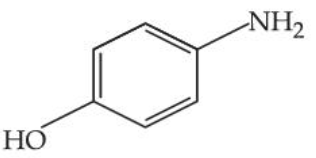
The reagent $$C_6H_5SO_2Cl$$ (benzenesulfonyl chloride). This reagent is commonly known as Hinsberg’s reagent. Let us state Hinsberg’s test in full because it is the key idea:
For a generic amine $$RNH_2$$ (primary), $$R_2NH$$ (secondary) or $$R_3N$$ (tertiary), the following behaviour is observed when the amine is treated with $$C_6H_5SO_2Cl$$ in the presence of aqueous or alcoholic $$KOH$$ and the product is subsequently subjected to acidification.
• For a primary amine: $$ RNH_2 + C_6H_5SO_2Cl \;\xrightarrow{KOH}\; C_6H_5SO_2NHR \; (\text{sulphonamide}) + HCl $$ The product retains one acidic hydrogen on nitrogen, therefore the sulphonamide is soluble in excess alkali as $$ C_6H_5SO_2NHR + KOH \rightarrow C_6H_5SO_2NR^-K^+ + H_2O. $$ Upon later acidification it precipitates again. Thus the sequence “dissolves in alkali, re-precipitates on acidification” is a sure sign of a primary amine.
• For a secondary amine: $$ R_2NH + C_6H_5SO_2Cl \;\xrightarrow{KOH}\; C_6H_5SO_2NR_2 + HCl $$ There is no acidic hydrogen left on nitrogen in the product, so the sulphonamide remains insoluble in the alkaline medium; it simply precipitates and stays precipitated. That behavior is characteristic of secondary amines.
• For a tertiary amine: $$ R_3N + C_6H_5SO_2Cl \;\text{(no reaction)} $$ The tertiary amine lacks an $$N-H$$ bond, so it does not attack Hinsberg’s reagent at all. The original amine remains unchanged and, being a free base, it dissolves in the acid layer on acidification instead of forming any sulphonamide. This “no reaction” outcome uniquely identifies a tertiary amine.
We therefore see that one single experiment with $$C_6H_5SO_2Cl$$ followed by appropriate treatment lets us distinguish all three classes in a clear, mutually exclusive fashion. None of the other three options provides this triple discrimination.
So, the reagent $$C_6H_5SO_2Cl$$—that is, the Hinsberg test—is the required choice.
Hence, the correct answer is Option 4.
In the reaction,
The product E is
Step 1: Diazotization (Formation of Intermediate D)
Step 2: Sandmeyer Reaction (Formation of Product E)
Reaction:
$$p\text{-}CH_3C_6H_4NH_2 \xrightarrow{NaNO_2/HCl, 0\text{--}5^\circ C} p\text{-}CH_3C_6H_4N_2^+Cl^- (D)$$
$$p\text{-}CH_3C_6H_4N_2^+Cl^- (D) \xrightarrow{CuCN/KCN, \Delta} p\text{-}CH_3C_6H_4CN (E) + N_2$$
The correct order of basicity is
Aliphatic amines are more basic than aromatic amines because the lone pair in aromatic amines is delocalized into the benzene ring via resonance.
$$p$$-methoxyaniline: The methoxy group ($$-OCH_3$$) exert a strong $$+M$$ (Mesomeric) effect. This highly increases basicity relative to aniline.
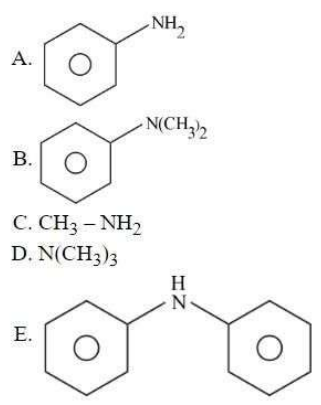
Aniline: It has no additional substituents. The lone pair is delocalized into the ring, making it less basic than aliphatic amines but more basic than those with withdrawing groups.
$$p$$-nitroaniline: The nitro group ($$-NO_2$$) is a powerful $$-M$$ and $$-I$$ group. This highly decreases basicity.
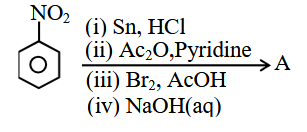
Thus, the increasing order of basicity is $$p\text{-nitroaniline} < \text{Aniline} < p\text{-methoxyaniline} < CH_3NH_2$$
Considering the basic strength of amines in an aqueous solution, which one has the smallest pK$$_b$$ value?
We begin by recalling the mathematical link between the equilibrium constant for basicity and the tabulated quantity pKb.
The definition is $$pK_b=-\log K_b\;,$$ so a smaller numerical value of $$pK_b$$ corresponds to a larger $$K_b$$ and therefore to a stronger base in water.
Now we examine the four amines.
First, let us write each structure clearly and note the factors that influence its basic strength:
1. Option A : $$(CH_3)_2NH$$ (dimethylamine, a secondary amine)
2. Option B : $$CH_3NH_2$$ (methylamine, a primary amine)
3. Option C : $$(CH_3)_3N$$ (trimethylamine, a tertiary amine)
4. Option D : $$C_6H_5NH_2$$ (aniline, an aryl primary amine)
Three main effects control basic strength in water:
(i) The +I (electron-donating inductive) effect of alkyl groups increases electron density on the nitrogen atom and makes proton acceptance easier.
(ii) Steric hindrance around the nitrogen may make solvation of the conjugate acid difficult; poorer solvation lowers the effective basicity in aqueous solution.
(iii) Resonance, if it withdraws the lone pair from nitrogen (as in aniline), decreases basicity.
Applying these points one by one:
• In aniline $$C_6H_5NH_2$$, the lone pair on nitrogen is partially delocalised into the benzene ring through resonance. This sharply decreases the availability of the pair for protonation, so aniline is the weakest base among the four.
• Between the three aliphatic amines, the inductive effect grows when we attach more methyl groups: two methyl groups in dimethylamine push more electron density than one in methylamine, and three in trimethylamine push the most.
• However, after protonation, the cation $$\left((CH_3)_3NH\right)^+$$ of trimethylamine is bulky. Water molecules find it hard to surround and stabilise this ion. Because solvation is poor, the net basicity of trimethylamine is lower than what its inductive effect alone would suggest.
• Dimethylamine $$ (CH_3)_2NH $$ strikes an optimal balance: it enjoys a strong +I effect from two methyl groups and, being less crowded than the tertiary cation, it is still very well solvated. Consequently its equilibrium constant $$K_b$$ is the largest, and hence its $$pK_b$$ is the smallest.
• Methylamine $$CH_3NH_2$$ has only one +I methyl group, so its electron donation and basicity are less than that of dimethylamine.
Putting the arguments together, the basic strength order in aqueous solution is
$$ (CH_3)_2NH \;>\; CH_3NH_2 \;>\; (CH_3)_3N \;>\; C_6H_5NH_2. $$
Translating this into pKb values (remember, smaller means stronger), we get
$$ pK_b\big((CH_3)_2NH\big) \;<\; pK_b\big(CH_3NH_2\big) \;<\; pK_b\big((CH_3)_3N\big) \;<\; pK_b\big(C_6H_5NH_2\big). $$
Therefore, the amine with the smallest pKb value is dimethylamine, shown in the list as $$(CH_3)NH$$ (Option A).
Hence, the correct answer is Option A.
Conversion of benzene diazonium chloride to chlorobenzene is an example of which of the following reactions?
The conversion of benzene diazonium chloride to chlorobenzene involves replacing the diazonium group (−N₂⁺Cl⁻) with a chlorine atom. The reaction is:
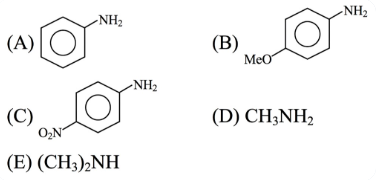
$$C_{6}H_{5}N_{2}Cl -> C_{6}H_{5}Cl + N_{2}$$
Now, let's examine each option:
Option A: Claisen reaction - This typically refers to condensation or rearrangement reactions involving carbonyl compounds, such as esters forming β-keto esters. It does not apply to diazonium salt conversions.
Option B: Friedel-Crafts reaction - This is an electrophilic aromatic substitution where halogens or alkyl groups are introduced using catalysts like AlCl₃. For example, benzene reacts with Cl₂/AlCl₃ to form chlorobenzene. However, here we start from benzene diazonium chloride, not benzene, so this is incorrect.
Option C: Sandmeyer reaction - This reaction specifically converts aryl diazonium salts to aryl halides using copper(I) halides. For chlorobenzene, benzene diazonium chloride reacts with CuCl:
$$C_{6}H_{5}N_{2}Cl + CuCl -> C_{6}H_{5}Cl + N_{2} + CuCl$$
This matches the given conversion exactly.
Option D: Wurtz reaction - This couples alkyl halides with sodium metal to form higher alkanes (e.g., 2CH₃Br + 2Na → CH₃CH₃ + 2NaBr). It does not involve diazonium salts.
Therefore, the conversion is a Sandmeyer reaction.
Hence, the correct answer is Option C.
The final product formed when methylamine is treated with NaNO$$_2$$ and HCl followed by hydrolysis is:
$$NaNO_2 + HCl \rightarrow HNO_2 + NaCl$$
$$CH_3NH_2 + HNO_2 \xrightarrow{HCl} [CH_3-N \equiv N]^+ Cl^-$$
$$[CH_3-N_2]^+ Cl^- + H_2O \rightarrow CH_3OH + N_2 \uparrow + HCl$$
Main Product: Methyl alcohol (Methanol)
By-products: Nitrogen gas ($$N_2$$) and Hydrochloric acid ($$HCl$$)
On heating an aliphatic primary amine with chloroform and ethanolic potassium hydroxide, the organic compound formed is:
We start by recalling that when a primary aliphatic amine is heated with chloroform $$\left(CHCl_3\right)$$ in the presence of strong alcoholic potassium hydroxide, a characteristic reaction known as the Carbylamine reaction (or isocyanide test) takes place. The overall transformation produces an isocyanide (also called an isonitrile).
The general chemical equation for this reaction is first stated:
$$RNH_2 + CHCl_3 + 3KOH \;(\text{alc}) \;\rightarrow\; RNC + 3KCl + 3H_2O$$
Here $$RNH_2$$ stands for any aliphatic primary amine. Now let us see every algebraic-type step that leads to this summary equation.
1. The alcoholic $$KOH$$ provides hydroxide ions. The first step is deprotonation of the amine:
$$RNH_2 + OH^- \;\rightarrow\; RNH^- + H_2O$$
2. Simultaneously, hydroxide removes one hydrogen from chloroform, generating the powerful base chloride ion and forming the intermediate dichlorocarbene $$:CCl_2$$:
$$CHCl_3 + OH^- \;\rightarrow\; CCl_3^- + H_2O$$
$$CCl_3^- \;\rightarrow\; :CCl_2 + Cl^-$$
3. The anion $$RNH^-$$ formed in step 1 attacks the electron-deficient dichlorocarbene:
$$RNH^- + :CCl_2 \;\rightarrow\; RNH\!-\!CCl_2$$
4. Repeated action of hydroxide ions now removes two chlorides and two protons step by step, giving potassium chloride and water each time, and finally furnishing the isocyanide:
$$RNH\!-\!CCl_2 + 2OH^- \;\rightarrow\; RNC + 2Cl^- + 2H_2O$$
5. Collecting all chloride ions as potassium chloride and summing water molecules from the previous elementary processes, we arrive again at the net equation already written:
$$\boxed{RNH_2 + CHCl_3 + 3KOH \;\rightarrow\; RNC + 3KCl + 3H_2O}$$
The organic product contains the functional group $$-NC$$, which identifies an isocyanide (alkyl isocyanide).
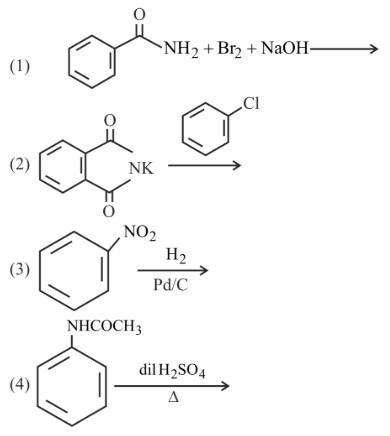
Therefore, among the given choices, the compound formed is an alkyl isocyanide.
Hence, the correct answer is Option D.
The major product of the reaction is:
Complete reduction of benzene-diazonium chloride with Zn/HCl gives:
We begin with benzene-diazonium chloride, whose formula is written as $$C_6H_5N_2Cl$$. In the reaction mixture we add metallic zinc in the presence of dilute hydrochloric acid, symbolised as $$Zn/HCl$$. Zinc is easily oxidised from $$Zn$$ to $$Zn^{2+}$$, and during this oxidation it releases electrons. Simultaneously, the acid furnishes protons $$H^+$$. The combination of electrons from zinc and protons from the acid produces what chemists call “nascent hydrogen”, often represented simply as $$[H]$$. Thus, overall, the pair $$Zn/HCl$$ behaves as a reducing agent, supplying hydrogen atoms to whatever group is capable of being reduced.
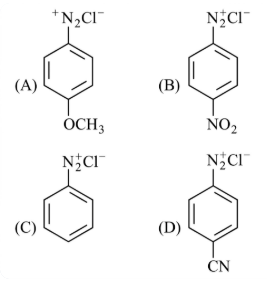
Now, a diazonium group $$-N_2^+$$ attached to an aromatic ring is a very good leaving group because molecular nitrogen $$N_2$$ is extremely stable. When nascent hydrogen attacks the diazonium cation, two elementary steps occur in sequence:
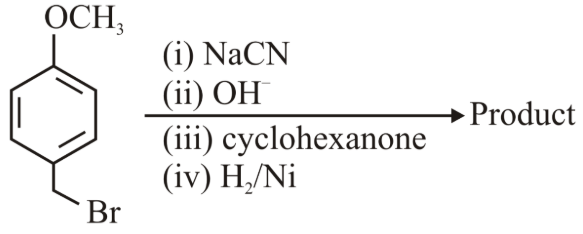
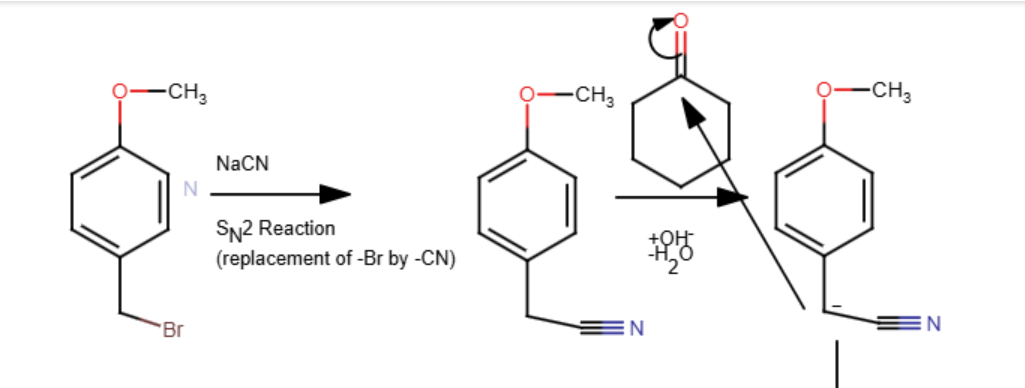
First, one hydrogen atom neutralises the positive charge on nitrogen, and molecular nitrogen departs:
$$C_6H_5N_2^+Cl^- + [H] \;\rightarrow\; C_6H_5\!-\!N(H)\!-\!N \;+\; Cl^-$$
Second, a second hydrogen atom cleaves the $$N\!-\!N$$ bond and attaches to the nitrogen still bonded to the ring, while the other nitrogen leaves as $$N_2$$ gas:
$$C_6H_5\!-\!N(H)\!-\!N + [H] \;\rightarrow\; C_6H_5NH_2 + N_2 \uparrow$$
Combining both elementary steps in one overall balanced equation we obtain
$$C_6H_5N_2Cl + 2[H] \;\rightarrow\; C_6H_5NH_2 + N_2 \uparrow + HCl$$
We see that the product attached to the benzene ring is $$C_6H_5NH_2$$, which is called aniline. No $$N\!-\!N$$ bond remains in the final product; instead we have converted the diazonium group completely into a primary amine group $$-NH_2$$. This fits the phrase “complete reduction of benzene-diazonium chloride”.
A brief check of the other choices confirms that phenylhydrazine $$C_6H_5NHNH_2$$, azobenzene $$C_6H_5N{=}NC_6H_5$$, and hydrazobenzene $$C_6H_5NHNH C_6H_5$$ all still contain an $$N\!-\!N$$ linkage, so they cannot be the fully reduced product under these conditions. Only aniline lacks that linkage and matches the reaction we have just derived.
Hence, the correct answer is Option A.
Aryl fluoride may be prepared from arene diazonium chloride using :
Aryl fluorides are compounds where a fluorine atom is directly bonded to an aromatic ring. They can be prepared from arene diazonium chloride (Ar-N₂⁺ Cl⁻) using specific reagents that replace the diazonium group (-N₂⁺) with fluorine.
Let's evaluate each option:
Option A: $$HBF_4/\Delta$$
This method is known as the Schiemann reaction. The arene diazonium chloride reacts with fluoroboric acid (HBF₄) to form arene diazonium fluoroborate. Upon heating (Δ), this salt decomposes to yield the aryl fluoride, boron trifluoride, and nitrogen gas. The reactions are:
Step 1: $$\text{Ar-N}_2^+ \text{Cl}^- + \text{HBF}_4 \rightarrow \text{Ar-N}_2^+ \text{BF}_4^- + \text{HCl}$$
Step 2: $$\text{Ar-N}_2^+ \text{BF}_4^- \rightarrow \text{Ar-F} + \text{BF}_3 + \text{N}_2$$
This is a standard and reliable method for preparing aryl fluorides.
Option B: $$HBF_4/\text{NaNO}_2, \text{Cu}, \Delta$$
Here, NaNO₂ is used for diazotization, but the starting material is already arene diazonium chloride, so diazotization is unnecessary. Adding copper (Cu) and heat (Δ) suggests a Sandmeyer-like reaction, but Sandmeyer is typically used for chlorine, bromine, or cyanide, not fluorine. Copper(I) fluoride is unstable and not suitable for fluorination. Moreover, HBF₄ is used in the Schiemann reaction without NaNO₂ or copper. Thus, this combination is incorrect for aryl fluoride synthesis.
Option C: $$\text{CuF}/\text{HF}$$
Copper(I) fluoride (CuF) is unstable and not commonly used in organic synthesis. HF alone can be hazardous and is typically used for hydrofluorination or in other contexts, but not for converting diazonium salts to aryl fluorides. There is no standard reaction using CuF/HF for this purpose.
Option D: $$\text{Cu}/\text{HF}\ 0$$
The "0" likely indicates a temperature of 0°C, but this combination is unclear. Copper metal (Cu) and hydrofluoric acid (HF) do not form a known reagent for replacing the diazonium group with fluorine. No standard method uses Cu/HF at any temperature for aryl fluoride preparation.
After evaluating all options, only Option A ($$HBF_4/\Delta$$) correctly describes the Schiemann reaction, which is a specific and effective method for preparing aryl fluorides from arene diazonium chloride.
Hence, the correct answer is Option A.
The order of basicity of amines in gaseous state is :
The order of basicity of amines in the gaseous state depends on the ability of the amine to donate its lone pair of electrons to accept a proton, forming a conjugate acid. In the gaseous state, solvent effects like solvation are absent, so the basicity is governed by the electronic effects of the alkyl groups attached to the nitrogen atom.
Amines are derivatives of ammonia (NH₃), where hydrogen atoms are replaced by alkyl groups. Alkyl groups are electron-donating due to the +I effect (inductive effect) and hyperconjugation, which increase the electron density on the nitrogen atom. This makes the lone pair more available for donation, enhancing basicity. Additionally, the stability of the conjugate acid (formed when the amine accepts a proton) is crucial. More alkyl groups provide greater stabilization of the positive charge on the conjugate acid through hyperconjugation and the +I effect.
Consider the conjugate acids:
- Ammonia (NH₃) accepts a proton to form NH₄⁺, which has no alkyl groups and thus no additional stabilization.
- A primary amine (1°) like RNH₂ accepts a proton to form RNH₃⁺, stabilized by one alkyl group.
- A secondary amine (2°) like R₂NH accepts a proton to form R₂NH₂⁺, stabilized by two alkyl groups.
- A tertiary amine (3°) like R₃N accepts a proton to form R₃NH⁺, stabilized by three alkyl groups.
Therefore, the stability of the conjugate acid increases with the number of alkyl groups, leading to higher basicity. The order should be tertiary amine > secondary amine > primary amine > ammonia.
Experimental data from proton affinity measurements in the gas phase confirms this order:
- Ammonia (NH₃): approximately 204 kcal/mol
- Methylamine (primary, CH₃NH₂): approximately 215 kcal/mol
- Dimethylamine (secondary, (CH₃)₂NH): approximately 222 kcal/mol
- Trimethylamine (tertiary, (CH₃)₃N): approximately 225 kcal/mol
Thus, the proton affinity order is tertiary amine > secondary amine > primary amine > ammonia, which directly corresponds to basicity order in the gaseous state.
Now, evaluating the options:
- Option A: $$1° > 2° > 3° > NH_3$$ — Incorrect, as primary amine is not stronger than secondary or tertiary.
- Option B: $$3° > 2° > NH_3 > 1°$$ — Incorrect, as ammonia is not stronger than primary amine.
- Option C: $$3° > 2° > 1° > NH_3$$ — Correct, matches the expected order.
- Option D: $$NH_3 > 1° > 2° > 3°$$ — Incorrect, as ammonia is the weakest base.
Hence, the correct answer is Option C.
Carbylamine forms from aliphatic or aromatic primary amine via which of the following intermediates?
The carbylamine reaction, also known as the isocyanide test, is used to detect primary amines (both aliphatic and aromatic). The reaction involves heating a primary amine with chloroform (CHCl₃) and a strong base like potassium hydroxide (KOH). The overall reaction is:
$$ R-NH_2 + CHCl_3 + 3KOH \rightarrow R-NC + 3KCl + 3H_2O $$Here, R can be an alkyl or aryl group, and R-NC is the carbylamine (isocyanide). To determine the intermediate, we need to understand the mechanism step by step.
First, the base (OH⁻ from KOH) reacts with chloroform. Chloroform has three chlorine atoms, making the C-H bond acidic due to the electron-withdrawing effect of the chlorines. The base deprotonates chloroform:
$$ CHCl_3 + OH^- \rightarrow CCl_3^- + H_2O $$The trichloromethanide ion (CCl₃⁻) formed is unstable and undergoes alpha-elimination. This means it loses a chloride ion (Cl⁻) to form dichlorocarbene (:CCl₂), a neutral species with a divalent carbon atom:
$$ CCl_3^- \rightarrow :CCl_2 + Cl^- $$So, the net reaction for carbene formation is:
$$ CHCl_3 + OH^- \rightarrow :CCl_2 + Cl^- + H_2O $$Note that this step requires one equivalent of base. In the overall reaction, three equivalents are used because additional steps consume more base.
Next, the primary amine (RNH₂) is deprotonated by another equivalent of base to form the amide ion (RNH⁻):
$$ RNH_2 + OH^- \rightarrow RNH^- + H_2O $$The amide ion (RNH⁻) acts as a nucleophile and attacks the electrophilic carbene intermediate (:CCl₂). Carbenes are electron-deficient and highly reactive, so they readily accept electrons. This forms a new carbon-nitrogen bond:
$$ RNH^- + :CCl_2 \rightarrow [RNH-CCl_2]^- $$The intermediate [RNH-CCl₂]⁻ is a carbanion because the carbon atom (originally from the carbene) has three bonds (one to N and two to Cl) and a negative charge. However, this carbanion is unstable and quickly loses a chloride ion to form a neutral dichloroamine:
$$ [RNH-CCl_2]^- \rightarrow RN=CCl_2 + Cl^- $$The dichloroamine (RN=CCl₂) is still unstable under the basic conditions. It undergoes dehydrohalogenation (loss of HCl) facilitated by another equivalent of base. The base deprotonates the nitrogen, forming an anion that eliminates chloride:
$$ RN=CCl_2 + OH^- \rightarrow [RN-CCl_2]^- + H_2O \quad \text{(deprotonation)} $$ $$ [RN-CCl_2]^- \rightarrow R-NC + Cl^- \quad \text{(elimination)} $$Alternatively, RN=CCl₂ can directly lose HCl to form the isocyanide, but the base assists in the removal of the proton.
The key point is that the reaction proceeds through the dichlorocarbene (:CCl₂) intermediate, which is a type of carbene. Carbenes are neutral, divalent carbon species with two unshared electrons. They are highly reactive intermediates in organic reactions.
Now, evaluating the options:
- A. Carbanion: While a carbanion ([RNH-CCl₂]⁻) appears later in the mechanism, it is not the primary intermediate responsible for initiating the reaction with the amine. The carbene is formed first and is essential for the reaction.
- B. Carbene: This is the intermediate formed from chloroform and base, and it directly reacts with the amine. It is the characteristic intermediate of the carbylamine reaction.
- C. Carbocation: A carbocation has a positive charge and is not involved in this reaction. The mechanism does not generate any carbocation.
- D. Carbon radical: Radicals have unpaired electrons and are not part of this mechanism, which proceeds via ionic and concerted steps.
Therefore, the intermediate via which carbylamine forms is carbene.
Hence, the correct answer is Option B.
An organic compound A upon reacting with $$NH_3$$ gives B. On heating, B gives C. C in presence of KOH reacts with $$Br_2$$ to give $$CH_3CH_2NH_2$$. A is :
The final step involves reacting C with $$Br_2/KOH$$ to produce $$CH_3CH_2NH_2$$ (ethylamine). This is the characteristic Hofmann Bromamide Degradation reaction, which converts an amide into a primary amine with one fewer carbon atom.
Since the product is $$CH_3CH_2NH_2$$ (2 carbons), the starting amide C must have 3 carbons. Therefore, C is Propanamide: $$CH_3CH_2CONH_2$$.
The problem states that heating B gives C ($$CH_3CH_2CONH_2$$). Amides are typically formed by heating ammonium salts of carboxylic acids. Thus, B is the ammonium salt: $$CH_3CH_2COONH_4$$ (Ammonium propionate).
The compound A reacts with $$NH_3$$ to give B ($$CH_3CH_2COONH_4$$). Carboxylic acids react with ammonia to form ammonium salts. To form a 3-carbon ammonium salt, the starting acid A must be Propanoic acid.
A = $$CH_3CH_2COOH$$.
Complete Reaction Sequence:
- $$CH_3CH_2COOH \xrightarrow{NH_3} CH_3CH_2COONH_4$$ (Compound A to B)
- $$CH_3CH_2COONH_4 \xrightarrow{\Delta} CH_3CH_2CONH_2 + H_2O$$ (Compound B to C)
- $$CH_3CH_2CONH_2 \xrightarrow{Br_2/KOH} CH_3CH_2NH_2$$ (Hofmann Bromamide Degradation)
In the following compounds:
the order of basicity is as follows

The order of basicity of the compounds is
The most basic compound among the following is
$$\text{C}_2\text{H}_5\text{Br} \xrightarrow{\text{AgCN}} X \xrightarrow[\text{Zn-Hg/HCl}]{\text{Reduction}} Y$$. Here Y is
The conversion of benzene diazonium chloride to bromobenzene can be accomplished by
In the chemical reactions shown below, the compounds 'A' and 'B' respectively are
Toluene is nitrated and the resulting product is reduced with tin and hydrochloric acid. The product so obtained is diazotised and then heated with cuprous bromide. The reaction mixture so formed contains
In the chemical reaction, $$CH_3 CH_2 NH_2 - CHCl_3 + 3KOH \longrightarrow (A) + (B) + 3H_2 O$$, the compound (A) and (B) are respectively
Which one of the following is the strongest base in aqueous solution?
Which one of the following methods is neither meant for the synthesis nor for separation of amines?
Amongst the following the most basic compound is
Which of the following is the strongest base?