
Join Our JEE Preparation Group
Prep with like-minded aspirants; Get access to free daily tests and study material.
Sign in
Please select an account to continue using cracku.in
↓ →
Join Our JEE Preparation Group
Prep with like-minded aspirants; Get access to free daily tests and study material.
The Gabriel phthalimide reaction is based on the bimolecular nucleophilic substitution mechanism, usually abbreviated as $$\mathrm{S_N2}$$. The classical sequence is:
$$\text{Phthalimide} + \text{KOH} \;\longrightarrow\; \text{Potassium phthalimide (a strong nucleophile)}$$
$$\text{Potassium phthalimide} + \text{R-X} \;\xrightarrow{\mathrm{S_N2}}\; \text{N-alkylphthalimide} + \text{KX}$$
$$\text{N-alkylphthalimide} + \text{H}_2\text{O}/\text{OH}^- \;\longrightarrow\; \text{RNH}_2 + \text{Phthalic acid (or its salt)}$$
Here, $$\text{R-X}$$ must be a halide that undergoes an $$\mathrm{S_N2}$$ reaction. The key theoretical point is that $$\mathrm{S_N2}$$ reactions proceed fastest with unhindered primary alkyl halides, proceed slowly with secondary halides, and are practically blocked with tertiary or highly branched halides. Therefore:
• If $$\text{R-X}$$ is derived from a simple straight-chain primary halide, the reaction is smooth and the corresponding primary amine $$\text{RNH}_2$$ is obtained in good yield.
• If $$\text{R-X}$$ is tertiary or even a very hindered primary halide (such as neopentyl bromide), the backside attack required for $$\mathrm{S_N2}$$ substitution is sterically impeded, so the reaction fails or proceeds extremely slowly.
Now we examine each option in the light of the above mechanistic requirement.
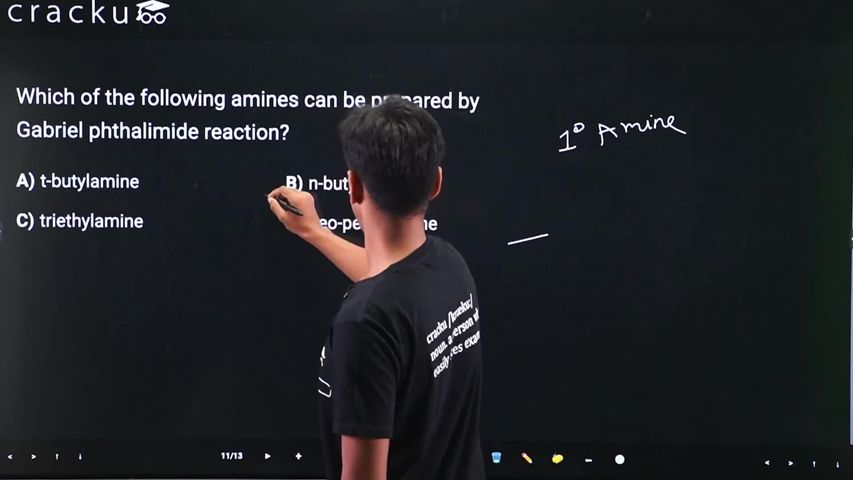
Option A: $$\text{t-butylamine}$$ would have to be obtained from t-butyl halide $$\big(\text{(CH}_3)_3\text{C-X}\big)$$. This halide is tertiary, and tertiary halides do not undergo $$\mathrm{S_N2}$$ reactions. So Gabriel synthesis cannot produce t-butylamine.
Option B: $$\text{n-butylamine}$$ comes from n-butyl halide $$\big(\text{CH}_3\text{CH}_2\text{CH}_2\text{CH}_2\text{-X}\big)$$, a straight-chain primary alkyl halide. Such a substrate is ideal for $$\mathrm{S_N2}$$ attack by potassium phthalimide, so n-butylamine can be prepared readily by the Gabriel method.
Option C: $$\text{triethylamine}$$ is a tertiary amine with three ethyl groups on nitrogen. The Gabriel pathway inherently generates only primary amines, because the nitrogen in phthalimide can accept only one alkyl group. Therefore triethylamine cannot be formed.
Option D: $$\text{neo-pentylamine}$$ would originate from neo-pentyl halide $$\big(\text{(CH}_3)_3\text{CCH}_2\text{-X}\big)$$. Although formally primary, the halide carbon is flanked by a bulky tert-butyl group, making the backside $$\mathrm{S_N2}$$ approach extremely difficult. Hence this halide is also unsuitable for the Gabriel reaction, and neo-pentylamine cannot be prepared.
Among the four choices, only the straight-chain primary amine, n-butylamine, satisfies the mechanistic requirements of the Gabriel phthalimide synthesis.
Hence, the correct answer is Option 2.
Was this solution helpful?
Click on the Email ☝️ to Watch the Video Solution
Create a FREE account and get:
_1.webp)

Educational materials for JEE preparation

Ask our AI anything

AI can make mistakes. Please verify important information.
AI can make mistakes. Please verify important information.
