
Join Our JEE Preparation Group
Prep with like-minded aspirants; Get access to free daily tests and study material.
Sign in
Please select an account to continue using cracku.in
↓ →
Join Our JEE Preparation Group
Prep with like-minded aspirants; Get access to free daily tests and study material.
We recall that the basic strength of an amine depends on the ease with which the lone-pair on the nitrogen atom can be donated to a proton. A larger electron density on nitrogen (because of electron-releasing groups) makes the donation easier and therefore increases the basic strength.
We also know the qualitative order given by inductive effect in the gas phase: each additional alkyl group exerts a $$+I$$ (electron-donating) effect. Hence, in the gas phase, the order is usually
tertiary amine $$\; > \;$$ secondary amine $$\; > \;$$ primary amine $$\; > \; NH_3.$$
However, in aqueous solution the picture is slightly modified because after accepting a proton, the conjugate acid $$RNH_3^+$$ has to be stabilised (solvated) by water. The solvation is best when the cation can make many hydrogen bonds with water. A bulky tertiary amine’s conjugate acid is less solvated, while a secondary amine’s conjugate acid is still quite well solvated. Experimental measurements therefore show the aqueous-phase order
secondary amine $$\; > \;$$ primary amine $$\; > \; NH_3 \; ($$ and usually tertiary comes next $$).$$
In the present question our three bases are
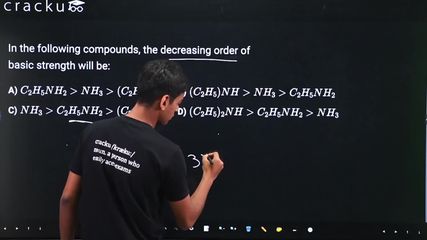
$$NH_3,$$ $$C_2H_5NH_2 \; (\text{a primary amine}),$$ $$(C_2H_5)_2NH \; (\text{a secondary amine}).$$
Comparing them step by step:
(i) Between $$NH_3$$ and $$C_2H_5NH_2$$: the ethyl group $$C_2H_5-$$ is an electron-releasing group by the $$+I$$ effect, so it pushes electron density toward nitrogen. Therefore
$$C_2H_5NH_2 \; > \; NH_3.$$
(ii) Between $$C_2H_5NH_2$$ and $$(C_2H_5)_2NH$$: the secondary amine has two ethyl groups, so the electron-donating effect is roughly doubled. Its conjugate acid $$[(C_2H_5)_2NH_2]^+$$ is still well solvated because only one hydrogen on nitrogen is replaced by an alkyl group. Consequently
$$(C_2H_5)_2NH \; > \; C_2H_5NH_2.$$
(iii) Finally, combining (i) and (ii) we get the complete decreasing order
$$(C_2H_5)_2NH \; > \; C_2H_5NH_2 \; > \; NH_3.$$
Now we examine the given options. Option D is written exactly as
$$(C_2H_5)_2NH > C_2H_5NH_2 > NH_3,$$
which matches our derived order.
Hence, the correct answer is Option D.
Was this solution helpful?
Click on the Email ☝️ to Watch the Video Solution
Create a FREE account and get:
_1.webp)

Educational materials for JEE preparation

Ask our AI anything

AI can make mistakes. Please verify important information.
AI can make mistakes. Please verify important information.
