Join WhatsApp Icon JEE WhatsApp Group
Question 64

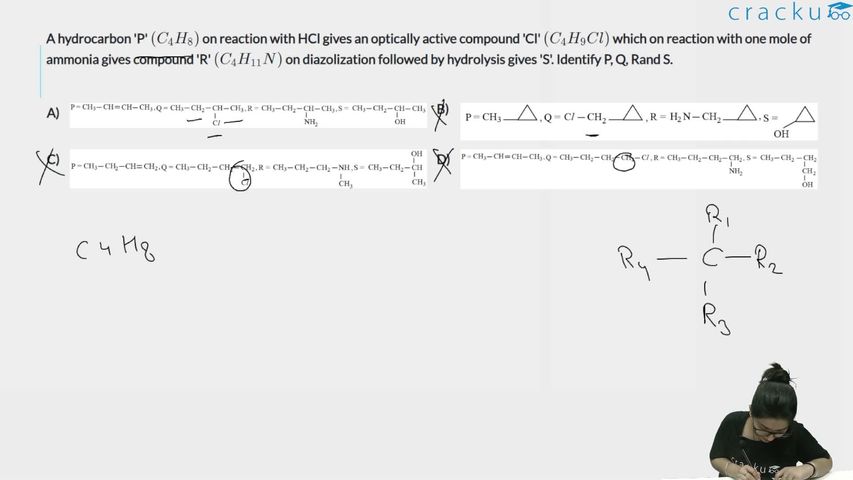
A hydrocarbon 'P' $$(C_{4}H_{8})$$ on reaction with HCl gives an optically active compound 'Cl' $$(C_{4}H_{9}Cl)$$ which on reaction with one mole of ammonia gives compound 'R' $$(C_{4}H_{11}N)$$ on diazolization followed by hydrolysis gives 'S'. Identify P, Q, Rand S.
image


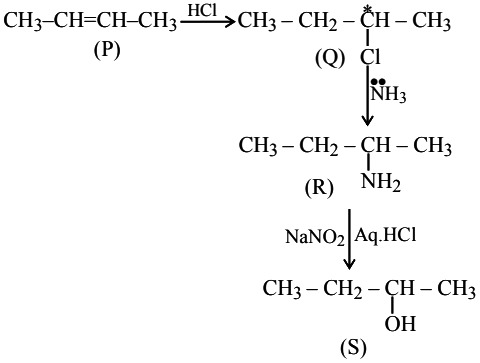
Step 1: Identify P and Q

  • P ($$C_4H_8$$) is an alkene.
  • Reaction with HCl is an electrophilic addition. The product Q ($$C_4H_9Cl$$) is an alkyl chloride.
  • The Clue: Q is optically active. This means Q must have a chiral center (a carbon bonded to four different groups).
  • If P were But-1-ene or But-2-ene, addition of HCl would yield 2-chlorobutane.
    • $$CH_3-CH_2-CHCl-CH_3$$ (2-chlorobutane) has a chiral center at $$C_2$$.
    • If P were Isobutylene, it would form tert-butyl chloride, which is achiral.
  • Therefore, Q is 2-chlorobutane.

Step 2: Identify R

  • Q reacts with one mole of Ammonia ($$NH_3$$). This is a nucleophilic substitution ($$S_N2/S_N1$$).
  • The chlorine atom is replaced by an amino group ($$-NH_2$$).
  • R ($$C_4H_{11}N$$) is butan-2-amine: $$CH_3-CH_2-CH(NH_2)-CH_3$$.

Step 3: Identify S

  • R undergoes diazotization ($$NaNO_2 + HCl$$), which converts the primary aliphatic amine into an unstable diazonium salt.
  • Subsequent hydrolysis (reaction with water) replaces the diazonium group with a hydroxyl group ($$-OH$$), releasing nitrogen gas.
  • S is butan-2-ol: $$CH_3-CH_2-CH(OH)-CH_3$$.


Get AI Help

Video Solution

video

Create a FREE account and get:

  • Free JEE Mains Previous Papers PDF
  • Take JEE Mains paper tests

50,000+ JEE Students Trusted Our Score Calculator

Predict your JEE Main percentile, rank & performance in seconds

Ask AI

Ask our AI anything

AI can make mistakes. Please verify important information.