JEE WhatsApp Group
Sign in
Please select an account to continue using cracku.in
↓ →
JEE WhatsApp Group

Join Our JEE Preparation Group
Prep with like-minded aspirants; Get access to free daily tests and study material.
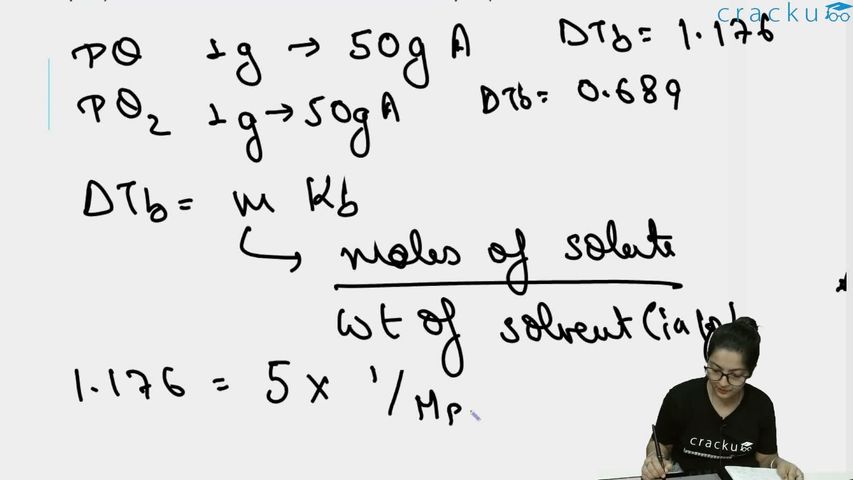
Elements P and Q form two types of non-volatile, non-ionizable compounds PQ and $$PQ_{2}$$. When 1g of PQ is dissolved in 50 g of solvent ''A', $$\Delta T_{b}$$was 1.176 K while when 1 g of $$PQ_{2}$$ is dissolved in 50g of solvent 'A'.$$\Delta T_{b}$$ was 0.689 K ($$K_{b}$$ of 'A' =5K kg $$mol^{-1}$$) The molar masses of elements P and Q (in g $$mol^{-1}$$ ) respectively, are:
Elements P and Q form compounds PQ and PQ₂. We need to find their molar masses from boiling point elevation data.
$$ \Delta T_b = K_b \times m = K_b \times \frac{\text{mass of solute}/M}{\text{mass of solvent (in kg)}} $$
$$ 1.176 = 5 \times \frac{1/M_{PQ}}{0.050} = \frac{5}{0.050 \times M_{PQ}} = \frac{100}{M_{PQ}} $$
$$ M_{PQ} = \frac{100}{1.176} \approx 85 \text{ g/mol} $$
$$ 0.689 = 5 \times \frac{1/M_{PQ_2}}{0.050} = \frac{100}{M_{PQ_2}} $$
$$ M_{PQ_2} = \frac{100}{0.689} \approx 145 \text{ g/mol} $$
$$M_{PQ} = P + Q = 85$$ ... (i)
$$M_{PQ_2} = P + 2Q = 145$$ ... (ii)
Subtracting (i) from (ii): $$Q = 60$$ g/mol
Substituting back: $$P = 85 - 60 = 25$$ g/mol
The correct answer is Option (3): P = 25, Q = 60.
Click on the Email ☝️ to Watch the Video Solution
Create a FREE account and get:
_1.webp)

Educational materials for JEE preparation

Ask our AI anything

AI can make mistakes. Please verify important information.
AI can make mistakes. Please verify important information.