
Join Our JEE Preparation Group
Prep with like-minded aspirants; Get access to free daily tests and study material.
Sign in
Please select an account to continue using cracku.in
↓ →
Join Our JEE Preparation Group
Prep with like-minded aspirants; Get access to free daily tests and study material.
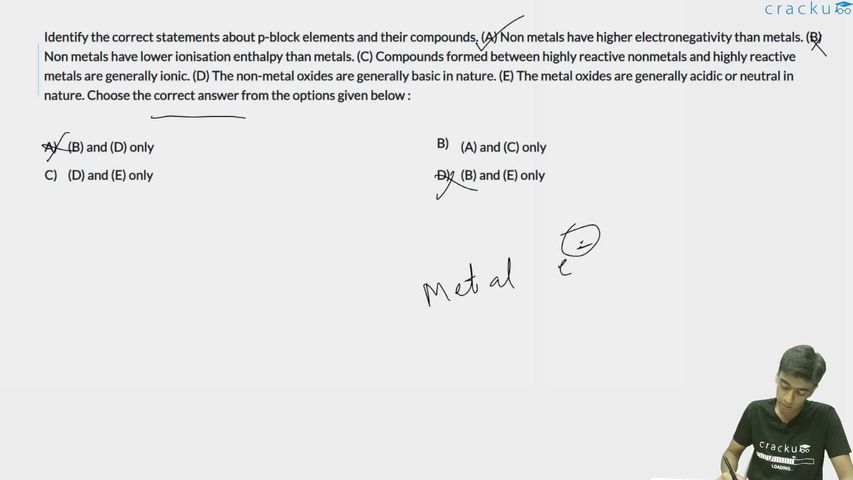
Identify the correct statements about p-block elements and their compounds. (A) Non metals have higher electronegativity than metals. (B) Non metals have lower ionisation enthalpy than metals. (C) Compounds formed between highly reactive nonmetals and highly reactive metals are generally ionic. (D) The non-metal oxides are generally basic in nature. (E) The metal oxides are generally acidic or neutral in nature. Choose the correct answer from the options given below :
We need to identify the correct statements about p-block elements and their compounds from the given list.
Analysis of each statement:
(A) Non-metals have higher electronegativity than metals.
This is TRUE. Electronegativity is the tendency of an atom to attract shared electrons towards itself. Non-metals, being on the right side of the periodic table, have higher electronegativity because they need fewer electrons to complete their octet and have smaller atomic sizes.
(B) Non-metals have lower ionisation enthalpy than metals.
This is FALSE. Non-metals generally have higher ionisation enthalpy than metals. Non-metals hold their electrons more tightly due to their smaller atomic size and higher effective nuclear charge, making it harder to remove an electron.
(C) Compounds formed between highly reactive non-metals and highly reactive metals are generally ionic.
This is TRUE. Highly reactive metals (like Na, K) have very low ionisation enthalpies and readily lose electrons, while highly reactive non-metals (like F, Cl) have high electron affinity and readily gain electrons. The large electronegativity difference between them leads to the formation of ionic bonds through complete transfer of electrons.
(D) The non-metal oxides are generally basic in nature.
This is FALSE. Non-metal oxides are generally acidic in nature. For example, $$CO_2$$ forms carbonic acid, $$SO_3$$ forms sulphuric acid, $$P_4O_{10}$$ forms phosphoric acid when dissolved in water.
(E) The metal oxides are generally acidic or neutral in nature.
This is FALSE. Metal oxides are generally basic in nature. For example, $$Na_2O$$, $$CaO$$, $$MgO$$ are all basic oxides that form hydroxides when dissolved in water.
The correct statements are (A) and (C) only.
The correct answer is Option (2): (A) and (C) only.
Was this solution helpful?
Click on the Email ☝️ to Watch the Video Solution
Create a FREE account and get:
_1.webp)

Educational materials for JEE preparation

Ask our AI anything

AI can make mistakes. Please verify important information.
AI can make mistakes. Please verify important information.
