
Join Our JEE Preparation Group
Prep with like-minded aspirants; Get access to free daily tests and study material.
Sign in
Please select an account to continue using cracku.in
↓ →
Join Our JEE Preparation Group
Prep with like-minded aspirants; Get access to free daily tests and study material.
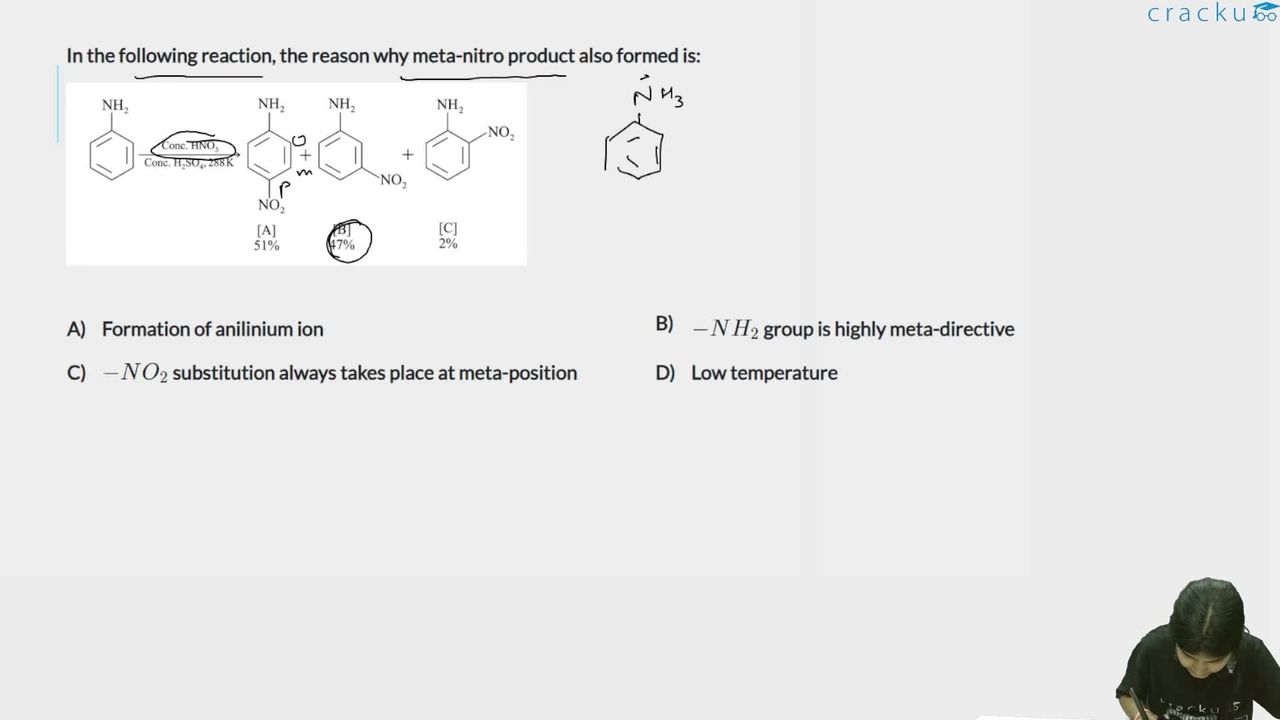
In the following reaction, the reason why meta-nitro product also formed is:
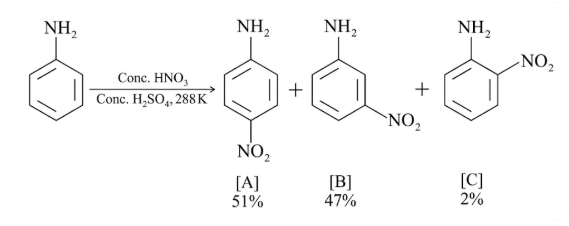
The formation of such a large amount of the meta-nitro product is due to the strongly acidic conditions used during the nitration process. Under normal circumstances, the amine group attached to the benzene ring is a powerful activating group. Because the nitrogen atom has a lone pair of electrons, it pushes those electrons into the ring through resonance, which naturally directs any incoming electrophiles, like the nitro group, to the ortho and para positions. This is why you still see a significant amount of the para product forming in the reaction mixture, as a portion of the molecules react in their standard state.
However, the reagents used for this nitration, concentrated nitric acid and concentrated sulfuric acid, create an intensely acidic environment. Because the amine group on the aniline molecule is basic, it rapidly reacts with the abundant protons in this acidic mixture. This acid-base reaction protonates the amine group, converting it into an anilinium ion. This transformation is the crucial key to the puzzle because the nitrogen atom now holds a positive charge and no longer has a free lone pair of electrons to donate to the benzene ring.
Once converted into the anilinium ion, the functional group entirely changes its chemical personality. Instead of pushing electrons into the ring, the positively charged nitrogen acts as a strong electron-withdrawing group, pulling electron density away from the benzene ring through the inductive effect. Electron-withdrawing groups inherently deactivate the ortho and para positions much more heavily than the meta position. Consequently, the anilinium ions in the mixture direct the incoming nitro groups almost exclusively to the meta position, which perfectly explains why you end up with a massive forty-seven percent yield of the meta-nitroaniline product alongside the expected para product.
Thus the right answer is the formation of anilinium ion, which is option A.
Was this solution helpful?
Click on the Email ☝️ to Watch the Video Solution
Create a FREE account and get:
_1.webp)

Educational materials for JEE preparation

Ask our AI anything

AI can make mistakes. Please verify important information.
AI can make mistakes. Please verify important information.


