Group
Group
 Group
Group

JEE Periodic Table & Periodicity PYQ
Periodic Table & Periodicity is an important chapter in JEE Chemistry. It helps you understand how the properties of elements change across periods and down groups in the periodic table. These trends are based on electronic configuration, effective nuclear charge, shielding effect, and atomic size. In this chapter, you study atomic radius, ionic radius, ionisation enthalpy, electron gain enthalpy, electronegativity, valency, metallic character, and periodic trends. These ideas are also useful in chemical bonding, coordination chemistry, p-block chemistry, and inorganic chemistry. That is why an understanding of this chapter is important for later topics as well. Most questions from Periodic Table & Periodicity are based on comparing properties, arranging elements in the correct order, identifying exceptions, and using electronic configuration. The calculations are usually limited, but a small mistake in group position, shell number, or trend can change the final answer. Solving previous-year questions helps you understand question patterns. It also improves your speed and makes trend-based questions easier to solve.
On this page, you can revise the key concepts, download the PYQ PDF, learn important formulas and trends, avoid common mistakes, and practise chapter-wise questions.
With regular practice, Periodic Table & Periodicity can become an easy and scoring chapter in JEE Chemistry.
JEE Periodic Table & Periodicity Previous-Year Questions
Previous-year questions help you understand which concepts are asked most often. In this chapter, questions commonly come from atomic size, ionisation enthalpy, electron gain enthalpy, electronegativity, effective nuclear charge, shielding, and electronic configuration.
While solving JEE Advanced PYQ, first identify the period, group, and electronic configuration of the elements being compared.
Across a period, effective nuclear charge generally increases.
Down a group, the number of electron shells increases.
These two ideas explain many important periodic trends.
Atomic radius generally decreases from left to right across a period and increases down a group.
Ionisation enthalpy generally increases across a period and decreases down a group.
For trend-based questions, do not apply a rule blindly.
There are important exceptions caused by extra stability of completely filled and half-filled subshells, differences in atomic size, and electron-electron repulsion.
For example, the first ionisation enthalpy of nitrogen is higher than oxygen because nitrogen has a stable half-filled 2p³ configuration. Similarly, beryllium has a higher first ionisation enthalpy than boron.
Electron gain enthalpy also shows exceptions. Chlorine has a more negative electron gain enthalpy than fluorine because the small size of fluorine increases repulsion in its compact 2p subshell.
Try to solve each question within a fixed time. After completing the set, check every wrong answer and find the exact reason behind the mistake.
Common reasons may include:
- You followed a general trend without checking an exception.
- You confused atomic radius with ionic radius.
- You ignored electronic configuration.
- You compared elements from different periods incorrectly.
- You forgot the effect of effective nuclear charge.
Keeping a short list of trends and major exceptions can make these questions much easier.
JEE Periodic Table & Periodicity PYQs PDF
You can download the JEE Periodic Table & Periodicity PYQs PDF from the section below.
First, solve the PDF without looking at the answers. Try to complete it in one sitting so that you can understand your current speed and accuracy.
After solving the questions, divide them into three groups:
- Questions you solved easily
- Questions that took more time
- Questions you could not solve
Revise the periodic trend or exception used in the difficult questions. Try those questions again after a few days.
While practising these JEE Periodic Table & Periodicity Questions, do not only compare the final answer with the solution.
Check the group, period, valence-shell configuration, number of shells, effective nuclear charge, and relevant exception.
When comparing isoelectronic species, remember that the species with the greater nuclear charge has the smaller radius.
For example, among O²⁻, F⁻, Na⁺, and Mg²⁺, all species have ten electrons. Their size decreases as nuclear charge increases.
For ionisation enthalpy questions, first check the electronic configuration.
Removing an electron from a stable filled or half-filled subshell may require more energy than a simple periodic trend suggests.
For electronegativity, remember that it generally increases across a period and decreases down a group.
Noble gases are usually not included in simple electronegativity comparisons.
When you solve the PDF again, focus on the questions that were incorrect or took too much time.
Important Formulas and Trends for JEE Periodic Table PYQs
Periodic Table and Periodicity questions are mainly based on periodic trends, electronic configurations and important exceptions. The following table summarises the most useful formulas and rules for quick revision.
| Concept | Formula or Trend | Simple Explanation |
|---|---|---|
| Effective Nuclear Charge | $$Z_{\mathrm{eff}}=Z-S$$ | Z is the atomic number, while S is the shielding constant. |
| Atomic Radius Across a Period | $$\mathrm{Atomic\ Radius\ Decreases\ from\ Left\ to\ Right}$$ | Effective nuclear charge increases across a period. |
| Atomic Radius Down a Group | $$\mathrm{Atomic\ Radius\ Increases\ from\ Top\ to\ Bottom}$$ | A new electron shell is added down the group. |
| Ionic Radius | $$\mathrm{Cation<Neutral\ Atom<Anion}$$ | Electron loss reduces size, while electron gain increases it. |
| Isoelectronic Species | $$\mathrm{Higher\ Nuclear\ Charge\Rightarrow Smaller\ Radius}$$ | More protons attract the same number of electrons more strongly. |
| Ionisation Enthalpy Across a Period | $$\mathrm{Ionisation\ Enthalpy\ Increases\ from\ Left\ to\ Right}$$ | Removing an electron generally becomes more difficult. |
| Ionisation Enthalpy Down a Group | $$\mathrm{Ionisation\ Enthalpy\ Decreases\ from\ Top\ to\ Bottom}$$ | Atomic size and shielding increase down the group. |
| Successive Ionisation Enthalpies | $$\mathrm{IE_1<IE_2<IE_3<\cdots}$$ | Each successive electron requires more energy to remove. |
| Electron Gain Enthalpy Across a Period | $$\mathrm{\Delta_{\mathrm{eg}}H\ Generally\ Becomes\ More\ Negative}$$ | Attraction for an incoming electron generally increases. |
| Electron Gain Enthalpy Down a Group | $$\mathrm{\Delta_{\mathrm{eg}}H\ Generally\ Becomes\ Less\ Negative}$$ | Greater atomic size reduces attraction for an added electron. |
| Electronegativity Across a Period | $$\mathrm{Electronegativity\ Increases\ from\ Left\ to\ Right}$$ | The attraction for bonding electrons increases. |
| Electronegativity Down a Group | $$\mathrm{Electronegativity\ Decreases\ from\ Top\ to\ Bottom}$$ | Atomic size and shielding increase. |
| Metallic Character Across a Period | $$\mathrm{Metallic\ Character\ Decreases\ from\ Left\ to\ Right}$$ | The tendency to lose electrons decreases. |
| Metallic Character Down a Group | $$\mathrm{Metallic\ Character\ Increases\ from\ Top\ to\ Bottom}$$ | Electron loss becomes easier down the group. |
| Valency Across a Period | $$1\rightarrow2\rightarrow3\rightarrow4\rightarrow3\rightarrow2\rightarrow1\rightarrow0$$ | Valency first increases and then decreases. |
These periodic trends are general and may have exceptions due to half-filled or completely filled subshells. For example, the first ionisation enthalpy of magnesium is higher than that of aluminium because magnesium has a stable filled 3s subshell. Similarly, nitrogen has a higher first ionisation enthalpy than oxygen because nitrogen has a stable half-filled 2p subshell.
Before applying a trend, identify the element’s group, period, valence-shell configuration and any important electronic-configuration exceptions.
Common Mistakes to Avoid in JEE Periodic Table & Periodicity PYQs
One common mistake is assuming that every periodic trend is perfectly regular.
General trends are useful, but JEE questions often test important exceptions.
Students also confuse atomic radius, covalent radius, van der Waals radius, and ionic radius.
Remember that a cation is usually smaller than its parent atom, while an anion is usually larger than its parent atom.
While solving JEE Periodic Table & Periodicity Questions, do not compare elements only by their position in the table.
Write the valence-shell electronic configuration when unclear.
Another common mistake is assuming that fluorine has the most negative electron gain enthalpy.
Chlorine has a more negative electron gain enthalpy than fluorine because the added electron experiences greater repulsion in fluorine's compact 2p orbital.
Students may also assume that oxygen has a higher first ionisation enthalpy than nitrogen because oxygen is placed to the right.
Nitrogen actually has a higher value due to the extra stability of its half-filled 2p³ configuration.
While comparing isoelectronic ions, students sometimes focus on charge signs instead of nuclear charge.
For isoelectronic species, a higher number of protons means a smaller radius.
Another mistake is treating electronegativity and electron gain enthalpy as the same property.
Electronegativity describes attraction for shared electrons in a bond, while electron gain enthalpy refers to the enthalpy change when an isolated gaseous atom gains an electron.
Before finalising your answer, check the electronic configuration, periodic table position, relevant trend, and possible exception once more.
List of JEE Periodic Table & Periodicity PYQs
Use the questions given below as a short chapter test.
Try to solve them like a JEE Advanced Mock Test. Set a time limit, avoid using notes, and check the answers only after completing the full set.
Question 1
Three elements X, Y and Z are in the 3$$^{rd}$$ period of the periodic table. The oxides of X, Y and Z, respectively, are basic, amphoteric and acidic. The correct order of the atomic numbers of X, Y and Z is:
correct answer:- 2
Question 2
The atomic number of the element unnilennium is:
correct answer:- 1
Question 3
The correct order of electron gain enthalpy is:
correct answer:- 3
Question 4
The ionic radius of Na$$^+$$ ions is 1.02 angstrom. The ionic radii (in angstrom) of Mg$$^{2+}$$ and Al$$^{3+}$$, respectively, are:
correct answer:- 2
Question 5
The ionic radius of Na$$^+$$ ions is 1.02 angstrom. The ionic radii (in $$\mathring{A}$$) of Mg$$^{2+}$$ and Al$$^{3+}$$, respectively, are:
correct answer:- 2

Question 6
Which one of the following statements for D.I. Mendeleeff, is incorrect?
correct answer:- 2
Question 7
The set of elements that differ in mutual relationship from those of the other sets is:
correct answer:- 4
Question 8
What are the products formed in sequence when excess of CO$$_2$$ is passed in slaked lime?
correct answer:- 3
Question 9
The absolute value of the electron gain enthalpy of halogens satisfies:
correct answer:- 3
Question 10
A s-block element (M) reacts with oxygen to form an oxide of the formula MO$$_2$$. The oxide is pale yellow in colour and paramagnetic. The element (M) is:
correct answer:- 4

Question 11
Match List - I with List - II.
| List-I (Salt) | List-II (Flame colour wavelength) |
|---|---|
| (a) LiCl | (i) 455.5 nm |
| (b) NaCl | (ii) 670.8 nm |
| (c) RbCl | (iii) 780.0 nm |
| (d) CsCl | (iv) 589.2 nm |
Choose the correct answer from the options given below:
correct answer:- 4
Question 12
The correct decreasing order for metallic character is
correct answer:- 1
Question 13
The first ionization energy of magnesium is smaller, as compared to that of elements X and Y, but higher than that of Z. The elements X, Y and Z, respectively, are :
correct answer:- 3
Question 14
Two elements A and B have similar chemical properties. They don't form solid hydrogencarbonates, but react with nitrogen to form nitrides. A and B, respectively, are:
correct answer:- 4
Question 15
Given below are two statements: One is labelled as Assertion
A
and the other is labelled as Reason
R
.
Assertion
A
: Sodium is about 30 times as abundant as potassium in the oceans.
Reason
R
: Potassium is bigger in size than sodium.
In the light of the above statements, choose the correct answer from the options given below
correct answer:- 1

Question 16
Inert gases have positive electron gain enthalpy. Its correct order is
correct answer:- 2
Question 17
The total number of isoelectronic species from the given set is _____.
O$$^{2-}$$, F$$^-$$, Al, Mg$$^{2+}$$, Na$$^+$$, O$$^+$$, Mg, Al$$^{3+}$$, F
correct answer:- 5
Question 18
Number of water molecules in washing soda and soda ash respectively are:
correct answer:- 3
Question 19
Match List I with List II.
List I With Ore
List II Composition
(A) Siderite (I) FeCO$$_3$$
(B) Malachite (II) CuCO$$_3$$ · Cu(OH)$$_2$$
(C) Sphalerite (III) ZnS
(D) Calamine (IV) ZnCO$$_3$$
Choose the correct answer from the options given below:
correct answer:- 1
Question 20
Given below are two statements:
Statement - I: Along the period, the chemical reactivity of the element gradually increases from group 1 to group 18.
Statement - II: The nature of oxides formed by group 1 element is basic while that of group 17 elements is acidic.
In the light of the above statements, choose the most appropriate from the options given below:
correct answer:- 3

Question 21
Ion having highest hydration enthalpy among the given alkaline earth metal ions is:
correct answer:- 1
Question 22
The correct statement(s) regarding the periodic properties of elements is(are)
correct answer:- 1,2
Question 23
The first ionization enthalpies of $$Be$$, $$B$$, $$N$$ and $$O$$ follow the order
correct answer:- 1
Question 24
The correct trend in the first ionization enthalpies of the elements in the 2nd period of the periodic table is:
correct answer:- 3
Question 25
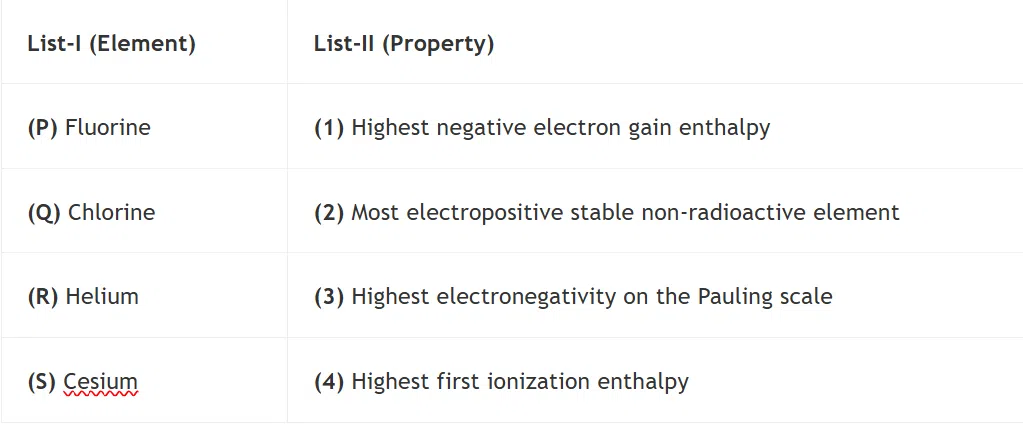
Match the chemical elements listed in List-I with their corresponding characteristic atomic or physical properties described in List-II according to the trends in the periodic table:
Select the correct matching option from the choices given below:
correct answer:- 4

Question 26
correct answer:- 2
Question 27
A monoatomic anion $$(A^-)$$ has 45 neutrons and 36 electrons. Atomic mass, group in the periodic table and physical state at room temperature of the element $$(A)$$ respectively are :
correct answer:- 1
Question 28
The IUPAC symbol for the element with atomic number 119 would be:
correct answer:- 4
Question 29
The electron gain enthalpy (in kJ/mol) of fluorine, chlorine, bromine and iodine, respectively, are
correct answer:- 3