
Join Our JEE Preparation Group
Prep with like-minded aspirants; Get access to free daily tests and study material.
Sign in
Please select an account to continue using cracku.in
↓ →
Join Our JEE Preparation Group
Prep with like-minded aspirants; Get access to free daily tests and study material.
Given below are two statements: One is labelled as Assertion A and the other is labelled as Reason R.
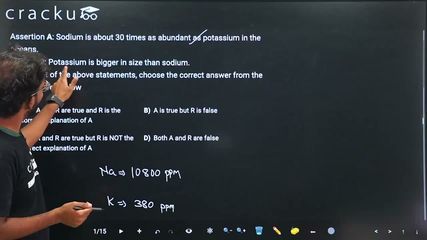
Assertion A: Sodium is about 30 times as abundant as potassium in the oceans.
Reason R: Potassium is bigger in size than sodium.
In the light of the above statements, choose the correct answer from the options given below
Assertion A: Sodium is about 30 times as abundant as potassium in the oceans.
This statement is true. The concentration of sodium in seawater is approximately 10,800 ppm, while potassium is only about 380 ppm, making sodium roughly 28-30 times more abundant.
Reason R: Potassium is bigger in size than sodium.
This statement is true. Potassium (atomic radius $$\approx 227$$ pm) is larger than sodium (atomic radius $$\approx 186$$ pm), since potassium lies one period below sodium in Group 1.
Connecting A and R:
The larger size of potassium ions ($$K^+$$) allows them to be more readily adsorbed and trapped by clay minerals and silicate structures in rocks and soil. This means potassium is preferentially retained on land rather than being washed into the oceans. Sodium ions ($$Na^+$$), being smaller, are less strongly held by soil particles and are more easily leached into rivers and eventually the oceans.
Thus, R correctly explains A -- the larger size of potassium is the key reason it is less abundant in seawater.
The correct answer is Option A: Both A and R are true and R is the correct explanation of A.
Was this solution helpful?
Click on the Email ☝️ to Watch the Video Solution
Create a FREE account and get:
_1.webp)

Educational materials for JEE preparation

Ask our AI anything

AI can make mistakes. Please verify important information.
AI can make mistakes. Please verify important information.


