
Join Our JEE Preparation Group
Prep with like-minded aspirants; Get access to free daily tests and study material.
Sign in
Please select an account to continue using cracku.in
↓ →
Join Our JEE Preparation Group
Prep with like-minded aspirants; Get access to free daily tests and study material.
The electron gain enthalpy (in kJ/mol) of fluorine, chlorine, bromine and iodine, respectively, are
We recall the definition first. Electron-gain enthalpy (also called electron affinity) is the enthalpy change when one mole of gaseous atoms accepts one mole of electrons to form gaseous anions. The more negative the value, the easier it is for that atom to accept an electron.
Across a period, effective nuclear charge increases and size decreases, so electron gain enthalpy generally becomes more negative. Down a group, atomic size increases, shielding increases and the added electron feels less attraction; therefore, electron gain enthalpy should normally become less negative from top to bottom of a group.
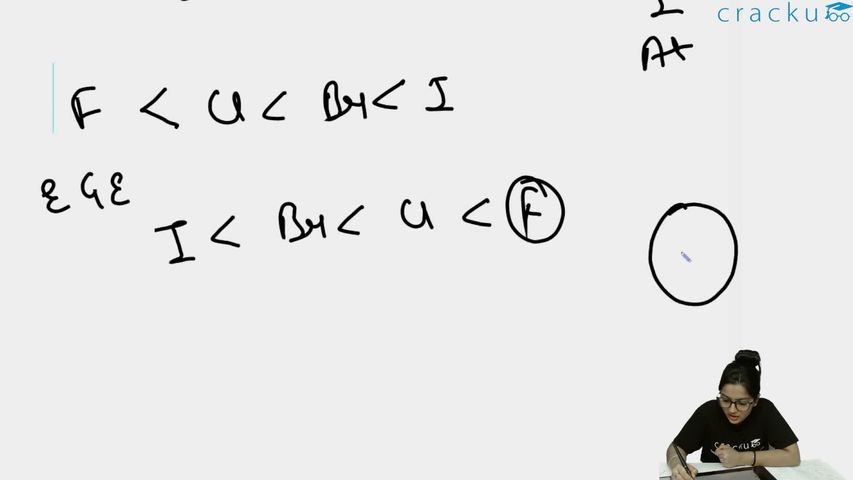
However, in the halogen group (Group 17) there is a very well-known exception: chlorine shows a more negative electron-gain enthalpy than fluorine. This happens because:
$$\text{(i) Fluorine is very small,}$$
$$$\text{(ii) The 2p subshell into which the extra electron must enter is already crowded,}$$$
$$$\text{(iii) Electron-electron repulsion partially offsets the nuclear attraction.}$$$
Hence the accepted experimental order is
$$$\Delta_{\text{eg}}H(\text{Cl}) < \Delta_{\text{eg}}H(\text{F}) < \Delta_{\text{eg}}H(\text{Br}) < \Delta_{\text{eg}}H(\text{I})$$$
(Remember that “more negative” means “smaller” on the number line.)
Numerically, the widely quoted values are approximately
$$\Delta_{\text{eg}}H(\text{F}) = -333\;\text{kJ mol}^{-1},$$
$$\Delta_{\text{eg}}H(\text{Cl}) = -349\;\text{kJ mol}^{-1},$$
$$\Delta_{\text{eg}}H(\text{Br}) = -325\;\text{kJ mol}^{-1},$$
$$\Delta_{\text{eg}}H(\text{I}) = -296\;\text{kJ mol}^{-1}.$$
Now we examine the options given:
Option A: $$-296,\,-325,\,-333,\,-349$$
Option B: $$-349,\,-333,\,-325,\,-296$$
Option C: $$-333,\,-349,\,-325,\,-296$$
Option D: $$-333,\,-325,\,-349,\,-296$$
We compare each list with the correct sequence $$\text{F},\;\text{Cl},\;\text{Br},\;\text{I}$$ having the numerical values just stated.
Option C exactly reproduces $$$-333\;(\text{F}),\;-349\;(\text{Cl}),\;-325\;(\text{Br}),\;-296\;(\text{I}).$$$
None of the other options aligns with both the correct order of elements and their accepted magnitudes.
Hence, the correct answer is Option 3.
Was this solution helpful?
Click on the Email ☝️ to Watch the Video Solution
Create a FREE account and get:
_1.webp)

Educational materials for JEE preparation

Ask our AI anything

AI can make mistakes. Please verify important information.
AI can make mistakes. Please verify important information.


