
Join Our JEE Preparation Group
Prep with like-minded aspirants; Get access to free daily tests and study material.
Sign in
Please select an account to continue using cracku.in
↓ →
Join Our JEE Preparation Group
Prep with like-minded aspirants; Get access to free daily tests and study material.
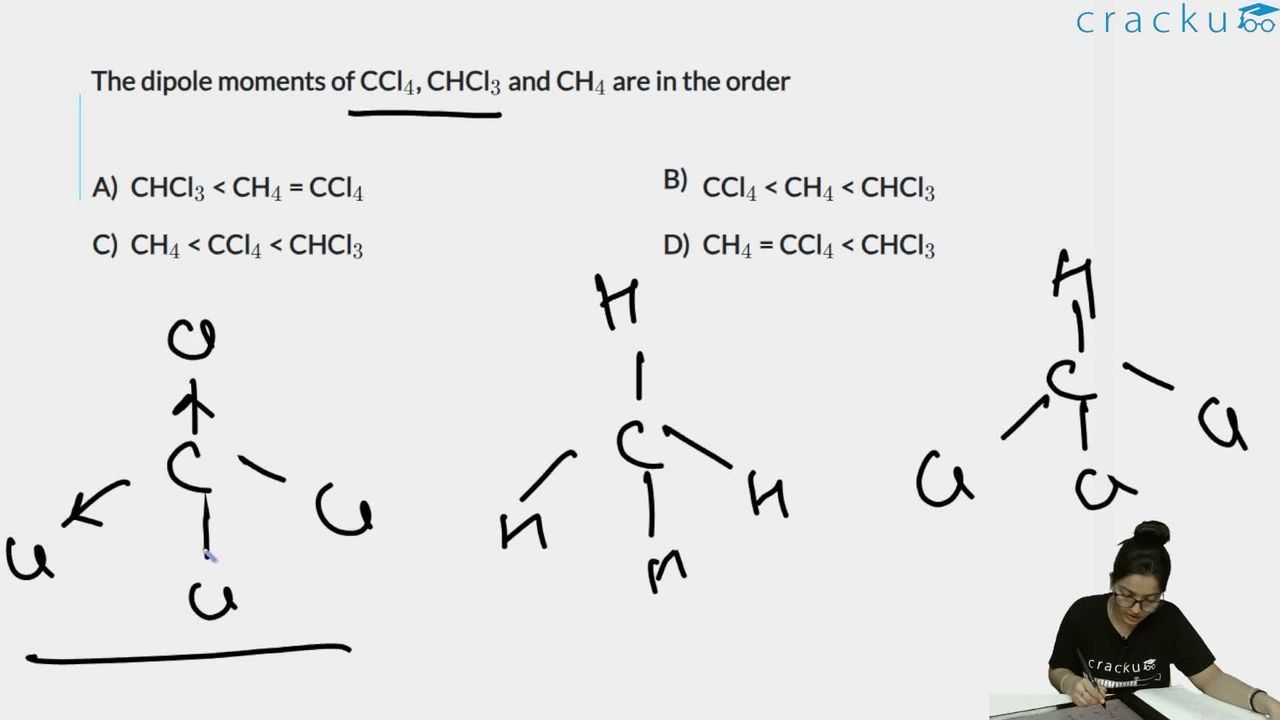
The dipole moments of CCl$$_4$$, CHCl$$_3$$ and CH$$_4$$ are in the order
First, we recall the definition of dipole moment. The magnitude of the dipole moment is written as $$\mu = q \times d$$, where $$q$$ is the magnitude of charge and $$d$$ is the distance between the centres of positive and negative charges. In a molecule, the individual bond dipoles are treated as vectors, and the net dipole moment is obtained by vector (head-to-tail) addition of all the bond dipoles.
Now we analyse each of the three molecules one by one, keeping in mind their shapes and the directions of the individual bond dipoles.
For $$CH_4$$ (methane) the molecular geometry is perfectly tetrahedral. All four $$C-H$$ bonds are identical and symmetrically oriented at equal angles of $$109.5^{\circ}$$. Each $$C-H$$ bond has a small bond dipole pointing from carbon towards hydrogen because carbon is slightly more electronegative than hydrogen. Because the four bond dipoles are equal in magnitude and symmetrically arranged, the vector sum of the four dipoles is exactly zero:
$$\vec{\mu}_{CH_4} = \vec{\mu}_1 + \vec{\mu}_2 + \vec{\mu}_3 + \vec{\mu}_4 = 0$$
Hence, $$\mu(CH_4) = 0\;\text{Debye}$$. So methane is a non-polar molecule.
For $$CCl_4$$ (carbon tetrachloride) the geometry is again perfectly tetrahedral. Now each $$C-Cl$$ bond dipole is larger in magnitude than a $$C-H$$ bond dipole because chlorine is much more electronegative than carbon. However, the four $$C-Cl$$ bond dipoles are still equal in magnitude and symmetrically oriented at the tetrahedral angles. The vector addition again gives zero:
$$\vec{\mu}_{CCl_4} = \vec{\mu}'_1 + \vec{\mu}'_2 + \vec{\mu}'_3 + \vec{\mu}'_4 = 0$$
Thus $$\mu(CCl_4) = 0\;\text{Debye}$$ as well. Even though each individual $$C-Cl$$ bond is quite polar, the symmetry causes complete cancellation.
For $$CHCl_3$$ (chloroform) the molecular geometry is still tetrahedral, but now three positions are occupied by chlorine atoms and one position by a hydrogen atom. Let us denote the bond dipoles by vectors. Each $$C-Cl$$ bond dipole is strong and points from carbon to chlorine, while the $$C-H$$ bond dipole is weak and points from carbon to hydrogen. The three identical $$C-Cl$$ vectors do not cancel each other perfectly because they occupy only three corners of the tetrahedron; the fourth corner has a weaker $$C-H$$ dipole. When we add these four vectors, the much larger resultant of the three $$C-Cl$$ vectors is only partially cancelled by the smaller $$C-H$$ vector. Consequently, a non-zero net dipole moment is obtained:
$$\vec{\mu}_{CHCl_3} = (\vec{\mu}_{C-Cl,1} + \vec{\mu}_{C-Cl,2} + \vec{\mu}_{C-Cl,3}) + \vec{\mu}_{C-H} \neq 0$$
Thus $$\mu(CHCl_3) > 0\;\text{Debye}$$ and its value is significantly larger than the (zero) dipole moments of $$CH_4$$ and $$CCl_4$$.
Collecting the results, we have
$$\mu(CH_4) = 0,\; \mu(CCl_4) = 0,\; \mu(CHCl_3) > 0.$$
Therefore the order of dipole moments is
$$CH_4 = CCl_4 \;<\; CHCl_3.$$
Among the given options, this corresponds exactly to
Option D: $$CH_4 = CCl_4 \;<\; CHCl_3$$.
Hence, the correct answer is Option D.
Was this solution helpful?
Click on the Email ☝️ to Watch the Video Solution
Create a FREE account and get:
_1.webp)

Educational materials for JEE preparation

Ask our AI anything

AI can make mistakes. Please verify important information.
AI can make mistakes. Please verify important information.


