
Join Our JEE Preparation Group
Prep with like-minded aspirants; Get access to free daily tests and study material.
Sign in
Please select an account to continue using cracku.in
↓ →
Join Our JEE Preparation Group
Prep with like-minded aspirants; Get access to free daily tests and study material.
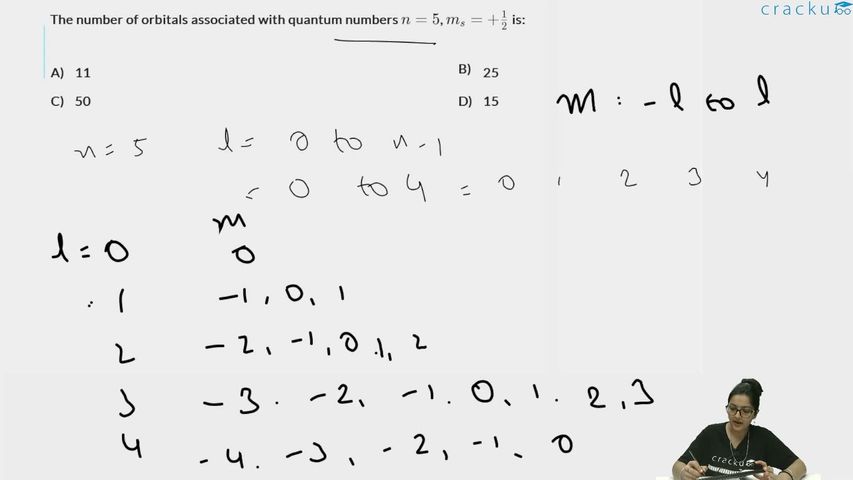
The number of orbitals associated with quantum numbers $$n = 5$$, $$m_s = +\frac{1}{2}$$ is:
We have been told that the principal quantum number is $$n = 5$$. The principal quantum number determines the main shell of the electron and, very importantly, fixes the possible values of the azimuthal quantum number $$\ell$$.
First, recall the rule for $$\ell$$: for any fixed $$n$$, $$\ell$$ can take all integral values from $$0$$ up to $$n-1$$. Therefore, when $$n = 5$$ we write
$$\ell = 0, 1, 2, 3, 4.$$
Now, for each specific value of $$\ell$$, the magnetic quantum number $$m_\ell$$ is allowed to vary from $$-\ell$$ to $$+\ell$$ in steps of one. Thus the total number of distinct $$m_\ell$$ values for a given $$\ell$$ is
$$2\ell + 1.$$
If we want the total number of orbitals for a fixed $$n$$, we must add up all the $$m_\ell$$ values for every possible $$\ell$$. Symbolically, that total is
$$\sum_{\ell = 0}^{n-1} (2\ell + 1) = n^{2}.$$
We now substitute $$n = 5$$ to get
$$\text{Number of orbitals for } n = 5 = 5^{2} = 25.$$
Each of these orbitals may be occupied by electrons having either of the two possible spin quantum numbers $$m_s = +\tfrac{1}{2}$$ or $$m_s = -\tfrac{1}{2}$$. The question explicitly fixes $$m_s = +\tfrac{1}{2}$$. When we restrict ourselves to a single spin orientation, we do not change the count of orbitals; we merely say that, out of the two spin possibilities for every orbital, we are picking just one.
Therefore, the number of orbitals that possess the principal quantum number $$n = 5$$ and the spin quantum number $$m_s = +\tfrac{1}{2}$$ remains
$$25.$$
Hence, the correct answer is Option B.
Was this solution helpful?
Click on the Email ☝️ to Watch the Video Solution
Create a FREE account and get:
_1.webp)

Educational materials for JEE preparation

Ask our AI anything

AI can make mistakes. Please verify important information.
AI can make mistakes. Please verify important information.


