
Join Our JEE Preparation Group
Prep with like-minded aspirants; Get access to free daily tests and study material.
Sign in
Please select an account to continue using cracku.in
↓ →
Join Our JEE Preparation Group
Prep with like-minded aspirants; Get access to free daily tests and study material.
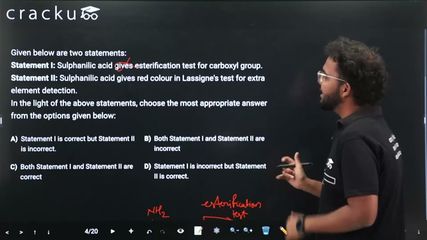
Given below are two statements:
Statement I: Sulphanilic acid gives esterification test for carboxyl group.
Statement II: Sulphanilic acid gives red colour in Lassigne's test for extra element detection.
In the light of the above statements, choose the most appropriate answer from the options given below:
We need to evaluate two statements about sulphanilic acid ($$H_2N-C_6H_4-SO_3H$$, also known as 4-aminobenzenesulphonic acid).
The first statement claims that sulphanilic acid gives the esterification test for a carboxyl group. This is incorrect. Sulphanilic acid contains a sulphonic acid group ($$-SO_3H$$), not a carboxyl group ($$-COOH$$). The esterification test involves reacting a carboxyl group with an alcohol in the presence of an acid catalyst to form a fruity-smelling ester, a reaction that sulphonic acid groups do not undergo. Therefore, sulphanilic acid will not give a positive esterification test for a carboxyl group.
The second statement asserts that sulphanilic acid gives a red colour in Lassaigne’s test for extra element detection. This is correct. Sulphanilic acid contains both nitrogen (in the $$-NH_2$$ group) and sulphur (in the $$-SO_3H$$ group). When subjected to sodium fusion (Lassaigne’s) test, these elements form sodium thiocyanate according to:
$$ Na + C + N + S \to NaSCN $$
Upon adding ferric chloride (FeCl$$_3$$) solution to the extract, the reaction is:
$$ 3NaSCN + FeCl_3 \to Fe(SCN)_3 + 3NaCl $$
Ferric thiocyanate, Fe(SCN)$$_3$$, imparts a characteristic blood-red colour, confirming the presence of both nitrogen and sulphur.
Thus, the correct answer is Option 4: Statement I is incorrect but Statement II is correct.
Was this solution helpful?
Click on the Email ☝️ to Watch the Video Solution
Create a FREE account and get:
_1.webp)

Educational materials for JEE preparation

Ask our AI anything

AI can make mistakes. Please verify important information.
AI can make mistakes. Please verify important information.


