
Join Our JEE Preparation Group
Prep with like-minded aspirants; Get access to free daily tests and study material.
Sign in
Please select an account to continue using cracku.in
↓ →
Join Our JEE Preparation Group
Prep with like-minded aspirants; Get access to free daily tests and study material.
Testosterone, which is a steroidal hormone, has the following structure.
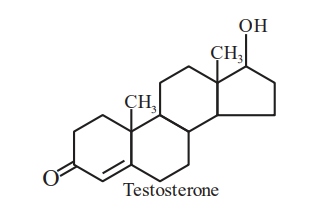
The total number of asymmetric carbon atom/s in testosterone is ______.
An asymmetric carbon atom is an $$sp^3$$ hybridized carbon bonded to four different groups. Any carbon involved in a double bond is $$sp^2$$ hybridized and cannot be asymmetric. Similarly, carbons bonded to two or more identical substituents are not chiral.
In the testosterone structure, the carbonyl carbon and the two carbons involved in the $$C=C$$ double bond are $$sp^2$$ hybridized and therefore achiral.
The various $$CH_2$$ and $$CH_3$$ carbons are also achiral because they are bonded to two or more identical hydrogen atoms.
The remaining stereogenic centers occur at the ring junctions and the carbon bearing the hydroxyl group.
The bridgehead carbon joining rings A and B is asymmetric because it is attached to four different groups.
The two bridgehead carbons joining rings B and C are asymmetric because each is bonded to four different carbon environments.
The bridgehead carbon joining rings C and D is asymmetric because the four groups attached to it are different.
The quaternary carbon bearing the angular methyl group is asymmetric because it is attached to four distinct carbon pathways.
The carbon bearing the $$-OH$$ group is asymmetric because it is attached to $$-OH$$, hydrogen, and two different carbon chains.
Thus, the asymmetric carbon atoms are located at
$$C_8,\ C_9,\ C_{10},\ C_{13},\ C_{14},\ C_{17}$$
Therefore, the total number of asymmetric carbon atoms in testosterone is $$6$$. Hence, the correct answer is $$6$$.
Was this solution helpful?
Click on the Email ☝️ to Watch the Video Solution
Create a FREE account and get:
_1.webp)

Educational materials for JEE preparation

Ask our AI anything

AI can make mistakes. Please verify important information.
AI can make mistakes. Please verify important information.


