
Join Our JEE Preparation Group
Prep with like-minded aspirants; Get access to free daily tests and study material.
Sign in
Please select an account to continue using cracku.in
↓ →
Join Our JEE Preparation Group
Prep with like-minded aspirants; Get access to free daily tests and study material.
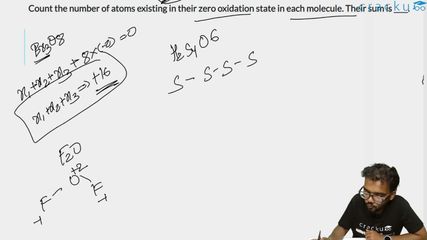
Consider the following molecules: Br$$_3$$O$$_8$$, F$$_2$$O, H$$_2$$S$$_4$$O$$_6$$, H$$_2$$S$$_5$$O$$_6$$, and C$$_3$$O$$_2$$.
Count the number of atoms existing in their zero oxidation state in each molecule. Their sum is ____.
Correct Answer: 6
Oxidation number (O.N.) is obtained by assigning the bonding electrons of every hetero-atomic bond to the more electronegative partner and adding the formal charge. Whenever an atom is bonded only to atoms of the same element, that bond contributes $$0$$ to its O.N.
Case 1: $$\mathbf{Br_3O_8}$$
Let the oxidation number of the three bromine atoms be $$x_1,x_2,x_3$$ (they need not be identical). Oxygen (except in peroxides and superoxides) has $$-2$$.
Total charge is zero, so
$$x_1+x_2+x_3+8(-2)=0\;\;\Longrightarrow\;\;x_1+x_2+x_3=+16$$
Whatever individual values the three bromine atoms possess, none of them can be $$0$$ because their sum is $$+16$$.
Number of atoms in O.N. $$0 = 0$$.
Case 2: $$\mathbf{F_2O}$$
Fluorine is the most electronegative element, so $$\text{O.N.(F)}=-1$$.
Let O.N.(O) = $$x$$.
$$x+2(-1)=0\;\;\Longrightarrow\;\;x=+2$$
No atom has O.N. $$0$$ here.
Number of atoms in O.N. $$0 = 0$$.
Case 3: $$\mathbf{H_2S_4O_6}$$ (tetrathionic acid)
This molecule contains a chain $$HO_3S\!-\!S\!-\!S\!-\!SO_3H$$.
• The two terminal sulphur atoms are each bonded to three oxygens and one sulphur. Such an environment is the same as in the dithionate ion, whose sulphur is known to be $$+5$$.
Assign O.N.(terminal S) = $$+5$$.
• Let the O.N. of each internal sulphur be $$y$$.
For the whole neutral acid (with $$2$$ hydrogens at $$+1$$):
$$2(+1)+2(+5)+2y+6(-2)=0$$
$$2+10+2y-12=0\;\;\Longrightarrow\;\;2y=0\;\;\Longrightarrow\;\;y=0$$
Thus both internal sulphur atoms are in the zero oxidation state.
Number of atoms in O.N. $$0 = 2$$.
Case 4: $$\mathbf{H_2S_5O_6}$$ (pentathionic acid)
Structure: $$HO_3S\!-\!S\!-\!S\!-\!S\!-\!SO_3H$$ (a five-sulphur chain).
• Terminal sulphur atoms again have O.N. $$+5$$.
• Let the three internal sulphur atoms have O.N.s $$y_1,y_2,y_3$$.
Overall charge $$0$$ gives
$$2(+1)+2(+5)+(y_1+y_2+y_3)+6(-2)=0$$
$$2+10+(y_1+y_2+y_3)-12=0\;\;\Longrightarrow\;\;y_1+y_2+y_3=0$$
In a pure $$S\!-\!S$$ chain an individual sulphur is normally either $$0$$ or $$-1$$.
A convenient integral solution is $$y_1=0,\;y_2=0,\;y_3=0$$ - fully consistent with the bonding scheme (each of those three S atoms is attached only to other sulphurs).
Hence all three internal sulphur atoms are in O.N. $$0$$.
Number of atoms in O.N. $$0 = 3$$.
Case 5: $$\mathbf{C_3O_2}$$ (carbon sub-oxide, $$O=C=C=C=O$$)
Let the oxidation numbers of the three carbons be $$x_1,x_2,x_3$$ (left to right).
Each oxygen is $$-2$$, so total for both oxygens is $$-4$$:
$$x_1+x_2+x_3-4=0\;\;\Longrightarrow\;\;x_1+x_2+x_3=+4$$
The two terminal carbonyl carbons (each double-bonded to an oxygen and singly to another carbon) are in O.N. $$+2$$.
Therefore $$x_1=+2,\;x_3=+2 \;\;\Rightarrow\;\;x_2=0$$ for the central carbon.
Number of atoms in O.N. $$0 = 1$$.
Total count of atoms in oxidation state 0:
$$0\;(Br_3O_8) + 0\;(F_2O) + 2\;(H_2S_4O_6) + 3\;(H_2S_5O_6) + 1\;(C_3O_2) = 6$$
Hence, the required sum is 6.
Was this solution helpful?
Click on the Email ☝️ to Watch the Video Solution
Create a FREE account and get:
_1.webp)

Educational materials for JEE preparation

Ask our AI anything

AI can make mistakes. Please verify important information.
AI can make mistakes. Please verify important information.


