
Join Our JEE Preparation Group
Prep with like-minded aspirants; Get access to free daily tests and study material.
Sign in
Please select an account to continue using cracku.in
↓ →
Join Our JEE Preparation Group
Prep with like-minded aspirants; Get access to free daily tests and study material.
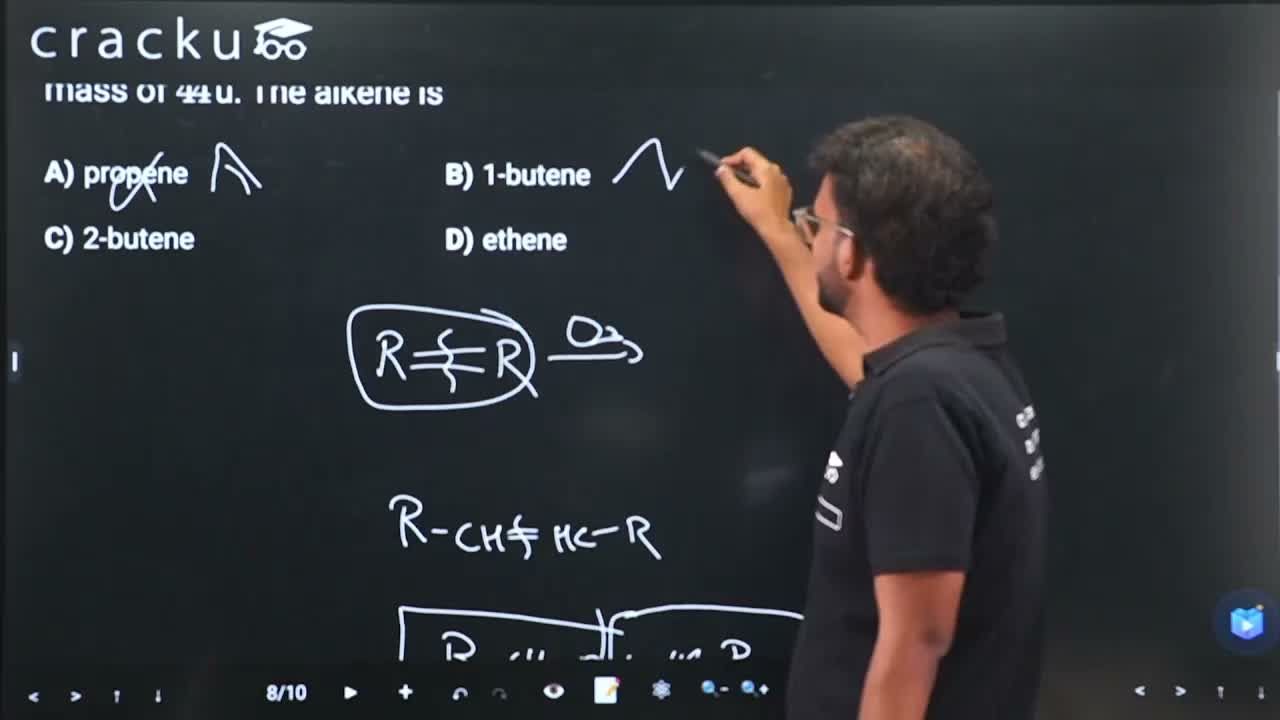
One mole of a symmetrical alkene on ozonolysis gives two moles of an aldehyde having a molecular mass of $$44$$ u. The alkene is
In ozonolysis, the $$\mathrm{C=C}$$ double bond is cleaved and each $$\mathrm{sp^2}$$ carbon becomes the carbonyl carbon of either an aldehyde or a ketone.
Thus, for an alkene $$R_1\,\!$$ $$\mathrm{CH=CH}$$ $$\,R_2$$, reductive ozonolysis (or oxidative followed by hydrolysis) gives $$R_1\!-\!CHO$$ and $$R_2\!-\!CHO$$.
Given data:
• The alkene is symmetrical ⇒ $$R_1 = R_2$$.
• Two moles of an aldehyde are obtained, each of molar mass $$44\ \text{u}$$.
Step 1: Identify the aldehyde of molar mass $$44\ \text{u}$$.
Molecular mass calculation for acetaldehyde $$\mathrm{CH_3CHO}$$ (formula $$\mathrm{C_2H_4O}$$):
$$2 \times 12\ (\text{C}) + 4 \times 1\ (\text{H}) + 16\ (\text{O}) = 24 + 4 + 16 = 44$$ u.
Hence the aldehyde produced is acetaldehyde $$\mathrm{CH_3CHO}$$.
Step 2: Work backwards to the alkene.
To give $$2$$ identical molecules of $$\mathrm{CH_3CHO}$$, each carbon of the $$\mathrm{C=C}$$ bond must carry a $$\mathrm{CH_3}$$ group, because cutting the double bond inserts an $$\mathrm{O}$$ and yields a $$\mathrm{CHO}$$ group:
$$\mathrm{CH_3{-}CH=CH{-}CH_3 \xrightarrow[H_2O]{O_3} 2\ CH_3CHO}$$
Thus the required alkene is $$\mathrm{CH_3{-}CH=CH{-}CH_3}$$, i.e. 2-butene (whether cis or trans, both are symmetrical about the double bond).
Verification of other options:
• Propene would yield $$\mathrm{CH_3CHO}$$ + $$\mathrm{HCHO}$$ (not symmetrical).
• 1-Butene would yield $$\mathrm{CH_3CH_2CHO}$$ + $$\mathrm{HCHO}$$.
• Ethene would yield only $$\mathrm{HCHO}$$.
Therefore, the only option matching all conditions is:
Option C which is: 2-butene
Was this solution helpful?
Click on the Email ☝️ to Watch the Video Solution
Create a FREE account and get:
_1.webp)

Educational materials for JEE preparation

Ask our AI anything

AI can make mistakes. Please verify important information.
AI can make mistakes. Please verify important information.
