The respective number of significant figures for the numbers $$23.023$$, $$0.0003$$ and $$2.1 \times 10^{-3}$$ are

Join Our JEE Preparation Group
Prep with like-minded aspirants; Get access to free daily tests and study material.
Sign in
Please select an account to continue using cracku.in
↓ →
Join Our JEE Preparation Group
Prep with like-minded aspirants; Get access to free daily tests and study material.
The respective number of significant figures for the numbers $$23.023$$, $$0.0003$$ and $$2.1 \times 10^{-3}$$ are
A particle is moving with velocity $$\vec{v} = K(y\hat{i} + x\hat{j})$$, where $$K$$ is a constant. The general equation for its path is
Loading solution...
A small particle of mass $$m$$ is projected at an angle $$\theta$$ with the x-axis with an initial velocity $$v_0$$ in the $$x-y$$ plane as shown in the figure. At a time $$t < \frac{v_0 \sin\theta}{g}$$, the angular momentum of the particle is where $$\hat{i}, \hat{j}$$ and $$\hat{k}$$ are unit vectors along x, y and z-axis respectively.
Loading solution...
.webp)
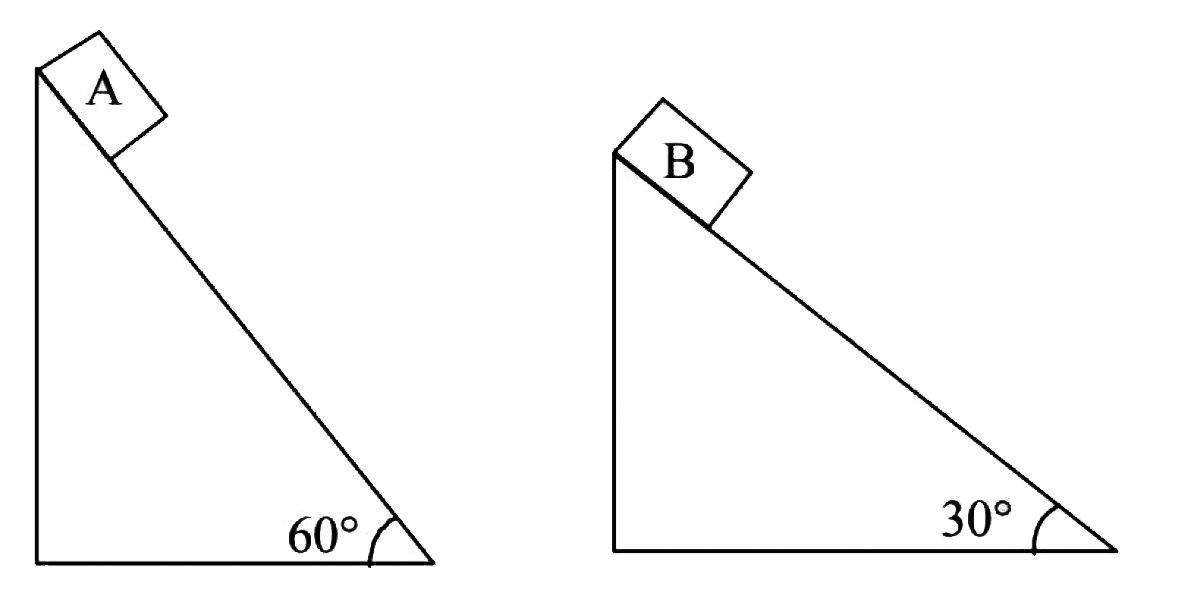
Two fixed frictionless inclined plane making an angle $$30^\circ$$ and $$60^\circ$$ with the vertical are shown in the figure. Two block $$A$$ and $$B$$ are placed on the two planes. What is the relative vertical acceleration of $$A$$ with respect to $$B$$?
Loading solution...
The potential energy function for the force between two atoms in a diatomic molecule is approximately given by $$U(x) = \frac{a}{x^{12}} - \frac{b}{x^6}$$, where $$a$$ and $$b$$ are constants and $$x$$ is the distance between the atoms. If the dissociation energy of the molecule is $$D = [U(x = \infty) - U_{\text{at equilibrium}}]$$, $$D$$ is
Loading solution...
Out of the four choices given after the statements, choose the one that best describes the two statements.
Statement-1 : Two particles moving in the same direction do not lose all their energy in a completely inelastic collision.
Statement-2 : Principle of conservation of momentum holds true for all kinds of collisions.
Loading solution...
The figure shows the position - time $$(x - t)$$ graph of one-dimensional motion of a body of mass $$0.4$$ kg. The magnitude of each impulse is
Loading solution...
A point P moves in counter-clockwise direction on a circular path as shown in the figure. The movement of 'P' is such that it sweeps out a length $$s = t^3 + 5$$, where $$s$$ is in metres and $$t$$ is in seconds. The radius of the path is $$20$$ m. The acceleration of 'P' when $$t = 2$$ s is nearly
Loading solution...
For a particle in uniform circular motion the acceleration $$\vec{a}$$ at a point $$P(R, \theta)$$ on the circle of radius R is (here $$\theta$$ is measured from the $$x$$-axis)
Loading solution...
A ball is made of a material of density $$\rho$$ where $$\rho_{\text{oil}} < \rho < \rho_{\text{water}}$$ with $$\rho_{\text{oil}}$$ and $$\rho_{\text{water}}$$ representing the densities of oil and water, respectively. The oil and water are immiscible. If the above ball is in equilibrium in a mixture of this oil and water, which of the following pictures represents its equilibrium position?
Loading solution...
Two conductors have the same resistance at $$0^\circ$$C but their temperature coefficients of resistance are $$\alpha_1$$ and $$\alpha_2$$. The respective temperature coefficients of their series and parallel combinations are nearly
Loading solution...
A diatomic ideal gas is used in a Car engine as the working substance. If during the adiabatic expansion part of the cycle, volume of the gas increases from $$V$$ to $$32V$$ the efficiency of the engine is
Loading solution...
The equation of a wave on a string of linear mass density $$0.04 \text{ kg m}^{-1}$$ is given by $$y = 0.02(\text{m}) \sin\left[2\pi\left(\frac{t}{0.04(\text{s})} - \frac{x}{0.50(\text{m})}\right)\right]$$. The tension in the string is
Loading solution...
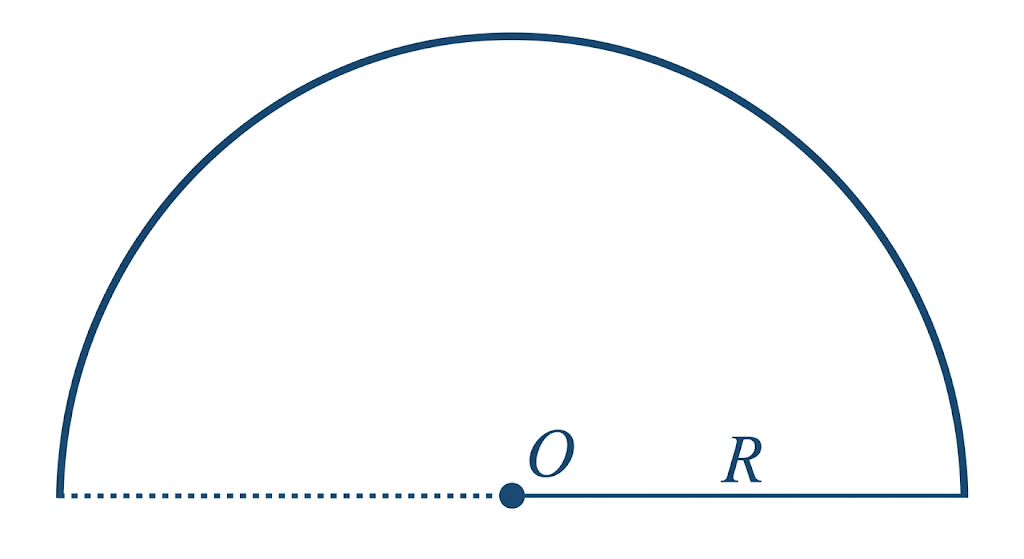
A thin semi-circular ring of radius $$r$$ has a positive charge $$q$$ distributed uniformly over it. The net field $$\vec{E}$$ at the centre $$O$$ is
Loading solution...
Let there be a spherically symmetric charge distribution with charge density varying as $$\rho(r) = \rho_0 \left(\frac{5}{4} - \frac{r}{R}\right)$$ upto $$r = R$$, and $$\rho(r) = 0$$ for $$r > R$$, where $$r$$ is the distance from the origin. The electric field at a distance $$r$$ ($$r < R$$) from the origin is given by
Loading solution...
Two identical charged spheres are suspended by strings of equal lengths. The strings make an angle of $$30^\circ$$ with each other. When suspended in a liquid of density $$0.8$$ g cm$$^{-3}$$, the angle remains the same. If density of the material of the sphere is $$16$$ g cm$$^{-3}$$, the dielectric constant of the liquid is
Loading solution...
Let $$C$$ be the capacitance of a capacitor discharging through a resistor R. Suppose $$t_1$$ is the time taken for the energy stored in the capacitor to reduce to half its initial value and $$t_2$$ is the time taken for the charge to reduce to one-fourth its initial value. Then the ratio $$t_1/t_2$$ will be
Loading solution...
Two long parallel wires are at a distance $$2d$$ apart. They carry steady equal current flowing out of the plane of the paper as shown. The variation of the magnetic field along the line $$XX'$$ is given by
Loading solution...
A rectangular loop has a sliding connector PQ of length $$\ell$$ and resistance $$R\Omega$$ and it is moving with a speed $$v$$ as shown. The set-up is placed in a uniform magnetic field going into the plane of the paper. The three currents $$I_1, I_2$$ and $$I$$ are
Loading solution...
In the circuit shown below, the key K is closed at $$t = 0$$. The current through the battery is

Loading solution...
In a series LCR circuit $$R = 200\,\Omega$$ and the voltage and the frequency of the main supply is $$220$$ V and $$50$$ Hz respectively. On taking out the capacitance from the circuit the current lags behind the voltage by $$30^\circ$$. On taking out the inductor from the circuit the current leads the voltage by $$30^\circ$$. The power dissipated in the LCR circuit is
Loading solution...
If a source of power $$4$$ kW produces $$10^{20}$$ photons/second, the radiation belong to a part of the spectrum called
Loading solution...
An initially parallel cylindrical beam travels in a medium of refractive index $$\mu(I) = \mu_0 + \mu_2 I$$, where $$\mu_0$$ and $$\mu_2$$ are positive constants and $$I$$ is the intensity of the light beam. The intensity of the beam is decreasing with increasing radius. As the beam enters the medium, it will
Loading solution...
An initially parallel cylindrical beam travels in a medium of refractive index $$\mu(I) = \mu_0 + \mu_2 I$$, where $$\mu_0$$ and $$\mu_2$$ are positive constants and $$I$$ is the intensity of the light beam. The intensity of the beam is decreasing with increasing radius. The initial shape of the wave front of the beam is
Loading solution...
An initially parallel cylindrical beam travels in a medium of refractive index $$\mu(I) = \mu_0 + \mu_2 I$$, where $$\mu_0$$ and $$\mu_2$$ are positive constants and $$I$$ is the intensity of the light beam. The intensity of the beam is decreasing with increasing radius. The speed of light in the medium is
Loading solution...
Statement-1 : When ultraviolet light is incident on a photocell, its stopping potential is $$V_0$$ and the maximum kinetic energy of the photoelectrons is $$K_{\max}$$. When the ultraviolet light is replaced by X-rays, both $$V_0$$ and $$K_{\max}$$ increase. Statement-2 : Photoelectrons are emitted with speeds ranging from zero to a maximum value because of the range of frequencies present in the incident light. Of the four choices given after the statements, choose the one that best describes the two statements.
Loading solution...
A nucleus of mass $$M + \Delta m$$ is at rest and decays into two daughter nuclei of equal mass $$\frac{M}{2}$$ each. Speed of light is $$c$$. The binding energy per nucleon for the parent nucleus is $$E_1$$ and that for the daughter nuclei is $$E_2$$. Then
Loading solution...
A nucleus of mass $$M + \Delta m$$ is at rest and decays into two daughter nuclei of equal mass $$\frac{M}{2}$$ each. Speed of light is $$c$$. The speed of daughter nuclei is
Loading solution...
A radioactive nucleus (initial mass number $$A$$ and atomic number $$Z$$) emits 3 $$\alpha$$-particles and 2 positrons. The ratio of number of neutrons to that of protons in the final nucleus will be
Loading solution...
The combination of gates shown below yields
Loading solution...
Ionisation energy of $$\text{He}^+$$ is $$19.6 \times 10^{-18}$$ Jatom$$^{-1}$$. The energy of the first stationary state ($$n = 1$$) of $$\text{Li}^{2+}$$ is
Loading solution...
The correct sequence which shows decreasing order of the ionic radii of the elements is
Loading solution...
The standard enthalpy of formation of $$\text{NH}_3$$ is $$-46.0$$ kJ mol$$^{-1}$$. If the enthalpy of formation of $$\text{H}_2$$ from its atoms is $$-436$$ kJ mol$$^{-1}$$ and that of $$\text{N}_2$$ is $$-712$$ kJ mol$$^{-1}$$, the average bond enthalpy of N$$-$$H bond in $$\text{NH}_3$$ is
Loading solution...
The energy required to break one mole of Cl$$-$$Cl bonds in $$\text{Cl}_2$$ is $$242$$ kJ mol$$^{-1}$$. The longest wavelength of light capable of breaking a single Cl$$-$$Cl bond is ($$c = 3 \times 10^8$$ ms$$^{-1}$$ and $$N_A = 6.02 \times 10^{23}$$ mol$$^{-1}$$)
Loading solution...
For a particular reversible reaction at temperature $$T$$, $$\Delta H$$ and $$\Delta S$$ were found to be both $$+ve$$. If $$T_e$$ is the temperature at equilibrium, the reaction would be spontaneous when
Loading solution...
In aqueous solution the ionization constants for carbonic acid are $$K_1 = 4.2 \times 10^{-7}$$ and $$K_2 = 4.8 \times 10^{-11}$$. Select the correct statement for a saturated $$0.034$$M solution of the carbonic acid.
Loading solution...
Solubility product of silver bromide is $$5.0 \times 10^{-13}$$. The quantity of potassium bromide (molar mass taken as $$120$$ g mol$$^{-1}$$) to be added to $$1$$ litre of $$0.05$$ M solution of silver nitrate to start the precipitation of AgBr is
Loading solution...
At $$25^\circ$$C, the solubility product of $$\text{Mg(OH)}_2$$ is $$1.0 \times 10^{-11}$$. At which pH, will $$\text{Mg}^{2+}$$ ions start precipitating in the form of $$\text{Mg(OH)}_2$$ from a solution of $$0.001$$M $$\text{Mg}^{2+}$$ ions?
Loading solution...
$$29.5$$ mg of an organic compound containing nitrogen was digested according to Kjeldahl's method and the evolved ammonia was absorbed in $$20$$ mL of $$0.1$$ M HCl solution. The excess of the acid required $$15$$ mL of $$0.1$$ M NaOH solution for complete neutralization. The percentage of nitrogen in the compound is
Loading solution...
The correct order of increasing basicity of the given conjugate bases ($$R = CH_3$$) is
Loading solution...
Out of the following, the alkene that exhibits optical isomerism is
Loading solution...
The main product of the following reaction is $$\text{C}_6\text{H}_5\text{CH}_2\text{CH(OH)CH(CH}_3)_2 \xrightarrow{\text{conc. H}_2\text{SO}_4} ?$$
Loading solution...
The edge length of a face centered cubic cell of an ionic substance is $$508$$ pm. If the radius of the cation is $$110$$ pm, the radius of the anion is
Loading solution...
Percentage of free space in cubic close packed structure and in body centred packed structure are respectively
Loading solution...
If $$10^{-4}$$ dm$$^3$$ of water is introduced into a $$1.0$$ dm$$^3$$ flask at $$300$$ K, how many moles of water are in the vapour phase when equilibrium is established? (Given: Vapour pressure of $$\text{H}_2\text{O}$$ at $$300$$ K is $$3170$$ Pa; $$R = 8.314$$ J K$$^{-1}$$ mol$$^{-1}$$)
Loading solution...
If sodium sulphate is considered to be completely dissociated into cations and anions in aqueous solution, the change in freezing point of water $$(\Delta T_f)$$, when $$0.01$$ mol of sodium sulphate is dissolved in $$1$$ kg of water, is ($$K_f = 1.86$$ K kg mol$$^{-1}$$)
Loading solution...
On mixing, heptane and octane form an ideal solution. At $$373$$ K, the vapour pressures of the two liquid components (heptane and octane) are $$105$$ kPa and $$45$$ kPa respectively. Vapour pressure of the solution obtained by mixing $$25.0$$ g of heptane and $$35$$ g of octane will be (molar mass of heptane $$= 100$$ g mol$$^{-1}$$ and of octane $$= 114$$ g mol$$^{-1}$$).
Loading solution...
The Gibbs energy for the decomposition of $$\text{Al}_2\text{O}_3$$ at $$500^\circ$$C is as follows: $$\frac{2}{3} \text{Al}_2\text{O}_3 \rightarrow \frac{4}{3} \text{Al} + \text{O}_2$$, $$\Delta_r G = +966$$ kJ mol$$^{-1}$$. The potential difference needed for electrolytic reduction of $$\text{Al}_2\text{O}_3$$ at $$500^\circ$$C is at least
Loading solution...
The correct order of $$E^0_{M^{2+}/M}$$ values with negative sign for the four successive elements Cr, Mn, Fe and Co is
Loading solution...
The time for half life period of a certain reaction $$A \to$$ products is $$1$$ hour. When the initial concentration of the reactant '$$A$$' is $$2.0$$ mol L$$^{-1}$$, how much time does it take for its concentration to come from $$0.50$$ to $$0.25$$ mol L$$^{-1}$$ if it is a zero order reaction?
Loading solution...
Consider the reaction: $$\text{Cl}_2(\text{aq}) + \text{H}_2\text{S}(\text{aq}) \to \text{S}(\text{s}) + 2\text{H}^+(\text{aq}) + 2\text{Cl}^-(\text{aq})$$. The rate equation for this reaction is rate $$= k[\text{Cl}_2][\text{H}_2\text{S}]$$. Which of these mechanisms is/are consistent with this rate equation? (A) $$\text{Cl}_2 + \text{H}_2\text{S} \to \text{H}^+ + \text{Cl}^- + \text{Cl}^+ + \text{HS}^-$$ (slow); $$\text{Cl}^+ + \text{HS}^- \to \text{H}^+ + \text{Cl}^- + \text{S}$$ (fast). (B) $$\text{H}_2\text{S} \leftrightarrow \text{H}^+ + \text{HS}^-$$ (fast equilibrium); $$\text{Cl}_2 + \text{HS}^- \to 2\text{Cl}^- + \text{H}^+ + \text{S}$$ (slow).
Loading solution...
Three reactions involving $$\text{H}_2\text{PO}_4^-$$ are given below: (i) $$\text{H}_3\text{PO}_4 + \text{H}_2\text{O} \to \text{H}_3\text{O}^+ + \text{H}_2\text{PO}_4^-$$ (ii) $$\text{H}_2\text{PO}_4^- + \text{H}_2\text{O} \to \text{HPO}_4^{2-} + \text{H}_3\text{O}^+$$ (iii) $$\text{H}_2\text{PO}_4^- + \text{OH}^- \to \text{H}_3\text{PO}_4 + \text{O}^{2-}$$. In which of the above does $$\text{H}_2\text{PO}_4^-$$ act as an acid?
Loading solution...
A solution containing $$2.675$$ g of $$\text{CoCl}_3 \cdot 6\text{NH}_3$$ (molar mass $$= 267.5$$ g mol$$^{-1}$$) is passed through a cation exchanger. The chloride ions obtained in solution were treated with excess of $$\text{AgNO}_3$$ to give $$4.78$$ g of AgCl (molar mass $$= 143.5$$ g mol$$^{-1}$$). The formula of the complex is (At. Mass of Ag $$= 108$$ u)
Loading solution...
Which one of the following has an optical isomer? (en = ethylenediamine)
Loading solution...
Consider the following bromides: 
The correct order of $$S_N1$$ reactivity is
Loading solution...
From amongst the following alcohols the one that would react fastest with conc. HCl and anhydrous $$\text{ZnCl}_2$$, is
Loading solution...
One mole of a symmetrical alkene on ozonolysis gives two moles of an aldehyde having a molecular mass of $$44$$ u. The alkene is
Loading solution...
In the chemical reactions shown below, the compounds 'A' and 'B' respectively are
Loading solution...
The polymer containing strong intermolecular forces e.g. hydrogen bonding, is
Loading solution...
Biuret test is not given by
Loading solution...
If $$\alpha$$ and $$\beta$$ are the roots of the equation $$x^2 - x + 1 = 0$$, then $$\alpha^{2009} + \beta^{2009} =$$
Loading solution...
The number of complex numbers $$z$$ such that $$|z - 1| = |z + 1| = |z - i|$$ equals
Loading solution...
There are two urns. Urn A has $$3$$ distinct red balls and urn B has $$9$$ distinct blue balls. From each urn two balls are taken out at random and then transferred to the other. The number of ways in which this can be done is
Loading solution...
A person is to count $$4500$$ currency notes. Let $$a_n$$ denote the number of notes he counts in the $$n^{\text{th}}$$ minute. If $$a_1 = a_2 = \ldots = a_{10} = 150$$ and $$a_{10}, a_{11}, \ldots$$ are in A.P. with common difference $$-2$$, then the time taken by him to count all notes is
Loading solution...
Let $$S_1 = \sum_{j=1}^{10} j(j-1)\,^{10}C_j$$, $$S_2 = \sum_{j=1}^{10} j\,^{10}C_j$$ and $$S_3 = \sum_{j=1}^{10} j^2\,^{10}C_j$$. Statement-1: $$S_3 = 55 \times 2^9$$. Statement-2: $$S_1 = 90 \times 2^8$$ and $$S_2 = 10 \times 2^8$$.
Loading solution...
Let $$\cos(\alpha + \beta) = \frac{4}{5}$$ and let $$\sin(\alpha - \beta) = \frac{5}{13}$$, where $$0 \le \alpha, \beta \le \frac{\pi}{4}$$, then $$\tan 2\alpha =$$
Loading solution...
The line $$L$$ given by $$\frac{x}{5} + \frac{y}{b} = 1$$ passes through the point $$(13, 32)$$. The line $$K$$ is parallel to $$L$$ and has the equation $$\frac{x}{c} + \frac{y}{3} = 1$$. Then the distance between $$L$$ and $$K$$ is
Loading solution...
The circle $$x^2 + y^2 = 4x + 8y + 5$$ intersects the line $$3x - 4y = m$$ at two distinct points if
Loading solution...
If two tangents drawn from a point $$P$$ to the parabola $$y^2 = 4x$$ are at right angles, then the locus of $$P$$ is
Loading solution...
Let $$f: R \to R$$ be a positive increasing function with $$\lim_{x \to \infty} \frac{f(3x)}{f(x)} = 1$$. Then $$\lim_{x \to \infty} \frac{f(2x)}{f(x)} =$$
Loading solution...
For two data sets, each of size $$5$$, the variances are given to be $$4$$ and $$5$$ and the corresponding means are given to be $$2$$ and $$4$$, respectively. The variance of the combined data set is
Loading solution...
For a regular polygon, let $$r$$ and $$R$$ be the radii of the inscribed and the circumscribed circles. A false statement among the following is
Loading solution...
Let $$S$$ be a non-empty subset of $$R$$. Consider the following statement: P: There is a rational number $$x \in S$$ such that $$x > 0$$. Which of the following statements is the negation of the statement $$P$$?
Loading solution...
Consider the following relations: $$R = \{(x, y) \mid x, y \text{ are real numbers and } x = wy \text{ for some rational number } w\}$$; $$S = \left\{\left(\frac{m}{n}, \frac{p}{q}\right) \mid m, n, p \text{ and } q \text{ are integers such that } n, q \ne 0 \text{ and } qm = pn\right\}$$. Then
Loading solution...
The number of $$3 \times 3$$ non-singular matrices, with four entries as $$1$$ and all other entries as $$0$$, is
Loading solution...
Let $$A$$ be a $$2 \times 2$$ matrix with non-zero entries and let $$A^2 = I$$, where $$I$$ is $$2 \times 2$$ identity matrix. Define $$\text{Tr}(A) = $$ sum of diagonal elements of $$A$$ and $$|A| = $$ determinant of matrix $$A$$. Statement-1: $$\text{Tr}(A) = 0$$. Statement-2: $$|A| = 1$$.
Loading solution...
Consider the system of linear equations: $$x_1 + 2x_2 + x_3 = 3$$; $$2x_1 + 3x_2 + x_3 = 3$$; $$3x_1 + 5x_2 + 2x_3 = 1$$. The system has
Loading solution...
Let $$f: R \to R$$ be a continuous function defined by $$f(x) = \frac{1}{e^x + 2 e^{-x}}$$. Statement-1: $$f(c) = \frac{1}{3}$$, for some $$c \in R$$. Statement-2: $$0 < f(x) \le \frac{1}{2\sqrt{2}}$$, for all $$x \in R$$.
Loading solution...
Let $$f: (-1, 1) \to R$$ be a differentiable function with $$f(0) = -1$$ and $$f'(0) = 1$$. Let $$g(x) = [f(2f(x) + 2)]^2$$. Then $$g'(0) =$$
Loading solution...
The equation of the tangent to the curve $$y = x + \frac{4}{x^2}$$, that is parallel to the $$x$$-axis, is
Loading solution...
Let $$f: R \to R$$ be defined by $$f(x) = \begin{cases} k - 2x, & \text{if } x \le -1 \\ 2x + 3, & \text{if } x > -1 \end{cases}$$. If $$f$$ has a local minimum at $$x = -1$$, then a possible value of $$k$$ is
Loading solution...
Let $$p(x)$$ be a function defined on $$R$$ such that $$p'(x) = p'(1 - x)$$, for all $$x \in [0, 1]$$, $$p(0) = 1$$ and $$p(1) = 41$$. Then $$\int_0^1 p(x) \, dx$$ equals
Loading solution...
The area bounded by the curves $$y = \cos x$$ and $$y = \sin x$$ between the ordinates $$x = 0$$ and $$x = \frac{3\pi}{2}$$ is
Loading solution...
Solution of the differential equation $$\cos x \, dy = y(\sin x - y)\,dx$$, $$0 < x < \frac{\pi}{2}$$ is
Loading solution...
Let $$\vec{a} = \hat{j} - \hat{k}$$ and $$\vec{c} = \hat{i} - \hat{j} - \hat{k}$$. Then vector $$\vec{b}$$ satisfying $$\vec{a} \times \vec{b} + \vec{c} = \vec{0}$$ and $$\vec{a} \cdot \vec{b} = 3$$ is
Loading solution...
If the vectors $$\vec{a} = \hat{i} - \hat{j} + 2\hat{k}$$, $$\vec{b} = 2\hat{i} + 4\hat{j} + \hat{k}$$ and $$\vec{c} = \lambda \hat{i} + \hat{j} + \mu \hat{k}$$ are mutually orthogonal, then $$(\lambda, \mu) =$$
Loading solution...
Statement-1: The point $$A(3, 1, 6)$$ is the mirror image of the point $$B(1, 3, 4)$$ in the plane $$x - y + z = 5$$.
Statement-2: The plane $$x - y + z = 5$$ bisects the line segment joining $$A(3, 1, 6)$$ and $$B(1, 3, 4)$$.
Loading solution...
A line $$AB$$ in three-dimensional space makes angles $$45^\circ$$ and $$120^\circ$$ with the positive $$x$$-axis and the positive $$y$$-axis respectively. If $$AB$$ makes an acute angle $$\theta$$ with the positive $$z$$-axis, then $$\theta$$ equals
Loading solution...
Four numbers are chosen at random (without replacement) from the set $$\{1, 2, 3, \ldots, 20\}$$. Statement-1: The probability that the chosen numbers when arranged in some order will form an AP is $$\frac{1}{85}$$. Statement-2: If the four chosen numbers form an AP, then the set of all possible values of common difference is $$\{\pm 1, \pm 2, \pm 3, \pm 4, \pm 5\}$$.
Loading solution...
An urn contains nine balls of which three are red, four are blue and two are green. Three balls are drawn at random without replacement from the urn. The probability that the three balls have different colours is
Loading solution...
Educational materials for JEE preparation
 Share
Share