
Join Our JEE Preparation Group
Prep with like-minded aspirants; Get access to free daily tests and study material.
Sign in
Please select an account to continue using cracku.in
↓ →
Join Our JEE Preparation Group
Prep with like-minded aspirants; Get access to free daily tests and study material.
Let $$A$$ be a $$2 \times 2$$ matrix with non-zero entries and let $$A^2 = I$$, where $$I$$ is $$2 \times 2$$ identity matrix. Define $$\text{Tr}(A) = $$ sum of diagonal elements of $$A$$ and $$|A| = $$ determinant of matrix $$A$$. Statement-1: $$\text{Tr}(A) = 0$$. Statement-2: $$|A| = 1$$.
Since $$A^2 = I$$, we can write $$(A-I)(A+I)=0$$ $$-(1)$$
Equation $$-(1)$$ shows that every eigenvalue $$\lambda$$ of $$A$$ satisfies $$\lambda^2=1$$, hence $$\lambda=\pm 1$$.
Because $$A$$ is a $$2 \times 2$$ matrix, the multiset of its eigenvalues can be
$$\{1,1\},\;\{1,-1\},\;\{-1,-1\}$$.
If the eigenvalues are $$\{1,1\}$$, then the minimal polynomial divides $$(x-1)$$. For a diagonalizable matrix that forces $$A=I$$; for a non-diagonalizable matrix we would have $$A=I+N$$ with $$N^2=0$$ and $$2N=0\Rightarrow N=0$$, again giving $$A=I$$. But the identity matrix has zero off-diagonal entries, contradicting the given condition that every entry of $$A$$ is non-zero. Hence this case is impossible.
By the same argument, the eigenvalue set $$\{-1,-1\}$$ would force $$A=-I$$, whose off-diagonals are also zero; so this case is also impossible.
Therefore the only admissible spectrum is $$\{1,-1\}$$.
Trace: $$\text{Tr}(A)=1+(-1)=0$$.
Determinant: $$|A|=1\cdot(-1)=-1\neq 1$$.
Thus
• Statement-1 ($$\text{Tr}(A)=0$$) is true.
• Statement-2 ($$|A|=1$$) is false.
Moreover, because Statement-2 itself is wrong, it cannot explain Statement-1.
Option B which is: Statement-1 is true, Statement-2 is false
Was this solution helpful?
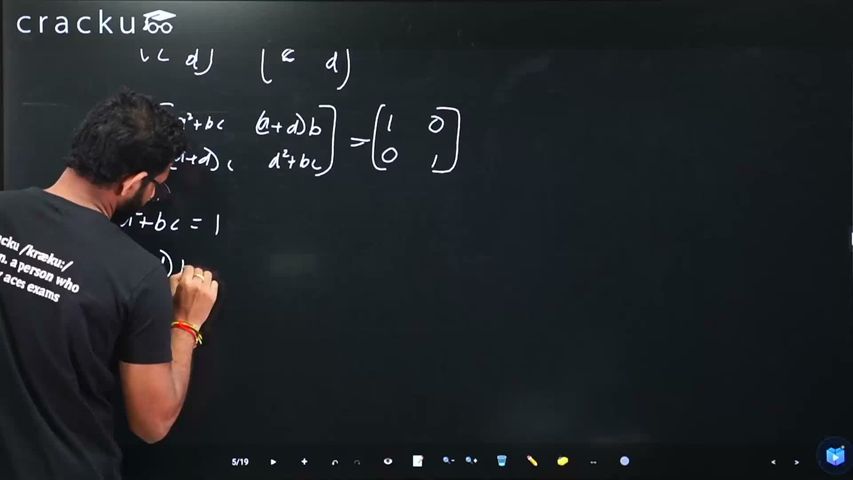
Click on the Email ☝️ to Watch the Video Solution
Create a FREE account and get:
_1.webp)

Educational materials for JEE preparation

Ask our AI anything

AI can make mistakes. Please verify important information.
AI can make mistakes. Please verify important information.
