
Join Our JEE Preparation Group
Prep with like-minded aspirants; Get access to free daily tests and study material.
Sign in
Please select an account to continue using cracku.in
↓ →
Join Our JEE Preparation Group
Prep with like-minded aspirants; Get access to free daily tests and study material.
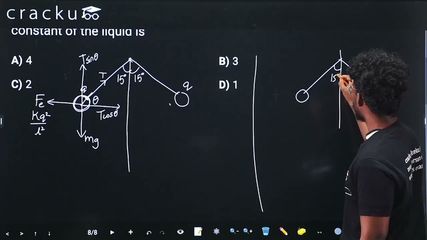
Two identical charged spheres are suspended by strings of equal lengths. The strings make an angle of $$30^\circ$$ with each other. When suspended in a liquid of density $$0.8$$ g cm$$^{-3}$$, the angle remains the same. If density of the material of the sphere is $$16$$ g cm$$^{-3}$$, the dielectric constant of the liquid is
Let $$ \theta $$ be the half-angle, so:
$$ \theta = 15^\circ $$
Let $$ q $$ be the charge on each sphere and $$ r $$ be the separation distance between them. These are constant in both cases because the angle does not change. Let $$ V $$ be the volume of each sphere and $$ g $$ be the acceleration due to gravity.
Case 1: Equilibrium in Air
In equilibrium in air, the forces on each sphere are its weight ($$ W $$), the electrostatic repulsive force ($$ F_e $$), and tension ($$ T $$). The weight is given by:
$$ W = \rho_s V g $$
The equilibrium conditions provide:
$$ \tan \theta = \frac{F_e}{W} $$
$$ \tan \theta = \frac{F_e}{\rho_s V g} \quad \text{---(Equation 1)} $$
Case 2: Equilibrium in Liquid
When suspended in a liquid with dielectric constant $$ K $$, the electrostatic repulsive force becomes:
$$ F'_e = \frac{F_e}{K} $$
The effective downward force (effective weight, $$ W_{\text{eff}} $$) is the weight minus the buoyant force (upthrust, $$ B $$):
$$ W_{\text{eff}} = W - B $$
The buoyant force is equal to the weight of the liquid displaced:
$$ B = \rho_l V g $$
So, effective weight is:
$$ W_{\text{eff}} = \rho_s V g - \rho_l V g = (\rho_s - \rho_l) V g $$
Since the angle is unchanged, the equilibrium condition is similar, but with effective forces:
$$ \tan \theta = \frac{F'_e}{W_{\text{eff}}} $$
$$ \tan \theta = \frac{F_e / K}{(\rho_s - \rho_l) V g} $$
$$ \tan \theta = \frac{F_e}{K (\rho_s - \rho_l) V g} \quad \text{---(Equation 2)} $$
Finding the Dielectric Constant (K)
Equating Equation 1 and Equation 2 because $$ \tan \theta $$ is constant:
$$ \frac{F_e}{\rho_s V g} = \frac{F_e}{K (\rho_s - \rho_l) V g} $$
We can cancel $$ F_e $$, $$ V $$, and $$ g $$ from both sides:
$$ \frac{1}{\rho_s} = \frac{1}{K (\rho_s - \rho_l)} $$
Rearranging this to solve for $$ K $$:
$$ K = \frac{\rho_s}{\rho_s - \rho_l} $$
Substitute the given density values into the formula:
$$ K = \frac{1.6}{1.6 - 0.8} $$
$$ K = \frac{1.6}{0.8} $$
$$ K = 2 $$
Was this solution helpful?
Click on the Email ☝️ to Watch the Video Solution
Create a FREE account and get:
_1.webp)

Educational materials for JEE preparation

Ask our AI anything

AI can make mistakes. Please verify important information.
AI can make mistakes. Please verify important information.
