
Join Our JEE Preparation Group
Prep with like-minded aspirants; Get access to free daily tests and study material.
Sign in
Please select an account to continue using cracku.in
↓ →
Join Our JEE Preparation Group
Prep with like-minded aspirants; Get access to free daily tests and study material.
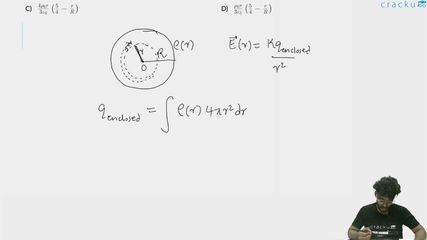
Let there be a spherically symmetric charge distribution with charge density varying as $$\rho(r) = \rho_0 \left(\frac{5}{4} - \frac{r}{R}\right)$$ upto $$r = R$$, and $$\rho(r) = 0$$ for $$r > R$$, where $$r$$ is the distance from the origin. The electric field at a distance $$r$$ ($$r < R$$) from the origin is given by
For a spherically symmetric charge distribution the electric field at a distance $$r$$ from the centre depends only on the total charge enclosed inside a Gaussian sphere of radius $$r$$. By Gauss’s law,
$$\oint \mathbf{E}\cdot d\mathbf{S}=E(4\pi r^{2})=\frac{Q_{\text{enc}}}{\varepsilon_{0}} \quad\Longrightarrow\quad E=\frac{1}{4\pi\varepsilon_{0}}\frac{Q_{\text{enc}}}{r^{2}}$$
Hence we first calculate $$Q_{\text{enc}}$$ for $$r\lt R$$.
Charge density in the sphere is given by $$\rho(r)=\rho_{0}\left(\frac{5}{4}-\frac{r}{R}\right)$$. A thin shell of radius $$r'$$ and thickness $$dr'$$ has volume $$dV=4\pi r'^{2}\,dr'$$, so the charge in this shell is
$$dq=\rho(r')\,dV =\rho_{0}\left(\frac{5}{4}-\frac{r'}{R}\right)4\pi r'^{2}\,dr'$$
Total charge enclosed within radius $$r$$:
$$\begin{aligned} Q_{\text{enc}}&=\int_{0}^{r}4\pi\rho_{0}\left(\frac{5}{4}-\frac{r'}{R}\right)r'^{2}\,dr'\\ &=4\pi\rho_{0}\int_{0}^{r}\left(\frac{5}{4}r'^{2}-\frac{r'^{3}}{R}\right)dr' \\[4pt] &=4\pi\rho_{0}\left[\frac{5}{4}\frac{r'^{3}}{3}-\frac{r'^{4}}{4R}\right]_{0}^{r}\\[4pt] &=4\pi\rho_{0}\left(\frac{5r^{3}}{12}-\frac{r^{4}}{4R}\right) \\[2pt] &=4\pi\rho_{0}r^{3}\left(\frac{5}{12}-\frac{r}{4R}\right) \end{aligned}$$
Insert this $$Q_{\text{enc}}$$ into Gauss’s law:
$$\begin{aligned} E&=\frac{1}{4\pi\varepsilon_{0}}\, \frac{4\pi\rho_{0}r^{3}\left(\dfrac{5}{12}-\dfrac{r}{4R}\right)}{r^{2}}\\[6pt] &=\frac{\rho_{0}}{\varepsilon_{0}}\, r\left(\frac{5}{12}-\frac{r}{4R}\right) \end{aligned}$$
Simplify the bracket by taking the common denominator $$12R$$:
$$\frac{5}{12}-\frac{r}{4R}=\frac{5R-3r}{12R}$$
Thus
$$E=\frac{\rho_{0}r}{\varepsilon_{0}}\, \frac{5R-3r}{12R} =\frac{\rho_{0}r}{12\varepsilon_{0}R}\,(5R-3r)$$
Factor out $$\dfrac{1}{4}$$ to match the given options:
$$E=\frac{\rho_{0}r}{4\varepsilon_{0}}\left(\frac{5}{3}-\frac{r}{R}\right)$$
This expression corresponds to Option B.
Option B which is: $$\dfrac{\rho_0\,r}{4\varepsilon_0}\left(\dfrac{5}{3}-\dfrac{r}{R}\right)$$
Was this solution helpful?
Click on the Email ☝️ to Watch the Video Solution
Create a FREE account and get:
_1.webp)

Educational materials for JEE preparation

Ask our AI anything

AI can make mistakes. Please verify important information.
AI can make mistakes. Please verify important information.
