
Join Our JEE Preparation Group
Prep with like-minded aspirants; Get access to free daily tests and study material.
Sign in
Please select an account to continue using cracku.in
↓ →
Join Our JEE Preparation Group
Prep with like-minded aspirants; Get access to free daily tests and study material.
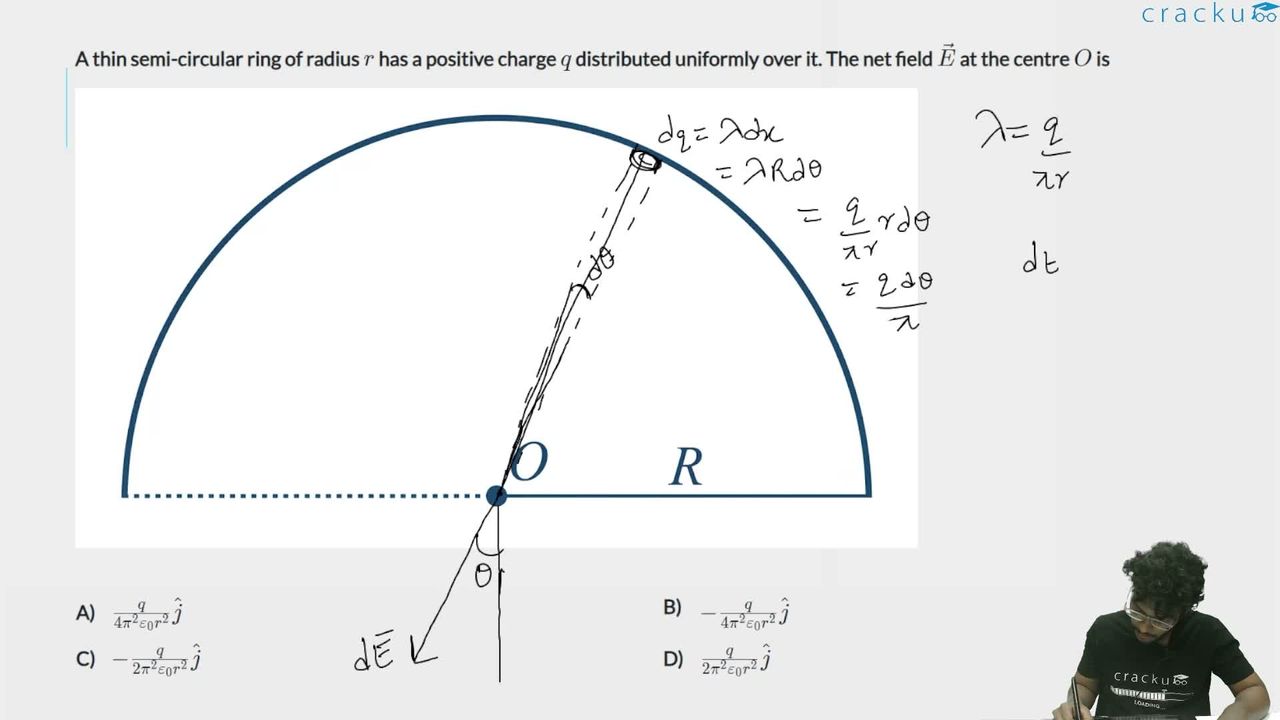
A thin semi-circular ring of radius $$r$$ has a positive charge $$q$$ distributed uniformly over it. The net field $$\vec{E}$$ at the centre $$O$$ is
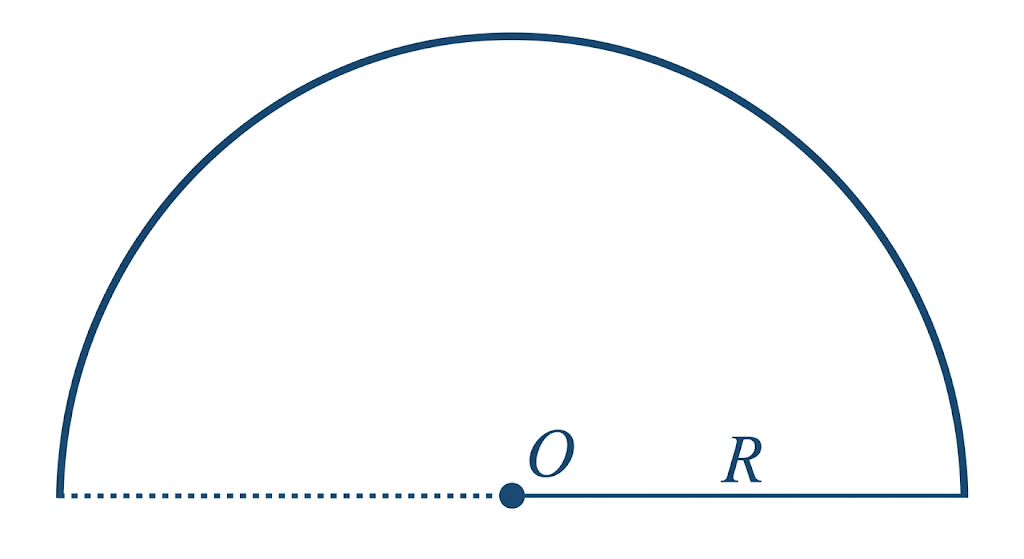
Let the thin semi-circular ring lie in the $$x\text{-}y$$ plane with its centre at the origin $$O(0,0)$$ and radius $$r$$. The two ends of the semicircle meet the $$x$$-axis at $$(-r,0)$$ and $$(+r,0)$$, so every point on the ring has positive $$y$$-coordinate.
The total positive charge distributed uniformly over the arc is $$q$$. Linear charge density $$\lambda$$ is therefore
$$\lambda = \frac{\text{total charge}}{\text{length of arc}} = \frac{q}{\pi r}$$
Choose an element of length $$dl$$ at the polar angle $$\alpha$$ measured from the +$$x$$-axis (see figure in mind). Coordinates of the element: $$(r\cos\alpha,\, r\sin\alpha)$$ where $$0 \le \alpha \le \pi$$.
Charge of the element $$dq = \lambda\,dl = \lambda\,r\,d\alpha$$
Magnitude of the electric field produced at the centre by this element:
$$dE = \frac{1}{4\pi\varepsilon_0}\,\frac{dq}{r^{2}}$$
The field vector points radially inward (towards the centre) because the observation point is on the line joining the charge element to the centre. The unit vector along this inward radial direction is $$\hat{r}_{\!in} = (-\cos\alpha, -\sin\alpha)$$.
Hence the $$y$$-component contributed by the element is
$$dE_y = dE\,(\text{component of } \hat{r}_{\!in} \text{ along } -\hat{j})$$ $$\qquad = dE\,(-\sin\alpha)$$ $$\qquad = -\frac{1}{4\pi\varepsilon_0}\,\frac{dq}{r^{2}}\sin\alpha$$
Substituting $$dq = \lambda r d\alpha$$:
$$dE_y = -\frac{1}{4\pi\varepsilon_0}\,\frac{\lambda r\,d\alpha}{r^{2}}\sin\alpha = -\frac{\lambda}{4\pi\varepsilon_0 r}\,\sin\alpha\,d\alpha$$
Integrate over the entire semicircle (from $$\alpha = 0$$ to $$\alpha = \pi$$):
$$E_y = \int_{0}^{\pi} dE_y = -\frac{\lambda}{4\pi\varepsilon_0 r}\int_{0}^{\pi}\sin\alpha\,d\alpha$$
The integral evaluates to
$$\int_{0}^{\pi}\sin\alpha\,d\alpha = \left[-\cos\alpha\right]_{0}^{\pi} = -\cos\pi + \cos 0 = 2$$
Therefore
$$E_y = -\frac{\lambda}{4\pi\varepsilon_0 r}\,(2) = -\frac{2\lambda}{4\pi\varepsilon_0 r}$$
Insert $$\lambda = \dfrac{q}{\pi r}$$:
$$E_y = -\frac{2}{4\pi\varepsilon_0 r}\,\frac{q}{\pi r} = -\frac{q}{2\pi^{2}\varepsilon_0 r^{2}}$$
All horizontal ($$x$$) components cancel by symmetry, so the net field is purely along $$-\,\hat{j}$$ (negative $$y$$-direction).
Hence,
$$\vec{E}_{\,\text{centre}} = -\,\frac{q}{2\pi^{2}\varepsilon_0 r^{2}}\;\hat{j}$$
Option C which is: $$-\dfrac{q}{2\pi^{2}\,\varepsilon_0\,r^{2}}\,\hat{j}$$
Was this solution helpful?
Click on the Email ☝️ to Watch the Video Solution
Create a FREE account and get:
_1.webp)

Educational materials for JEE preparation

Ask our AI anything

AI can make mistakes. Please verify important information.
AI can make mistakes. Please verify important information.
