
Join Our JEE Preparation Group
Prep with like-minded aspirants; Get access to free daily tests and study material.
Sign in
Please select an account to continue using cracku.in
↓ →
Join Our JEE Preparation Group
Prep with like-minded aspirants; Get access to free daily tests and study material.
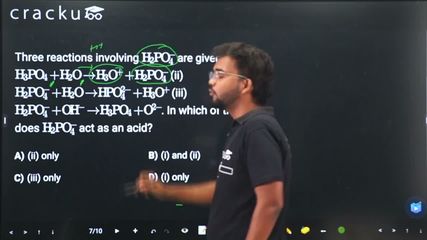
Three reactions involving $$\text{H}_2\text{PO}_4^-$$ are given below: (i) $$\text{H}_3\text{PO}_4 + \text{H}_2\text{O} \to \text{H}_3\text{O}^+ + \text{H}_2\text{PO}_4^-$$ (ii) $$\text{H}_2\text{PO}_4^- + \text{H}_2\text{O} \to \text{HPO}_4^{2-} + \text{H}_3\text{O}^+$$ (iii) $$\text{H}_2\text{PO}_4^- + \text{OH}^- \to \text{H}_3\text{PO}_4 + \text{O}^{2-}$$. In which of the above does $$\text{H}_2\text{PO}_4^-$$ act as an acid?
According to the Brønsted-Lowry concept,
• an acid is a species that donates a proton ( $$\text{H}^+$$ ) to some other species.
• a base is a species that accepts a proton from some other species.
We examine each reaction to see whether $$\text{H}_2\text{PO}_4^-$$ donates or accepts a proton.
Case (i):
$$\text{H}_3\text{PO}_4 + \text{H}_2\text{O} \;\rightarrow\; \text{H}_3\text{O}^+ + \text{H}_2\text{PO}_4^-$$
Here $$\text{H}_3\text{PO}_4$$ loses a proton to water, producing $$\text{H}_3\text{O}^+$$ and $$\text{H}_2\text{PO}_4^-$$. The species $$\text{H}_2\text{PO}_4^-$$ is formed after proton loss, so in the forward direction it has accepted that proton in the reverse reaction. Thus, in this forward reaction $$\text{H}_2\text{PO}_4^-$$ behaves as the conjugate base of $$\text{H}_3\text{PO}_4$$, i.e. it acts as a base, not as an acid.
Case (ii):
$$\text{H}_2\text{PO}_4^- + \text{H}_2\text{O} \;\rightarrow\; \text{HPO}_4^{2-} + \text{H}_3\text{O}^+$$
Compare the left- and right-hand sides:
• $$\text{H}_2\text{PO}_4^-$$ loses one proton and becomes $$\text{HPO}_4^{2-}$$.
• Water gains that proton and becomes $$\text{H}_3\text{O}^+$$.
Since $$\text{H}_2\text{PO}_4^-$$ donates a proton to water, it acts as a Brønsted-Lowry acid in this reaction.
Case (iii):
$$\text{H}_2\text{PO}_4^- + \text{OH}^- \;\rightarrow\; \text{H}_3\text{PO}_4 + \text{O}^{2-}$$
Here $$\text{H}_2\text{PO}_4^-$$ accepts a proton from $$\text{OH}^-$$ to form $$\text{H}_3\text{PO}_4$$. Accepting a proton classifies $$\text{H}_2\text{PO}_4^-$$ as a Brønsted-Lowry base in this reaction, not as an acid.
Therefore, $$\text{H}_2\text{PO}_4^-$$ behaves as an acid only in reaction (ii).
Option A which is: (ii) only
Was this solution helpful?
Click on the Email ☝️ to Watch the Video Solution
Create a FREE account and get:
_1.webp)

Educational materials for JEE preparation

Ask our AI anything

AI can make mistakes. Please verify important information.
AI can make mistakes. Please verify important information.
