
Join Our JEE Preparation Group
Prep with like-minded aspirants; Get access to free daily tests and study material.
Sign in
Please select an account to continue using cracku.in
↓ →
Join Our JEE Preparation Group
Prep with like-minded aspirants; Get access to free daily tests and study material.
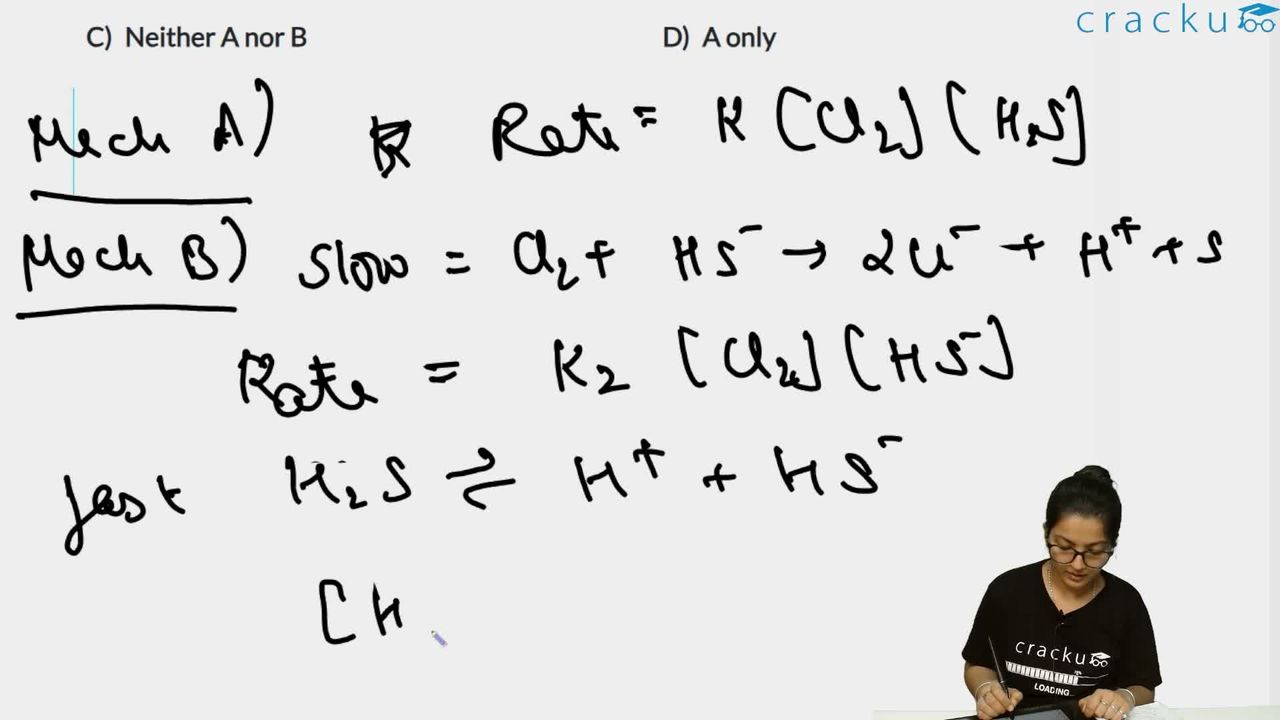
Consider the reaction: $$\text{Cl}_2(\text{aq}) + \text{H}_2\text{S}(\text{aq}) \to \text{S}(\text{s}) + 2\text{H}^+(\text{aq}) + 2\text{Cl}^-(\text{aq})$$. The rate equation for this reaction is rate $$= k[\text{Cl}_2][\text{H}_2\text{S}]$$. Which of these mechanisms is/are consistent with this rate equation? (A) $$\text{Cl}_2 + \text{H}_2\text{S} \to \text{H}^+ + \text{Cl}^- + \text{Cl}^+ + \text{HS}^-$$ (slow); $$\text{Cl}^+ + \text{HS}^- \to \text{H}^+ + \text{Cl}^- + \text{S}$$ (fast). (B) $$\text{H}_2\text{S} \leftrightarrow \text{H}^+ + \text{HS}^-$$ (fast equilibrium); $$\text{Cl}_2 + \text{HS}^- \to 2\text{Cl}^- + \text{H}^+ + \text{S}$$ (slow).
The experimental rate law is given as
$$\text{rate}=k[\text{Cl}_2][\text{H}_2\text{S}]$$
To check any proposed mechanism, write the rate law predicted by that mechanism and compare it with the experimental one.
Case 1: Mechanism A
Slow (rate-determining) step: $$\text{Cl}_2+\text{H}_2\text{S}\;\longrightarrow\;\text{H}^++\text{Cl}^-+\text{Cl}^++\text{HS}^-$$
The rate is governed solely by this slow step:
$$\text{rate}=k_1[\text{Cl}_2][\text{H}_2\text{S}]$$
This is exactly the experimentally observed form. Hence mechanism A is consistent with the given rate law.
Case 2: Mechanism B
Step (i) fast equilibrium: $$\text{H}_2\text{S}\;\rightleftharpoons\;\text{H}^++\text{HS}^-$$
Step (ii) slow (rate-determining): $$\text{Cl}_2+\text{HS}^-\;\longrightarrow\;2\text{Cl}^-+\text{H}^++\text{S}$$
Rate predicted by the slow step:
$$\text{rate}=k_2[\text{Cl}_2][\text{HS}^-]$$
Because $$\text{HS}^-$$ is an intermediate, express it using the fast equilibrium.
For equilibrium (i), let $$K=\dfrac{[\text{H}^+][\text{HS}^-]}{[\text{H}_2\text{S}]}$$, so
$$[\text{HS}^-]=\dfrac{K[\text{H}_2\text{S}]}{[\text{H}^+]}$$
Substituting:
$$\text{rate}=k_2K\frac{[\text{Cl}_2][\text{H}_2\text{S}]}{[\text{H}^+]}$$
This rate law contains an inverse dependence on $$[\text{H}^+]$$, which is absent in the experimentally observed law. Therefore mechanism B does not reproduce the correct rate expression (unless $$[\text{H}^+]$$ is kept strictly constant, which is not stated).
Thus, only mechanism A is compatible with the experimental kinetics.
Option D which is: A only
Was this solution helpful?
Click on the Email ☝️ to Watch the Video Solution
Create a FREE account and get:
_1.webp)

Educational materials for JEE preparation

Ask our AI anything

AI can make mistakes. Please verify important information.
AI can make mistakes. Please verify important information.
