
Join Our JEE Preparation Group
Prep with like-minded aspirants; Get access to free daily tests and study material.
Sign in
Please select an account to continue using cracku.in
↓ →
Join Our JEE Preparation Group
Prep with like-minded aspirants; Get access to free daily tests and study material.
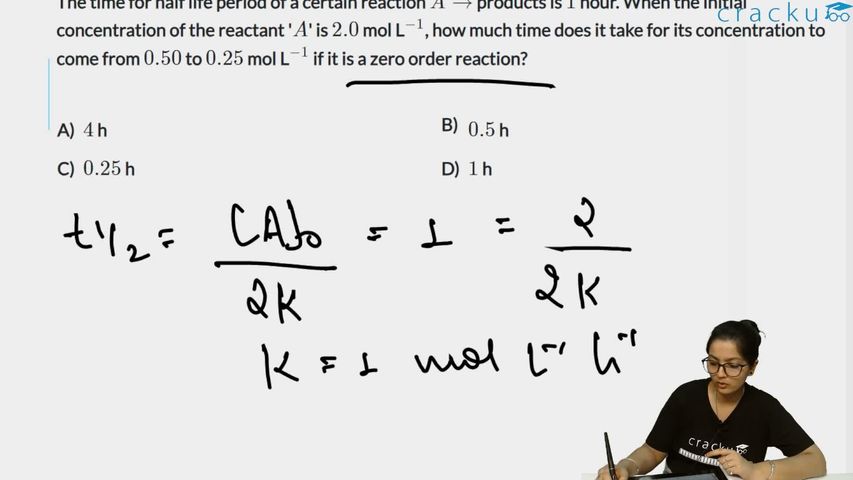
The time for half life period of a certain reaction $$A \to$$ products is $$1$$ hour. When the initial concentration of the reactant '$$A$$' is $$2.0$$ mol L$$^{-1}$$, how much time does it take for its concentration to come from $$0.50$$ to $$0.25$$ mol L$$^{-1}$$ if it is a zero order reaction?
For a zero-order reaction the integrated rate law is
$$[A] = [A]_0 - k\,t \qquad -(1)$$
The half-life $$t_{1/2}$$ (time for $$[A]$$ to become $$\tfrac12[A]_0$$) is obtained by putting $$[A] = \tfrac12[A]_0$$ in equation $$-(1)$$:
$$\tfrac12[A]_0 = [A]_0 - k\,t_{1/2}$$
$$k\,t_{1/2} = \tfrac12[A]_0$$
$$t_{1/2} = \dfrac{[A]_0}{2k} \qquad -(2)$$
The data for the given reaction are
initial concentration $$[A]_0 = 2.0\text{ mol L}^{-1}$$, and $$t_{1/2} = 1\text{ h}$$.
Insert these values in $$-(2)$$ to find $$k$$:
$$1 = \dfrac{2.0}{2k} \;\;\Longrightarrow\;\; k = 1.0\text{ mol L}^{-1}\,\text{h}^{-1}$$
Now we need the time $$t$$ for $$[A]$$ to fall from $$0.50$$ to $$0.25\text{ mol L}^{-1}$$.
Using equation $$-(1)$$ in the form $$t = \dfrac{[A]_{\text{initial}} - [A]_{\text{final}}}{k}$$:
$$t = \dfrac{0.50 - 0.25}{1.0} = 0.25\text{ h}$$
Therefore, the required time is $$0.25\text{ h}$$.
Option C which is: $$0.25\text{ h}$$
Was this solution helpful?
Click on the Email ☝️ to Watch the Video Solution
Create a FREE account and get:
_1.webp)

Educational materials for JEE preparation

Ask our AI anything

AI can make mistakes. Please verify important information.
AI can make mistakes. Please verify important information.
